
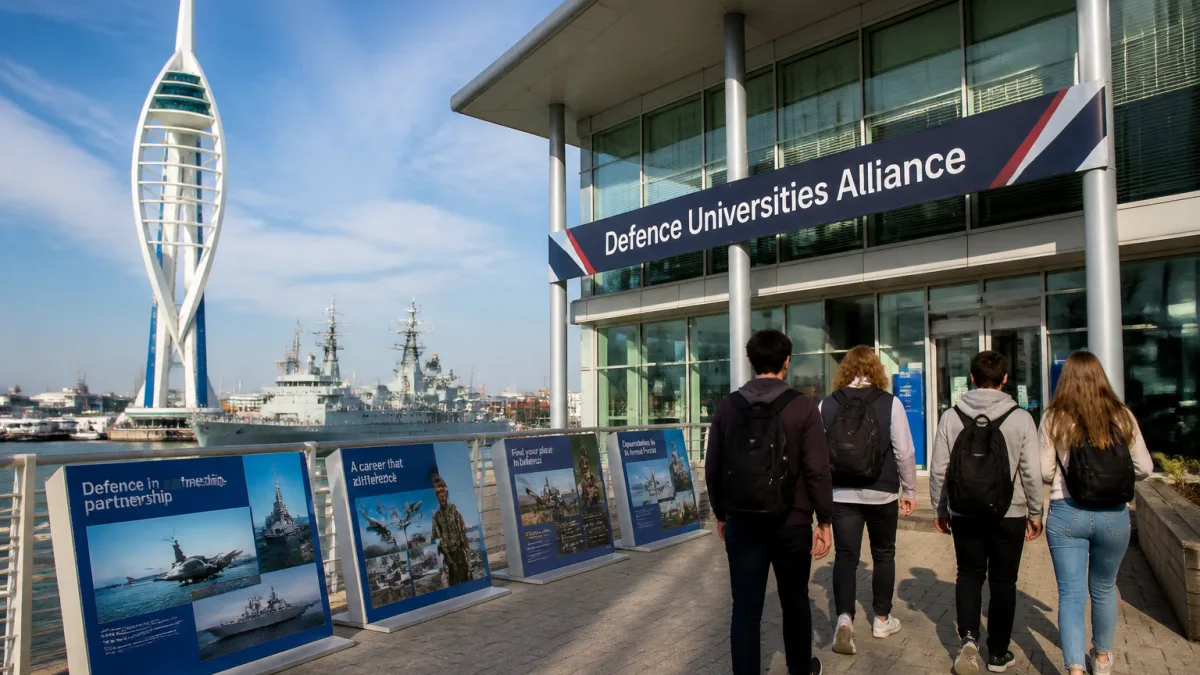
Portsmouth’s higher education sector steps into national defence collaboration
The University of Portsmouth has been confirmed as a founding member of the UK’s new Defence Universities Alliance (DUA), a national initiative launched by Defence Minister Luke Pollard to coordinate academic expertise with the needs of the Ministry of Defence and the wider national security community.
The alliance is intended to bring universities into closer partnership with the Ministry of Defence (MoD), the UK Armed Forces and the Office of the Chief Scientific Adviser for National Security. It aims to bolster defence-related research, expand specialist skills pipelines, and support career pathways across the UK’s defence and security sectors.
Political and civic backing
Stephen Morgan, the MP for Portsmouth South, welcomed the announcement and underlined the city’s longstanding role in the country’s defence infrastructure.
“I would like to congratulate the University of Portsmouth for becoming a founding member of the UK’s new Defence Universities Alliance. Portsmouth is the heart and home of the Royal Navy, and I have continuously advocated for the university as an engine for growth… I look forward to collaborating with them to take advantage of this crucial opportunity to strengthen defence research, develop future skills, and support careers across the UK’s defence and national security sectors.”
Professor Graham Galbraith, Vice-Chancellor of the University of Portsmouth, signalled the institution’s readiness to deepen its partnerships.
“The University of Portsmouth is proud to become a founding member of the Defence Universities Alliance. We have a long history of working with organisations across the defence and national security sectors, and we welcome the opportunity to strengthen those partnerships through research, innovation and skills development.”
Who is involved and why it matters locally
While the DUA is national in scope, it carries particular significance for Portsmouth. The city’s maritime economy, shipbuilding and naval operations create an environment where research, innovation and workforce skills are tightly coupled to defence and security needs. The new alliance formalises collaboration routes which can translate research into practice, while giving students and researchers clearer lines of sight into careers that serve defence and national security.
| Partner | Role in the Alliance |
|---|---|
| Ministry of Defence | Strategic direction and coordination with operational needs |
| UK Armed Forces | Operational partner and end-user of research and skills |
| Office of the Chief Scientific Adviser for National Security | Scientific leadership and national security priorities |
| Founding Universities (incl. University of Portsmouth) | Research, innovation, teaching and skills delivery |
Potential benefits for Portsmouth students and employers
Although detailed programmes have not yet been set out publicly, the university’s participation could support:
- Enhanced research opportunities tied to defence and national security priorities, building on existing institutional strengths.
- Clearer skills pathways linking degree courses and professional development to roles across defence, engineering, analysis and security.
- Local economic impact through stronger collaboration between academia, the Armed Forces and defence-related industries in and around Portsmouth.
For a city that hosts major naval operations and a large defence workforce, the alignment of academic programmes with sector demand may help to retain talent locally and expand options for graduates. It also positions the university to contribute more systematically to national research challenges where civilian and defence applications often intersect.
What happens next
As a founding member, the University of Portsmouth is expected to engage in joint workstreams under the DUA banner, from research projects to skills initiatives. The precise schedule and scope of those activities will depend on priorities agreed between participating universities and the alliance’s government and defence partners.
Residents, students and local employers interested in the implications of the DUA for course content, placements or research partnerships should look out for formal updates from the university as the alliance’s collaborative agenda takes shape. Given Portsmouth’s role as the home of the Royal Navy, the city is well placed to benefit from closer ties between academia and defence stakeholders.
Today’s announcement signals intent: to join up research, innovation and skills development so that universities like Portsmouth can contribute more directly to national security goals while offering students and staff stronger pathways into relevant careers. The university’s leadership and the city’s MP have both set a supportive tone; the coming months should indicate how that high-level agreement translates into practical opportunities on the ground.