
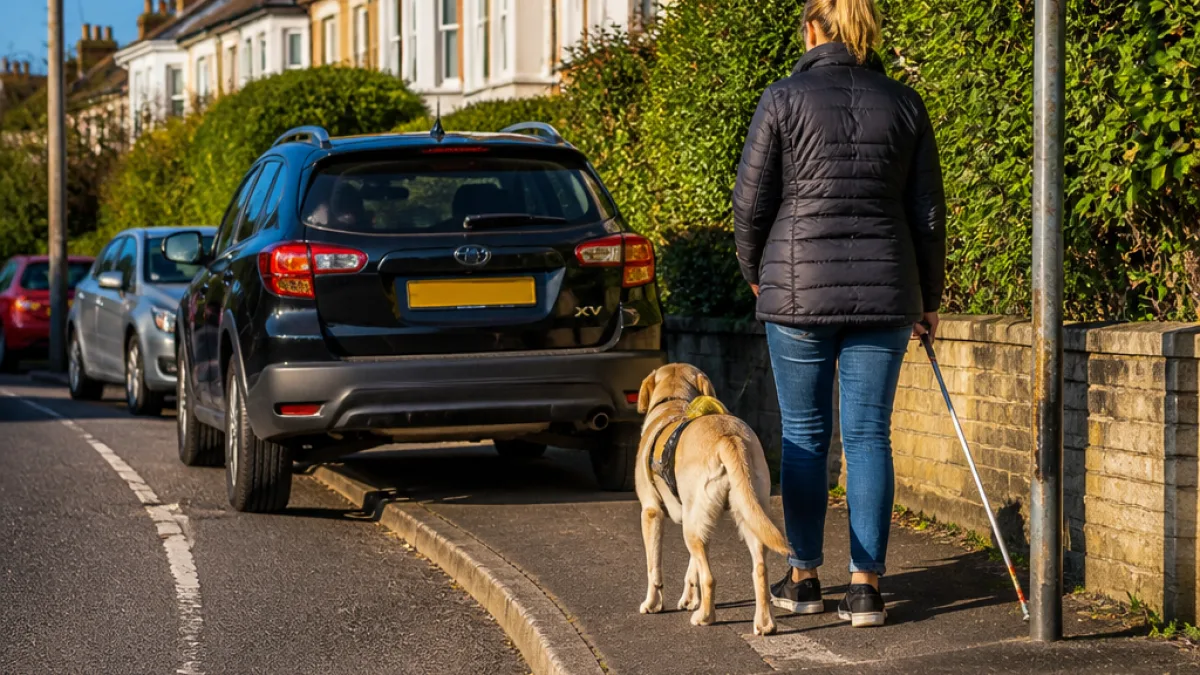
Motorists who park on pavements or in verge-marked bays can create a significant danger to people with sight loss and to other vulnerable pedestrians, a local campaigner has told InfoRadar.
Impact on vulnerable pedestrians
Steve Saunders, from East Sussex Vision Support, who is himself visually impaired and uses a guide dog, described situations in which vehicles parked partially on pavements leave an obstructed route that is difficult or impossible to negotiate. He said the problem affects a broad cross-section of residents, including parents with pushchairs, wheelchair users and anyone relying on a continuous footway.
“Many drivers leave what they think is enough space for a person to get through on the inside but they don't think of wing mirrors sticking out or overgrown hedges or trees. Parking on the pavement may only be seen by the driver as an inconvenience for a few minutes but it's seen by the person who can't get through the gap that has been left as a complete restriction to their life and safety.”
A recent dataset cited by campaigners indicates that around half of English councils currently allow some form of pavement parking by providing marked bays or explanatory signage. East Sussex County Council is named among those authorities.
Council response and practical issues
An East Sussex County Council spokesperson said the authority recognises the importance of the issue and the effect it can have on residents. The council did not, in the information available to InfoRadar, announce any immediate change of policy.
- Who is affected: people with visual impairment, wheelchair users, parents with pushchairs, older people
- Main hazards: blocked footways, protruding wing mirrors, overgrown hedges reducing space
- Local practice: some councils use marked bays or signage to permit pavement parking in limited locations
The debate over pavement parking pits convenience for some drivers against accessibility and safety for others. Where councils permit parking on pavements, the intention is often to manage limited kerbside space or to prevent cars from obstructing the carriageway; however, campaigners argue that any scheme must safeguard continuous pedestrian access.
| Issue | Local position |
|---|---|
| Pavement parking | Allowed in some areas through marked bays/signage; ESCC listed among councils permitting it |
| Accessibility concern | Visually impaired people and others can be effectively barred from using footways |
For residents concerned about specific instances of footway obstruction, the practical route is to report the matter to the local authority so it can be assessed. Evidence such as photographs or witness accounts can assist enforcement or policy review. Campaign groups, including East Sussex Vision Support, continue to press for measures that prioritise safe, continuous access for all pedestrians.
InfoRadar will continue to monitor any policy responses from East Sussex County Council and local authorities elsewhere as the debate over pavement parking and accessibility develops.