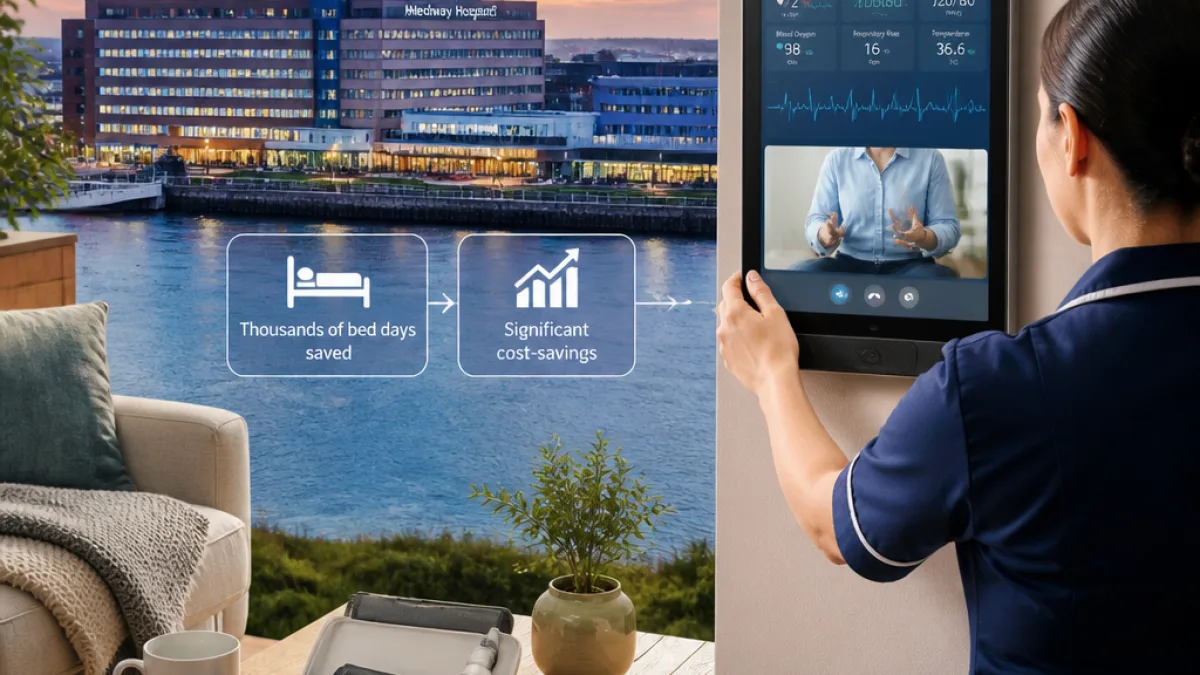
The Medway health economy has introduced a new way of treating acutely unwell patients outside hospital walls. The Medway SMART Acute Virtual Hospital — a multi-specialty service run by Medway Foundation Trust — has provided consultant-led, 24/7 clinical coverage for patients in their own homes, and in its first quarter of operation prevented the need for thousands of inpatient bed days.
What the service is and who it treats
Launched in November 2025 after around a decade of development from traditional hospital-at-home models into a digitally enabled virtual ward system, the service manages patients across a wide range of specialties. These include respiratory, neurology, gastroenterology, cardiology, urology, haematology, renal, general surgery and trauma. Clinical oversight is provided continuously, with rapid escalation pathways so critical alerts are responded to promptly.
Early results and local impact
In its first quarter the virtual hospital generated measurable benefits for the Trust and for patients at home. Key figures reported by NHS England show the service:
- saved 4,926 bed days — the equivalent of around 54 inpatient beds per month;
- completed between 93% and 96% of care episodes successfully, with a readmission rate of 0.6%;
- delivered care at an average cost of £196 per bed day compared with £303 for a physical inpatient bed;
- generated £864,000 in savings in that quarter;
- protected elective activity over winter with no capacity-related cancellations.
| Metric | First quarter result |
|---|---|
| Bed days saved | 4,926 |
| Equivalent beds per month | 54 |
| Episode success rate | 93–96% |
| Readmission rate | 0.6% |
| Cost per bed day (virtual) | £196 |
| Cost per bed day (inpatient) | £303 |
| Quarterly savings | £864,000 |
Winner of the Delivering Value award at the NHS Excellence Awards 2026.
Why this matters for Medway residents
The most immediate effect for patients locally is the option to receive acute-level care at home supported by continuous clinical monitoring and consultant oversight. For the wider NHS in Medway, freeing capacity equivalent to dozens of beds each month means fewer cancelled operations and more resilience during busy periods such as winter. Financially, the service shows a lower unit cost for providing acute care compared with conventional hospital beds.
Medway Foundation Trust is now preparing a transferable framework covering clinical governance, workforce, technology and performance indicators so other acute trusts can adopt the model. That aligns directly with the national 10 Year Health Plan ambition to shift appropriate care safely out of hospitals and into people’s homes.
For local health leaders and commissioners the next questions will be how the model scales across the trust’s footprint, how staffing and technology requirements are met sustainably, and how patient groups who most benefit from home-based acute care are identified and supported. The quarter-one figures provide a clear early case that could influence commissioning decisions across the region.
Medway residents should expect this service to continue evolving. The Trust’s plans to codify governance and operational arrangements aim to make the model reusable elsewhere, while protecting elective capacity and reducing pressure on hospital beds locally.