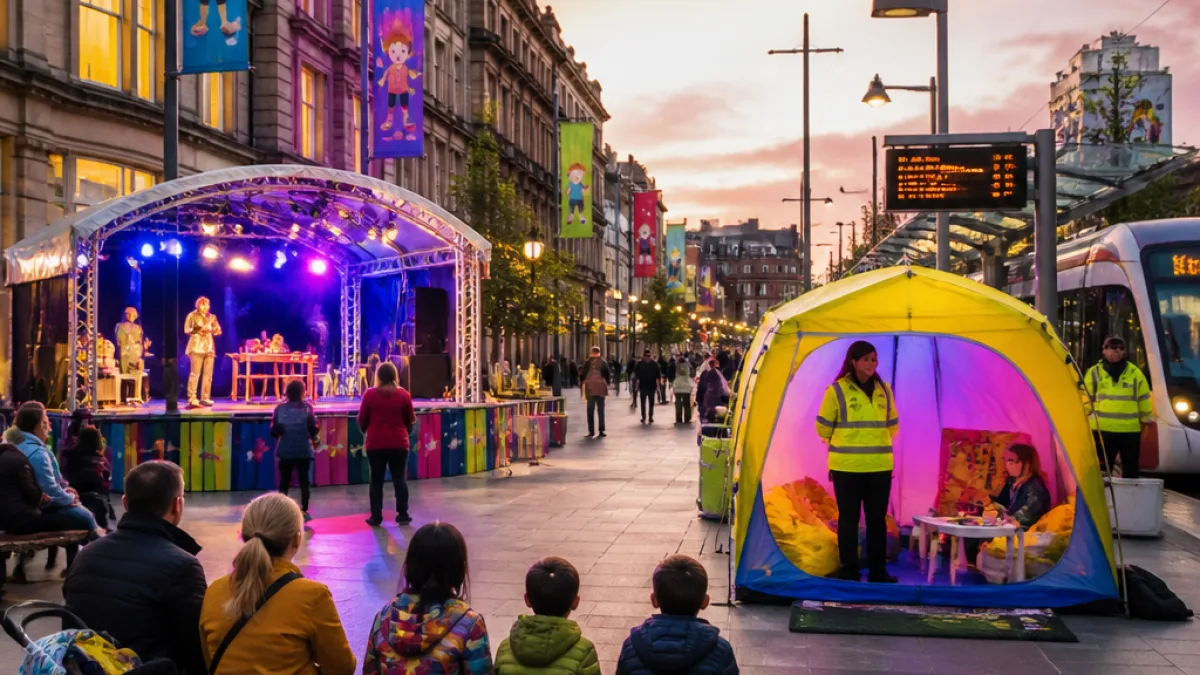
The Nighttime Economy Subgroup has published a vision report recommending a series of changes to make Glasgow City centre more welcoming to families and broader communities outside daytime hours. The document examines governance, safety, transport and the cultural offer, concluding the city is strong on music and nightlife but underperforms on family‑friendly evening activities.
Key findings: culture strong, family offer lacking
The report recognises Glasgow's international reputation for live music at both grassroots and large venues, and says the city should capitalise on that strength. Yet it finds a shortfall in evening cultural programming aimed at families, as well as a lack of investment in experiential leisure and dining that would make the centre attractive after dark to parents and children.
"There is a clear appetite for more non-alcohol led options and evening and nighttime activities that are family friendly, more inclusive and neurodivergent friendly (sensory appropriate), as well as reflective of a broader cross section of the city’s residents and visitors."
The subgroup notes a perception that Glasgow functions principally as a daytime destination for families and an evening destination for adults, and argues that repositioning the city centre would help businesses by broadening their customer base beyond peak summer months.
Recommended actions
- Research pilots to test interventions to make the city centre more family friendly.
- Deliver a comprehensive events series during quieter parts of the year aimed at families and diverse communities.
- Develop more non‑alcohol led leisure and sensory‑appropriate activities for neurodivergent visitors.
The report highlights examples from other UK cities to illustrate what is possible, pointing to large cultural festivals such as London’s Lunar New Year and Leicester’s Diwali as events that draw families in traditionally quieter months.
Implications for residents and businesses
For hospitality and cultural operators in Glasgow City, the report signals opportunities and challenges. Operators may be encouraged to diversify programming and opening hours to reach family audiences; local authorities will be asked to consider governance and transport improvements to support later, safer travel for children and carers.
| Suggested intervention | Intended outcome |
|---|---|
| Season‑round family event series | Increase mid‑week and off‑peak footfall |
| Non‑alcohol leisure pilot schemes | Broaden audience demographics |
| Sensory‑friendly programming | Improve inclusion for neurodivergent residents |
Subgroup members recommend targeted pilots before wider rollout, allowing the city to test which initiatives deliver measurable benefits for safety, inclusivity and local traders. The report also identifies transport and street safety as areas that require co‑ordination between council services and night‑time economy stakeholders.
Local leaders and business groups will now need to consider how to support and fund the proposed pilots, whether through public sector budgets, partnership funding or reallocation of existing cultural investment. If successful, the measures could extend economic activity outside peak periods and better reflect Glasgow City’s diverse communities.
The Nighttime Economy Subgroup's findings set out a strategic case for change rather than immediate policy decisions; implementation will require both political will and buy‑in from operators across the city centre.