Major preventive works to avert future restrictions
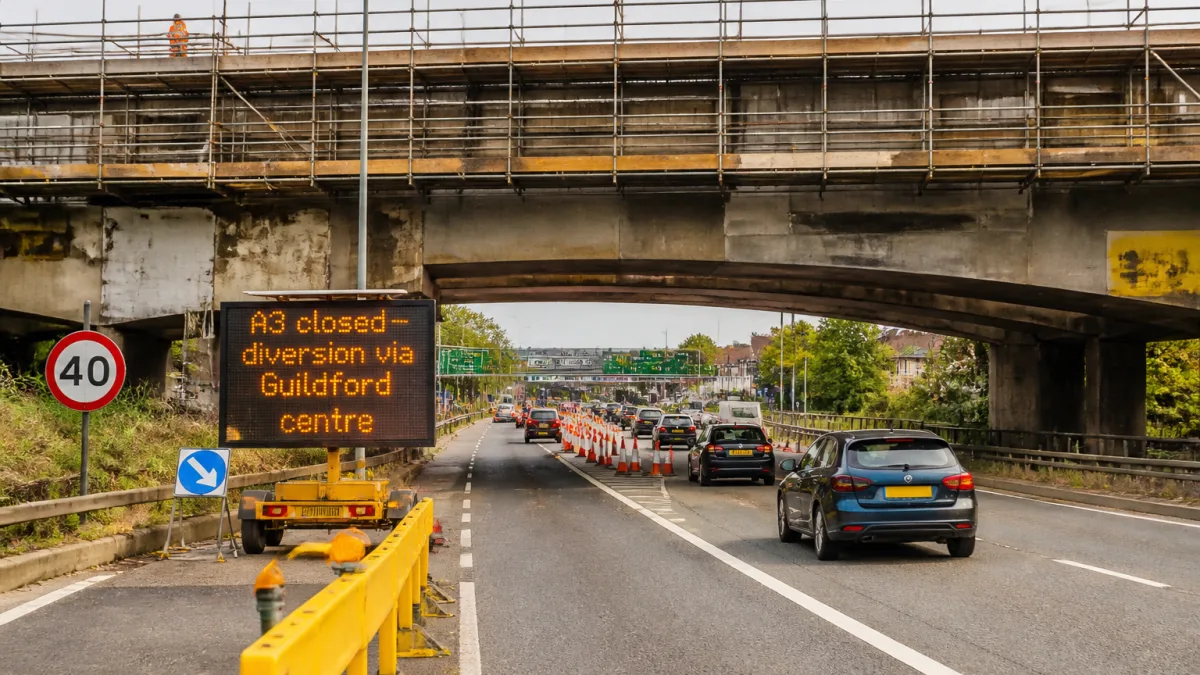
National Highways has begun a programme of £5 million repairs to the Dennis Interchange bridges on the A3 in Guildford, warning that deferring the job any longer could have left part of the route facing serious use restrictions within just a few years. Engineers say decades of water ingress and repeated exposure to winter road salt have corroded steel reinforcement embedded in the concrete, threatening the long-term integrity of a structure that carries one of Surrey’s busiest corridors.
The scheme combines repairs beneath the carriageway with improved waterproofing and resurfacing above, with the stated aim of extending the bridges’ life and avoiding more disruptive interventions later. The agency has framed the project as a preventative investment to restore strength and resilience before defects progress to the point where traffic restrictions would be unavoidable.
“We’re carrying out preventative repairs now to restore the structure to full strength and ensure it remains in service for many years.”
That was the message from Project Manager Nick Axford, who reiterated that tackling the underlying causes of deterioration — moisture reaching the reinforcement and the subsequent expansion of corroding steel that cracks the surrounding concrete — is essential to keeping the A3 running reliably.
Closures and diversions via Guildford town centre
To carry out the next phase safely, National Highways will close the A3 in each direction over consecutive weekends while crews waterproof and resurface the deck above and continue bridge repairs below. During these shutdowns, traffic will be diverted through Guildford town centre, and motorists are advised to allow extra time.
| Direction | Stretch | Start | End |
|---|---|---|---|
| Southbound | Dennis to Stoke interchanges | 9.00pm Friday | 6.00am Monday |
| Northbound | Stoke to Dennis interchanges | 9.00pm on 17 July | 6.00am on 20 July |
While precise diversion routes are managed by National Highways, the agency has confirmed that vehicles will be sent through the urban network during the closure windows. With the A3 acting as a primary artery for regional movements between London, Guildford and Portsmouth, even overnight and weekend works have the potential to displace substantial volumes of traffic onto local roads.
Why the works can’t wait
Engineers report that moisture penetrating the bridge deck has reached reinforcement within concrete support elements. As the embedded steel rusts, it expands, causing cracks and areas of concrete to spall. Left unchecked, this mechanism progressively weakens the structure. The current works are intended to halt that process by renewing waterproofing, repairing damaged concrete and addressing defects before they require heavier interventions and longer closures.
National Highways has set out the case for acting now: a relatively short, planned period of disruption in return for a longer service life and a reduced risk of future restrictions. The approach mirrors a broader trend across strategic roads — moving earlier to preserve assets rather than waiting until deterioration demands more intrusive and lengthier reconstruction.
What Guildford residents and drivers should expect
- Town-centre diversions: During closure periods, through-traffic will be routed into central Guildford.
- Extra journey time: Motorists are advised to allow additional time while the works take place.
- Consecutive weekends: Southbound closure from 9.00pm Friday to 6.00am Monday, followed by a northbound closure from 9.00pm on 17 July to 6.00am on 20 July.
For residents and town-centre businesses, the temporary re-routing highlights the delicate balance between maintaining a strategic highway and safeguarding local streets from displaced traffic. Although the construction windows are confined to weekends and nights, the A3’s status as a key inter-urban route means that impacts can still be felt locally, particularly at pinch points and junctions near the diversions.
Long-term benefits vs short-term pain
National Highways stresses that the package is designed to keep the A3 bridges at Dennis Interchange in serviceable condition for the long term, reducing the chance of more disruptive remedial works later. The inclusion of improved waterproofing above the deck is central to slowing future deterioration. The agency has indicated that, without this intervention, limitations on use could have arisen within a few years — a scenario that would have had far-reaching consequences for connectivity in and around Guildford.
As the closures approach, residents, commuters and freight operators are urged to plan ahead, heed the signed diversions and allow time for the extra mileage through the town. While the short-term inconvenience is unavoidable, the outcome sought is a more resilient structure, fewer emergency repairs and a better prospect of uninterrupted travel on one of Surrey’s most important routes.