A new focal point for a changing city centre
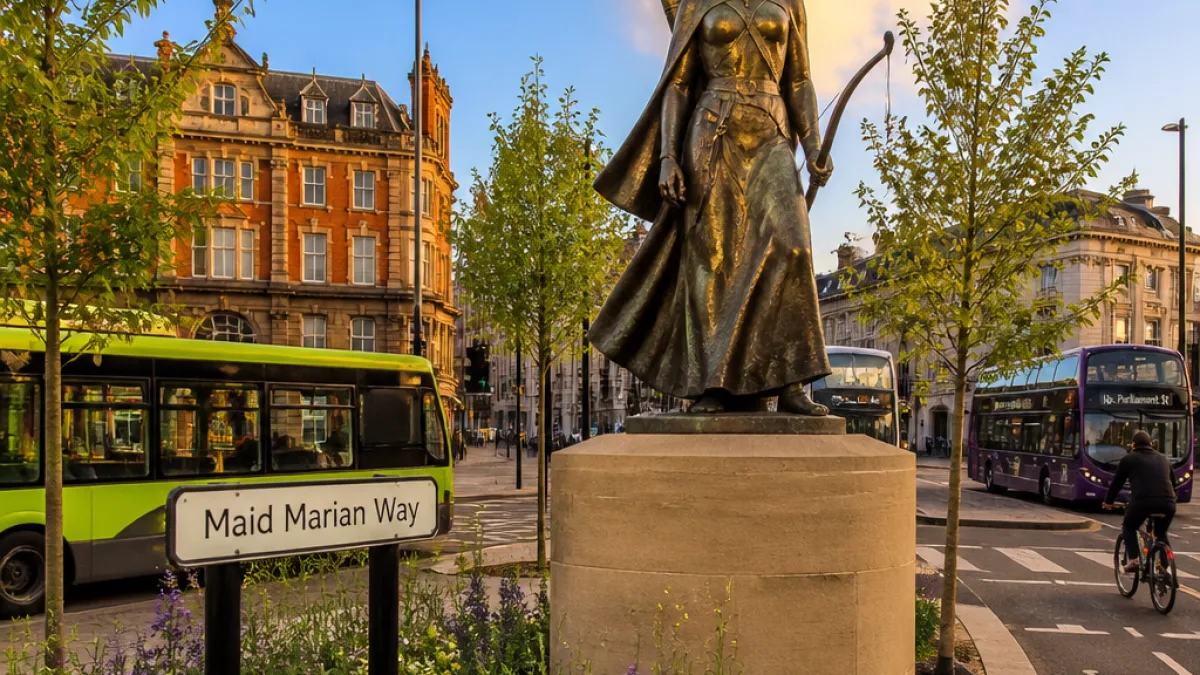
A contemporary sculpture celebrating the figure of Maid Marian has been installed in Nottingham city centre, adding a new cultural landmark to the streets just off Maid Marian Way. The piece, conceived by internationally recognised artist Alicja Biała, stands on a sandstone base at the redesigned junction where Tollhouse Hill, Upper Parliament Street and Derby Road converge — part of a £9 million upgrade to the area. It joins the long‑established Robin Hood statue near Nottingham Castle, offering a counterpart that highlights an often underrepresented character from the city’s folklore.
Redressing the balance in local legend
City councillor Sam Lux, the authority’s executive member for climate and energy, said the work offers a chance to centre the stories of women in Nottingham’s heritage and public spaces. In remarks to the Local Democracy Reporting Service (LDRS), Cllr Lux said:
“We talk about Robin Hood to the death and Maid Marian barely gets a mention in the 21st Century… I think we should be celebrating women… it is so important we don’t erase women from history and celebrate them as well.”
She added the addition is a sign of confidence in the city centre’s evolution, describing it as the “cherry on the cake” of the Maid Marian Way improvement scheme, with the potential to spark reflection on nature, feminism and art.
Nature etched into bronze
Biała’s approach weaves Nottinghamshire’s natural history into the fabric of the piece. Wax moulds of native flora — among them the Nottingham catchfly, English oak, silver birch, hawthorn, bluebell and common nettle — were used to create textures and forms within the bronze. The figure’s roots merge into the sandstone base, a deliberate motif linking Maid Marian to the county’s geology, ecology and communities. The artist involved hundreds of local participants through workshops, ensuring public input shaped the final work.
Symbolism aligned with climate goals
The sculpture has been framed as part of a broader narrative around Nottingham’s environmental commitments. The city has set out ambitions to be carbon neutral by 2028 and to deliver a greener urban core — aiming towards a ‘forest city’ vision by 2030 alongside the expansion of the Green Heart. The inclusion of indigenous plant imagery nods to those targets and to the integration of green thinking within city-centre design.
Context and location
For decades, Robin Hood’s statue has drawn visitors to the Castle area. The Maid Marian piece offers a complementary destination closer to the primary retail and transport corridors. Positioned on a major crossroads near Maid Marian Way, it is intended to be both a daily sight for residents and a point of interest for visitors exploring the centre on foot.
| Key detail | Information |
|---|---|
| Artist | Alicja Biała |
| Material | Bronze on sandstone plinth |
| Location | Junction of Tollhouse Hill, Upper Parliament Street and Derby Road (off Maid Marian Way) |
| Public realm spend | £9 million junction upgrade |
| Thematic focus | Nottingham folklore, native ecology, women in heritage |
What visitors will notice
- An open, silhouette-like form intended to evoke Maid Marian without a literal portrait.
- Botanical imprints of local species worked into the bronze surface.
- Root-like structures that visually connect the figure to the sandstone base.
The unveiling also signals a more plural approach to storytelling in the city’s public realm — complementing the familiar outlaw narrative with a focus on Marian’s role and identity. While the Robin Hood statue dates to the early 1950s, this new work reflects the present-day priorities of co‑creation, sustainability and inclusive heritage.
Practicalities and civic impact
The installation sits at a busy gateway to the city centre, where the upgraded streetscape is designed to improve movement around the core retail and cultural areas. Though no formal programme is attached to the statue, its location makes it easy to include on walking routes between the Theatres, Old Market Square and the Castle quarter. For residents, it becomes a familiar landmark; for visitors, it offers a fresh lens on Nottingham’s folklore that extends beyond a single hero.
With workshops involving hundreds of participants and a design steeped in local landscape and species, the piece stands as a collaborative statement. As Cllr Lux suggested, it is intended to provoke thought — about the environment, the stories cities choose to tell, and how public art can shape the character of a place.