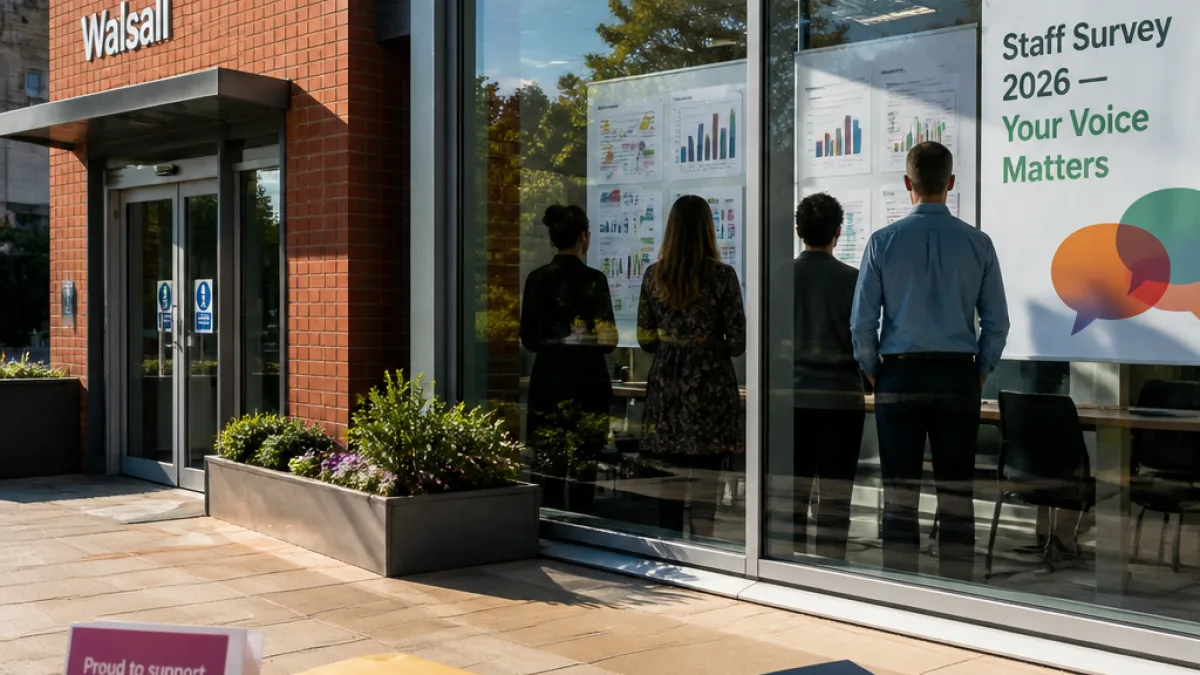
The latest staff survey at Walsall Council saw just over half of its workforce return responses, with officials saying the findings will be used to shape forthcoming workforce and organisational development plans.
Participation and independent delivery
The exercise, delivered by independent market researchers, opened on 23 February and closed on 10 April 2026. Of the 3,806 employees, agency, casual and in‑IR35 workers invited to take part, 2,056+ — equivalent to 54% — submitted responses, a slight rise on the 53% participation recorded in 2023.
The council stressed that responses were submitted anonymously and that individual answers cannot be linked back to staff in any supplied reports or data.
How results will be used
Senior leaders have been presented with the findings: the Corporate Management Team and the Senior Managers Group have reviewed the data. The council says the analysis will contribute to a refresh of its Organisational Development (OD) and Workforce strategies and will also identify areas of best practice to share across departments.
Further research will be commissioned to explore issues highlighted by the survey, and staff will be invited to take part in that follow‑up work so that any actions are informed by employee input.
"Thank you to everyone who took the time to fill in the survey. Your views are incredibly valuable to us."
Community benefit and next steps
Linked to the response rate, the research company made a charitable donation of £750 to Samaritans Walsall & District. The council says the survey results are being used to identify concerns raised by staff and to plan targeted actions intended to address them.
- Survey period: 23 February–10 April 2026
- Invited to participate: 3,806 staff (including agency/casual/IR35)
- Responses received: 2,056+ (54%)
- Donation made: £750 to Samaritans Walsall & District
| Item | Figure |
|---|---|
| Invited | 3,806 |
| Responded | 2,056+ |
| Response rate | 54% |
For Walsall residents the survey matters because staff views can influence how services are delivered and how the council recruits, retains and supports its workforce. The council has indicated that the results will inform practical interventions and that further staff engagement will follow as the next phase of work begins.
Officials have not published detailed breakdowns in the release accompanying the overall figures; staff and stakeholders will await the subsequent research and any action plans that arise from it.