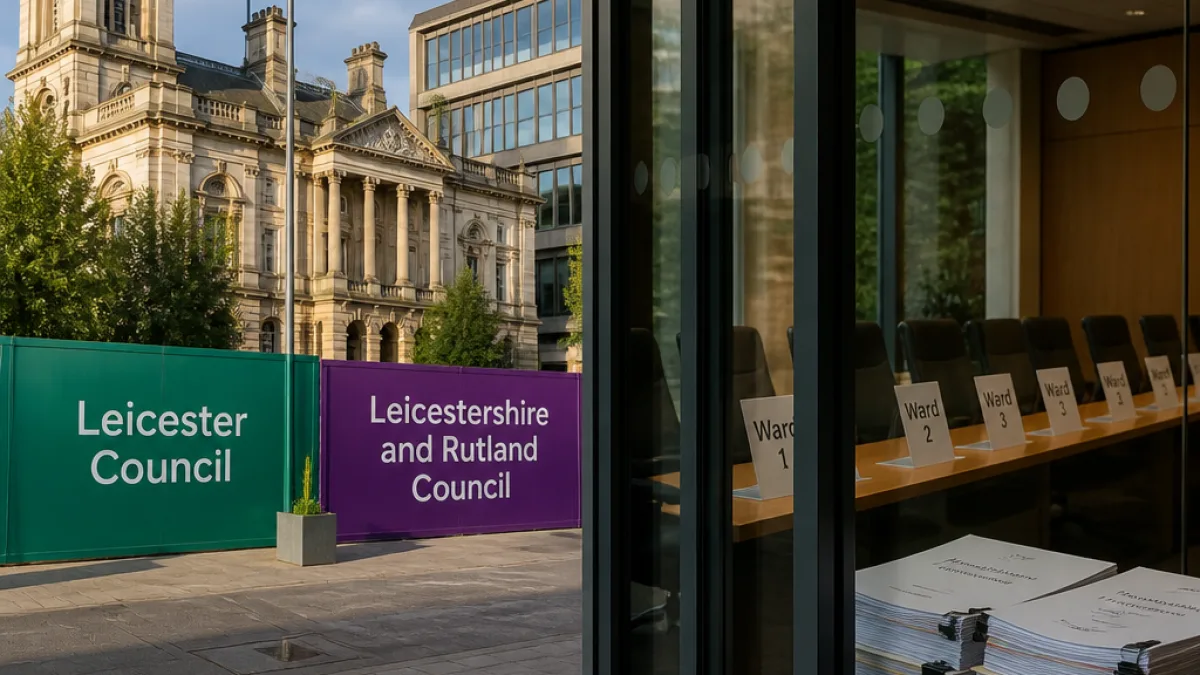
The Government has notified local chiefs of the provisional names and councillor allocations for the two replacement authorities created by the county's reorganisation, as plans proceed towards implementation next year.
What ministers have proposed
According to a letter sent to the chief executives of Leicester City Council, Leicestershire County Council and Rutland County Council, the formal legal titles proposed are Leicester Council and Leicestershire and Rutland Council. Ministers have made clear these are the names that will appear on the legal order establishing the new bodies, although local members could later adopt different working or branding names if two-thirds of councillors consent.
The move follows the recent approval to expand the city's boundary and replace several existing councils with two unitary authorities. The reorganisation is intended to streamline local government across the area, but it will also substantially reduce the number of elected representatives.
Councillor numbers and transitional arrangements
The proposals set out by officials allocate a total of 185 councillors across the new arrangements — a significant reduction from the current combined total of 384 district, borough, city and county councillors.
- Leicester Council: 91 councillors
- Leicestershire and Rutland Council: 94 councillors
To manage the transition towards full implementation, joint committees will be formed for each new authority made up of current councillors from the affected councils. These committees are intended to meet regularly to oversee preparations ahead of shadow elections due in May 2027.
Officials expect the committees to meet "on a regular basis" for up to six months before the new shadow elections in May 2027.
| Current total councillors | Proposed total councillors |
|---|---|
| 384 | 185 |
Local implications
The change will reshape political representation across urban and rural parts of the county. The joint committee compositions set out how existing members from city, county, district and borough councils will work together during the transition — for example, the Leicester committee will include representatives from the city and neighbouring districts, while the Leicestershire committee will bring together county, Rutland and district voices.
Proponents argue that unitary arrangements can simplify decision‑making and reduce duplication. Critics often warn of lost local voice where ward-level representation is reduced. Regardless, the next steps are procedural: final legal orders, the establishment of shadow structures and the election timetable leading to the new governance model taking effect in 2027.
Residents and local stakeholders will want clarity in the coming months about ward boundaries, how services will be organised under the new authorities and what the reduced number of councillors means for local access to elected representatives.