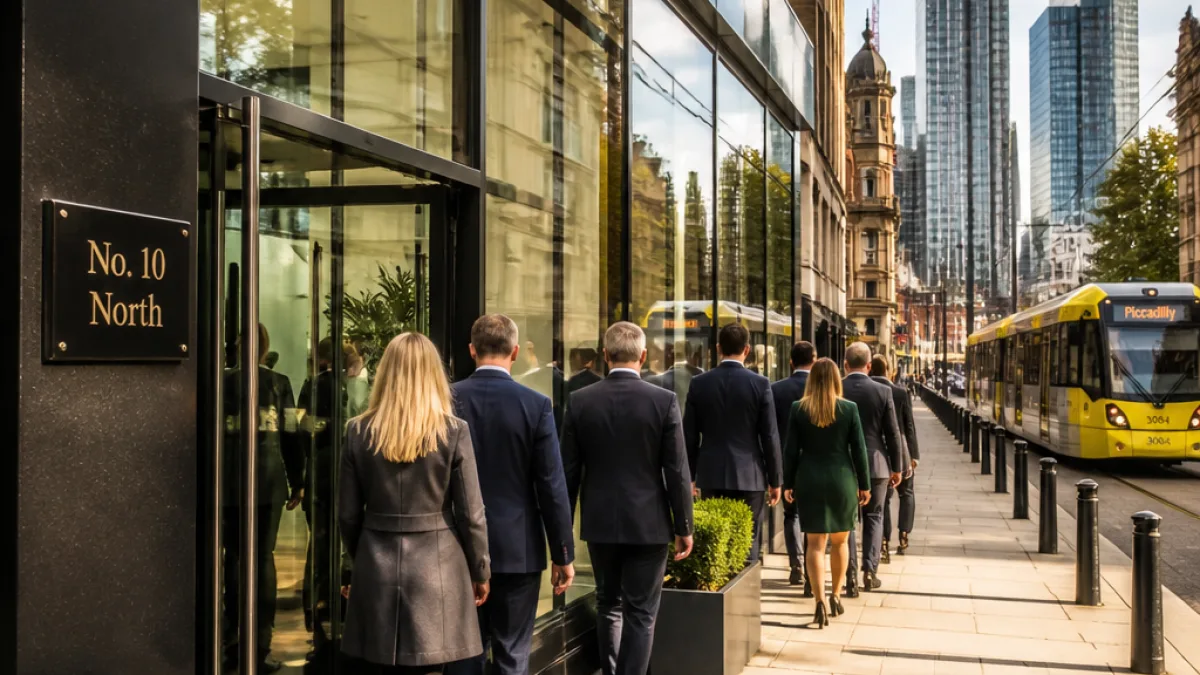
Prime Minister Andy Burnham has opened a permanent government base in Manchester, a modern low-rise office described as No. 10 North, in a move that shifts some central government activity about 165 miles (260 kilometres) from Westminster.
What No. 10 North is and why it matters
The Manchester office will be staffed by a full-time team of aides, experts and civil servants and is intended to be more than a symbolic presence. The prime minister has said he intends to work there at least one day a week, presenting the initiative as part of a wider plan to decentralise power and direct more investment and growth across the country rather than concentrating it in London.
“It’s not another office,” Burnham said Friday. “It is a fundamental change to the way the country thinks about growth and investment.”
Burnham, who served nine years as mayor of Greater Manchester before returning to national politics, has framed the site as a counterweight to Downing Street — calling it “a North Pole that balances the South Pole” of Westminster. The arrangement is unprecedented in recent memory: while prime ministers have kept weekend residences or spent time in their home constituencies, none in living memory has set up a large-scale ministerial office outside London.
Local response and political context
Reactions in Manchester and beyond are mixed. Supporters say the presence of senior ministers and civil servants on the ground could speed decisions on housing, transport and local growth projects and reinforce Burnham’s long-standing emphasis on devolved powers. Critics, however, have described the move as a possible gimmick, questioning whether an office outside Downing Street will deliver tangible policy change.
The new office follows a recent period of national political turbulence: Burnham’s predecessor, Keir Starmer, stepped down in July after two years as prime minister. Burnham’s proponents point to his record in Greater Manchester — where he became a nationally prominent figure for challenging central government and promoting a model some have called “Manchesterism” — as the rationale for placing a major government hub in the city.
Practicalities and what to watch
- The office is in a modern low-rise building in Manchester and will host full-time civil servants and aides.
- The prime minister plans to work there at least one day a week.
- Observers will watch whether policy decisions affecting local transport, housing and investment are accelerated by the on-the-ground presence.
| Detail | Fact |
|---|---|
| Distance from Downing Street | 165 miles (260 km) |
| Prime minister’s planned days per week in Manchester | At least one day |
| Burnham’s previous role | Mayor of Greater Manchester for nine years |
For Manchester residents, the office is likely to raise pragmatic questions about access to ministers, the prioritisation of local projects, and how devolved powers will be negotiated with Whitehall. Nationally, the development signals a deliberate attempt to rebalance where political power is exercised and to make central government more responsive to the regions — a test of whether such a model can move beyond symbolism to deliver measurable benefits.
As No. 10 North begins operations, local councils, businesses and community groups will be watching closely to see whether the presence of ministers and civil servants on Manchester soil translates into faster delivery on agreed priorities.