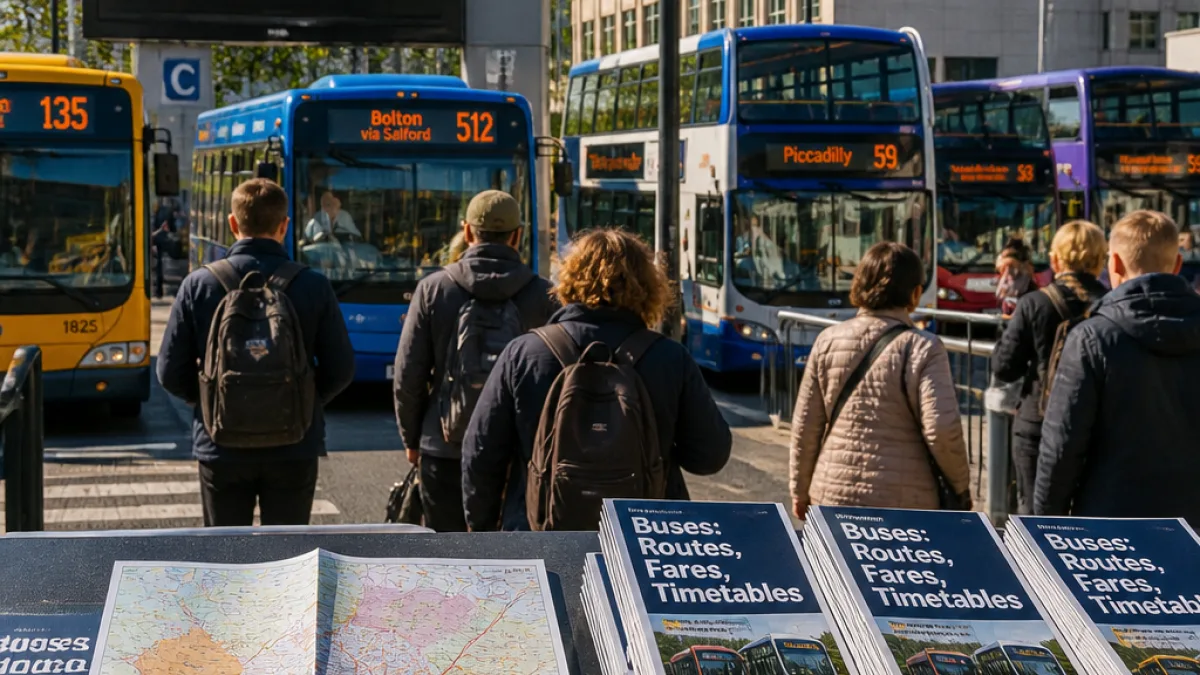
Scotland’s current discussion about the future of its bus network has brought renewed attention to two contrasting models seen elsewhere in Britain — the franchised, publicly‑controlled system used in London and parts of the north of England, and the deregulated, market‑led approach introduced nationally in the 1980s. For residents and councils in Greater Manchester, the debate is familiar: who should shape timetables, services and fares, and how should public accountability be preserved?
From the 1980s to today
The roots of the current split go back to reforms in the 1980s that opened most of the UK’s bus market to private operators. Outside the capital, private companies have been free to decide which routes to run and with what frequency — a situation that passenger groups argue left many communities with thinning or inconsistent provision when routes became unprofitable. Operators, for their part, point to substantial investment and high customer satisfaction on many services.
“African dictators”
London took a different course. There, routes and timetables are set by the transport authority and then contracted to private firms; vehicles run under the Transport for London roundel and competitors are not permitted to operate the same routes. The result has been a long‑term rise in passenger numbers in the capital, at least compared with the downward trends observed elsewhere in the UK.
Lessons from Edinburgh and what they mean locally
Edinburgh is another exception. The council kept majority control of the local bus company, which has returned some ticket revenue to the council in the form of dividends. That model — local public ownership or arms‑length ownership — is held up by some as a middle path between full franchising and the deregulated market.
In Scotland, legislation passed in 2019 already gives councils and regional transport partnerships the power to adopt franchising models. Proposals have been tabled by the Strathclyde Partnership for Transport and have secured cross‑party backing in places, but remain at an early stage.
- Franchising/direct ownership: Local authorities control routes and contracting, potentially improving coordination and accountability.
- Deregulation: Private operators choose services and frequencies, which can leave unprofitable routes at risk.
- Hybrid/arms‑length: Local authority ownership of a company running services, as in Edinburgh, offers another model.
| Model | Control over routes | Typical outcome cited |
|---|---|---|
| Franchised (London) | Transport authority sets routes | Rising passenger numbers |
| Deregulated (most of UK) | Operators decide services | Patches of unreliable provision |
| Arms‑length public ownership (Edinburgh) | Council retains majority control | Positive performance; revenue returned to council |
For Greater Manchester, where transport is already a devolved concern handled through combined authority arrangements, the choices are consequential. Franchising could enable better integration of timetables across bus and tram, clearer fares structures and more coordinated planning between town centres and suburban neighbourhoods. But it would also require political consensus, fresh contracting arrangements and public investment decisions.
Those considering these options here will be watching developments in Scotland closely. If Strathclyde or other regions move towards franchising, they will provide practical examples — for better or worse — of how the law passed in 2019 functions in practice.
What this means for passengers in Manchester and the wider county is straightforward: who sets the timetable matters. Whichever model is chosen will affect service frequency, the survival of less profitable routes and how easily people can plan journeys across modes. Local authorities and transport bodies will need to weigh operational control against cost, competition and the capacity of existing operators.
For now, the UK offers multiple case studies rather than a single blueprint. The ongoing debate will be shaped as much by local political choices in Manchester and elsewhere as by lessons drawn from London and Edinburgh.