Renfrewshire attainment spotlight: four secondaries lead local performance
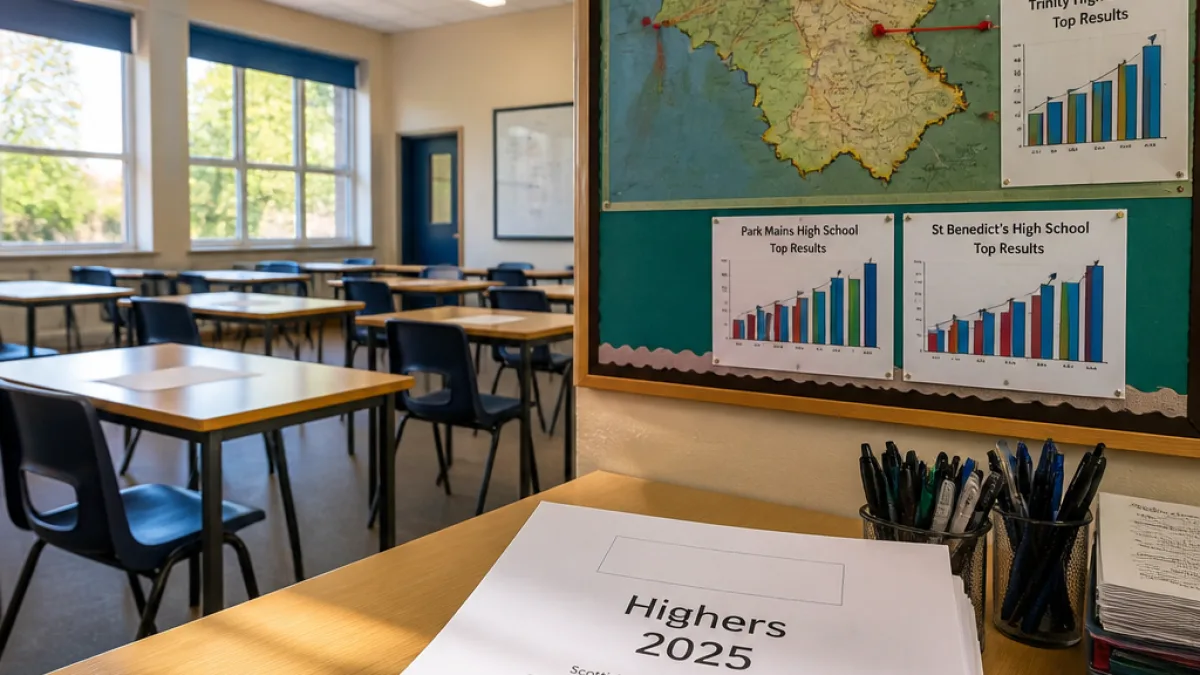
Fresh analysis of Scottish Government attainment data has highlighted robust performance across Renfrewshire’s secondary sector, with four schools singled out among Scotland’s stronger performers on the measure of pupils achieving five or more Highers (or equivalent) in 2025. While the wider list references 11 Renfrewshire secondaries performing well nationally, detailed figures in the latest summary identify Gryffe High, Trinity High, Park Mains High and St Benedict’s High as leading local contributors.
The measure used is the proportion of pupils attaining the Scottish Government’s so‑called “gold standard” of five Highers. This single metric does not attempt to rank schools in an absolute sense. As the release notes, outcomes depend on a complex mix of context, including levels of additional support needs, the experiences of pupils and staff, and the resources available through Renfrewshire Council’s education budget.
“These Higher result tables do not reflect schools or rank them in terms of ‘best to worst’ as that would fail to take into account factors such as the support offered to children with complex needs, the effort and quality of the teaching staff, working conditions for said staff, quality of the student experience, the funding the school receives from Renfrewshire Council, or whether or not the school is serving an underprivileged and disadvantaged area within the local authority.”
Who is leading locally?
Within Renfrewshire, the latest snapshot shows four schools with strong proportions of pupils gaining at least five Highers in 2025, with corresponding positions among Scotland’s higher performers:
| School | Location | % with ≥ five Highers | Scottish position |
|---|---|---|---|
| Gryffe High School | Houston | 68% | 21st |
| Trinity High School | Renfrew | 60% | 34th |
| Park Mains High School | Erskine | 50% | 67th |
| St Benedict’s High School | Linwood | 49% | 74th |
Gryffe’s performance places it in the country’s top cohort on this measure, while Trinity’s results consolidate Renfrew’s showing in the national picture. Park Mains and St Benedict’s also post strong outcomes, rounding out a locally diverse spread that includes schools serving communities from Houston and Renfrew to Erskine and Linwood.
Understanding what the numbers do—and do not—show
The “five Highers” benchmark is one of the clearest indicators of academic attainment for senior phase pupils, often linked to access to competitive university courses and apprenticeships. However, the data does not offer a full report card on a school’s work. It does not capture, for example, progress achieved by pupils from differing starting points, the breadth of vocational options, or the success of inclusion strategies. It also does not reflect the day‑to‑day support delivered by staff to pupils with complex needs—areas where schools often invest substantial effort alongside formal qualifications.
Renfrewshire schools educate young people with varied ambitions. Many pursue Highers to secure university offers; others thrive via skills‑based routes or alternative qualifications. The council’s schools also operate within contrasting social and economic contexts—factors that invariably shape the mix of learner pathways and the headline attainment profile in any given year. The data, therefore, is best read as a high‑level attainment snapshot rather than a definitive ranking.
Local context: councils, resources and pupil experience
The commentary accompanying the figures explicitly acknowledges the role of Renfrewshire Council funding, staffing conditions and the overall student experience in shaping outcomes. This reflects a long‑running reality for local authorities: resourcing decisions—both financial and staffing—intersect with the educational needs of distinct communities. Schools serving areas with higher levels of disadvantage often put substantial resource into equity and inclusion, ensuring pupils can access learning and support. Those efforts may not be fully visible in a single metric focused on five Highers.
For families, the figures can still be a useful guide, particularly for understanding how frequently pupils in a school reach the traditional university entry threshold. But they should be balanced against broader considerations—ranging from subject availability and support services to pastoral care and extracurricular opportunities—that shape the overall school experience for young people in Renfrewshire.
What this means for learners and parents
- For senior pupils considering S5 and S6, the data underlines where large cohorts currently achieve five or more Highers. This can inform conversations with guidance staff about course choices and post‑school plans.
- Parents should view the figures alongside school inspection findings, leaver destinations and the fit between a school’s offer and their child’s needs—academic or otherwise.
- For school communities, maintaining attainment while widening participation in a range of pathways remains a central challenge.
The results for Gryffe, Trinity, Park Mains and St Benedict’s show that a number of Renfrewshire secondaries are enabling significant numbers of pupils to secure the traditional “gold standard” in 2025. The broader compilation mentions 11 Renfrewshire schools among Scotland’s top performers overall; details publicly cited so far specify the four schools listed above. As more granular data is published and discussed at school and council level, attention will inevitably turn to how success is shared across the authority—and how support is targeted where the need is greatest.