Fewer vehicles and drivers as annual licensing report lands
West Berkshire Council has recorded a sharp fall in licensed taxi and private hire activity over the last financial year and is moving to update how it regulates and engages with the sector. Figures in the authority’s 2025–26 Licensing Annual Report, presented to the Licensing Committee on 6 July, show declines across most licence categories and outline a programme of policy reviews and a refreshed forum for dialogue with operators and drivers.
The council’s Public Protection Partnership handled 417 taxi and private hire licensing applications during 2025–26. Over the same period, licensing officers logged 98 service requests from or about the trade, including 46 complaints. Of those, five raised safeguarding concerns. The report confirms that three licensed drivers had their licences revoked in West Berkshire during the year.
Licence numbers fall across categories
Compared with the previous year, the council reports fewer operators, vehicles and drivers on the books. The most pronounced reduction was among hackney carriage vehicles. Private hire and dual driver licences also declined.
| Licence type | Previous year | 2025–26 |
|---|---|---|
| Private hire operator licences | 66 | 59 |
| Private hire vehicle licences | 175 | 160 |
| Hackney carriage vehicle licences | 149 | 97 |
| Private hire driver licences | 181 | 164 |
| Dual hackney carriage & private hire driver licences | 170 | 157 |
The fall in hackney carriage plates is likely to be felt most keenly where on-street or rank-based services are important, such as town centres and transport interchanges. While the report does not attribute causes, the figures will be closely watched by residents who rely on licensed vehicles for daily journeys, late-night travel, and links to rail services, particularly in more rural parts of the district.
Policy reviews and trade engagement to be strengthened
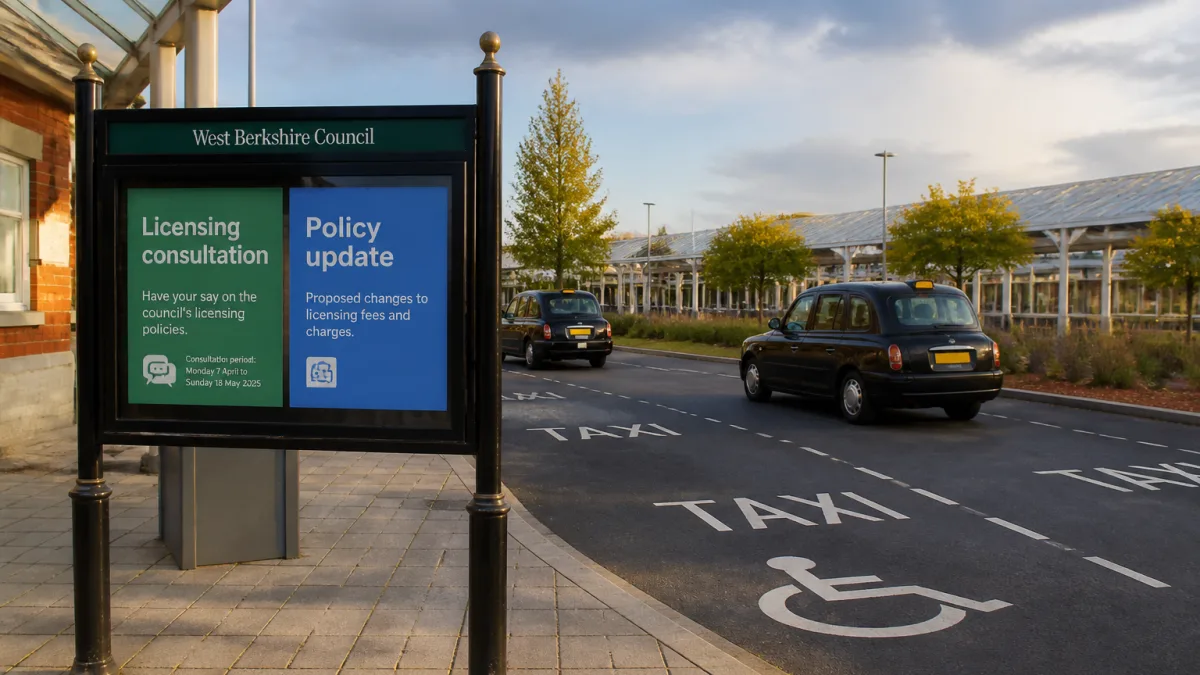
Alongside the headline statistics, the council confirms a busy year of consultations on fees and charges, the overarching Hackney Carriage and Private Hire Licensing Policy, and proposed amendments relating to protected plates and accessibility. The proposed changes form part of separate committee business following an earlier decision by members to review the protected plate policy.
In a bid to formalise dialogue with the sector, councillors are being asked to approve revised Terms of Reference for the West Berkshire Hackney Carriage and Private Hire Trade Meeting. The updated framework is intended to provide a structured channel for discussion between licensing officers and trade representatives before recommendations are brought back to the Licensing Committee. The group will not consider individual licensing cases.
Under the proposal, the forum would be used to explore:
- licensing policies, tariffs and fees;
- operational issues affecting drivers and operators;
- emerging legislation and regulatory changes; and
- new technology relevant to the trade.
Compliance, safeguarding and the local picture
The annual report spotlights the council’s compliance workload over the past year, with safeguarding flagged in a handful of cases among the wider complaints volume. While revocations were limited to three drivers, the combination of falling licence numbers and steady enforcement activity underscores the council’s focus on standards within a shrinking market.
Officers continued engagement with the trade throughout the year. The council’s move to codify that relationship through a regularised trade meeting signals a push for earlier, more transparent discussion of proposed changes that affect day-to-day operations, from fare structures to vehicle standards.
What it means for residents and businesses
A reduction in licensed vehicles and drivers can have knock-on effects. Fewer hackney carriages may lengthen waits at ranks at peak times or after major events, while a smaller pool of private hire vehicles could constrain pre-booked availability at busy periods. For local businesses and the night-time economy, reliable transport remains a cornerstone of safe dispersal and staff travel.
On the other hand, the council’s policy work — particularly on accessibility and engagement — may shape the mix and quality of services available in the medium term. Formalising consultation with the trade could smooth the path for changes intended to balance public safety, service reliability and the viability of local operators.
Residents who rely on licensed vehicles, including older people and those without access to a car, will watch closely as the committee considers the revised terms for the trade forum and the outcomes of the policy consultations. Any subsequent decisions on fees, vehicle standards or plate controls will determine how the market adapts in the year ahead.