Greater Manchester should be used as a template for national action on homelessness, according to a new report from the Institute for Public Policy Research (IPPR) and IPPR North.
Report presses for housing‑led, system‑wide approach
The paper, Home Truths: Housing‑led approaches to homelessness, argues that initiatives pioneered in the city region — notably the A Bed Every Night programme — contain lessons that could be scaled up across England. The authors, Dr Maya Singer Hobbs, India Gerritsen and Aleisha Ome, say that without a co‑ordinated, cross‑government drive, efforts to end rough sleeping will not succeed.
“Without a holistic, whole‑government approach, efforts to reduce rough sleeping and homelessness will fail. A lack of political will was identified as a significant barrier to action on homelessness. Government must show that tackling homelessness is a national priority,”
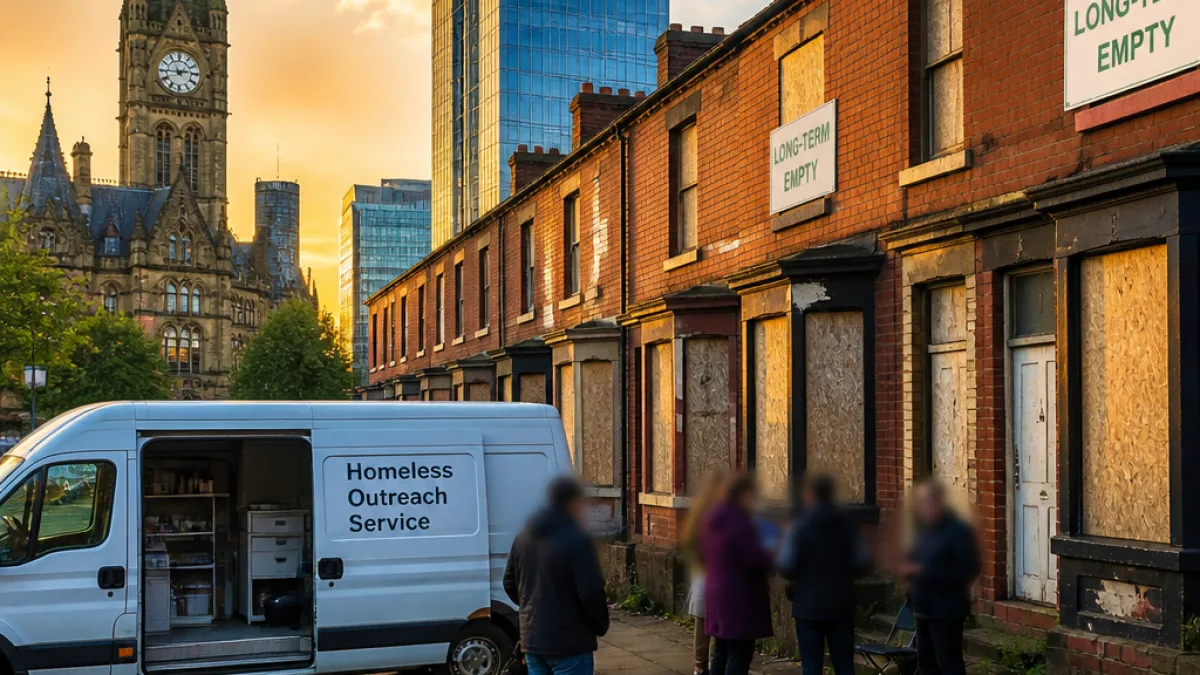
The report highlights a combination of immediate and strategic responses that it recommends government consider, many of which have been used in Greater Manchester. These include emergency shelter provision, routes into longer‑term housing and bringing empty properties back into temporary use.
Practical measures recommended
- Expansion of shelter and emergency support similar to A Bed Every Night.
- Programmes to return long‑term empty homes to occupancy as temporary accommodation.
- Stronger strategic governance and funding models to underpin local action.
- Greater powers for local authorities and clearer duties on registered providers to house referred rough sleepers.
The paper calls for a stronger duty to co‑operate that goes beyond the existing legal requirement on housing associations under the Housing Act 1996, which currently asks providers to "co‑operate to such extent as is reasonable in the circumstances." It argues this duty should be tightened so that registered providers accept referrals from local authorities where appropriate.
Local implications for Manchester and the wider city region
For Manchester and the wider city region, the report underlines the potential value of formalising the partnerships and governance arrangements that have supported local homelessness responses. It also points to the practical benefit of identifying empty housing stock that could be used quickly to reduce rough sleeping while longer‑term solutions are secured.
Policy makers in Greater Manchester will now face the task of demonstrating which elements are directly transferable, and which rely on local structures, funding streams and voluntary sector capacity. The IPPR authors stress that political commitment at national level is crucial to any successful roll‑out.
| Recommended action | Purpose |
|---|---|
| Emergency shelters (A Bed Every Night model) | Immediate protection from rough sleeping and route into services |
| Bring long‑term empty homes back into use | Provide temporary accommodation and relieve pressure on shelters |
| Stronger governance & funding | Ensure consistent, sustained local delivery |
| Tighter duty on registered providers | Improve co‑operation between housing providers and local authorities |
The IPPR and IPPR North paper will be of interest to councillors, mayoral teams and housing charities in Manchester, who have for years lobbied for a mix of emergency provision and housing solutions. Its recommendations add to an ongoing debate about how best to combine immediate respite for people sleeping rough with routes into settled tenancies.
Local residents and organisations seeking further detail should consult the full IPPR report for the evidence base and the authors’ detailed recommendations.