
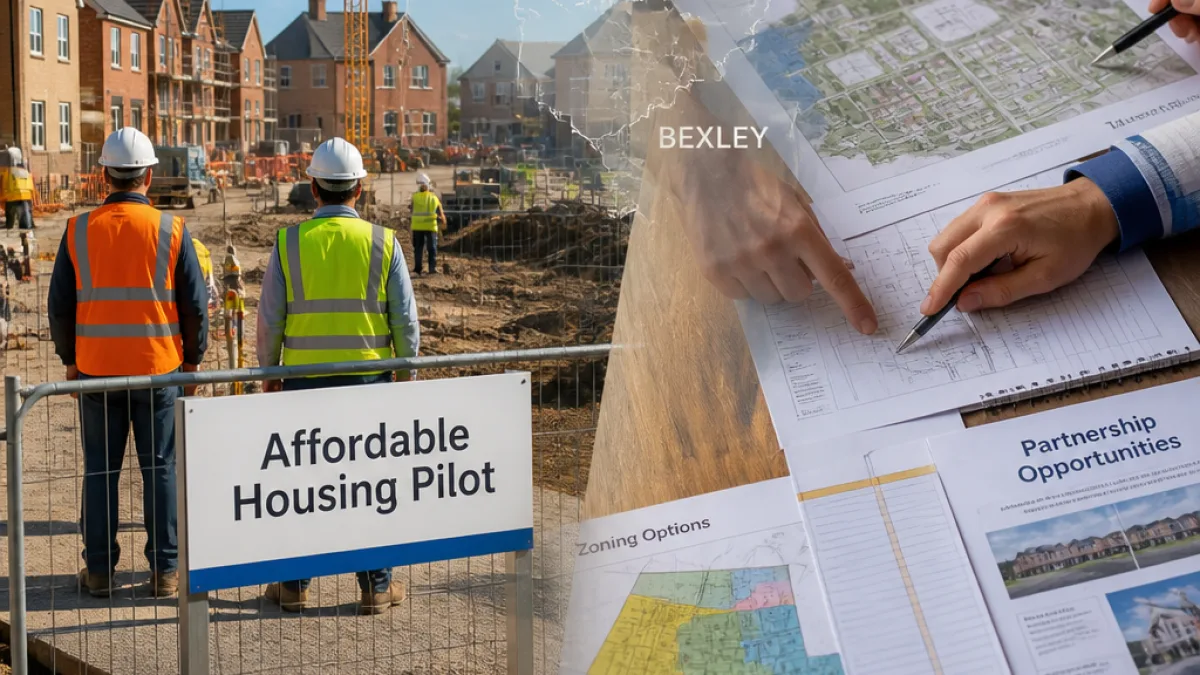
An affordable housing project in the US suburb of Bexley — part of a recent analysis of how to move schemes from idea to reality — offers lessons for local councillors, housing associations and residents in Bexley as they confront their own pressures around housing supply and affordability.
Scale of the problem and what the study found
The commentary draws on published figures showing Ohio faces a shortfall of 266,000 affordable housing units. It also highlights research by the Affordable Housing Alliance of Central Ohio suggesting that constructing just half of the region’s need could produce significant social and economic benefits: an estimated 40,000 jobs annually, a rise in life expectancy of five years, and an increase in the number of third graders meeting state reading benchmarks by 3,000 children.
Barriers to delivery identified
The account sets out several recurring obstacles that stall projects when they move beyond the drawing board. Among those cited are:
- Outdated zoning codes that do not permit the types or densities required to make affordable schemes viable;
- Mismatched building requirements that raise costs or complicate delivery;
- Local opposition arising from misunderstandings or lack of meaningful engagement, which can slow or derail proposals.
“We need affordable housing. We want affordable housing. But we won’t get there by relying on old approaches.”
That observation underpins the advocacy for a different approach: one based on authentic collaboration, transparency and shared outcomes. The piece also points to a practical example in which a partnership involving The Community Builders — with George Tabit, its senior vice-president for real estate development, mentioned as a local resident — helped advance a development through such methods.
Implications for Bexley
While the source is an opinion grounded in the US context, the challenges it lists are recognisable to planners and councillors here: zoning and planning rules, technical standards, and community trust. For Bexley residents and decision-makers considering how to expand genuinely affordable housing locally, the Ohio example emphasises three practical priorities:
- Review whether current local planning and zoning rules enable a range of housing types and tenures;
- Encourage cross-sector partnerships between councils, housing associations and experienced developers to pool expertise and capacity;
- Invest in early, transparent community engagement to address concerns and set shared objectives from the outset.
| Issue | Suggested focus |
|---|---|
| Zoning | Assess flexibility to allow diverse affordable housing models |
| Delivery costs | Align building standards with viability without compromising safety |
| Community buy-in | Embed meaningful consultation and shared outcomes |
The article also reminds readers that housing policy plays out across scales: national legislation and funding shape what is possible, but local choices about land use, design standards and community engagement are often decisive in whether projects proceed.
For Bexley, the immediate task is not to replicate an American project, but to examine the practical governance measures that accelerate delivery while protecting local character and public trust. Those measures include updating planning frameworks where necessary, fostering partnerships with experienced affordable-housing providers and ensuring residents are part of the conversation from the outset.
As debates over housing continue, evidence-based examples from elsewhere can help illuminate what works — and what does not — when converting political will into homes on the ground.