
High Court setback for resident opposing estate demolition
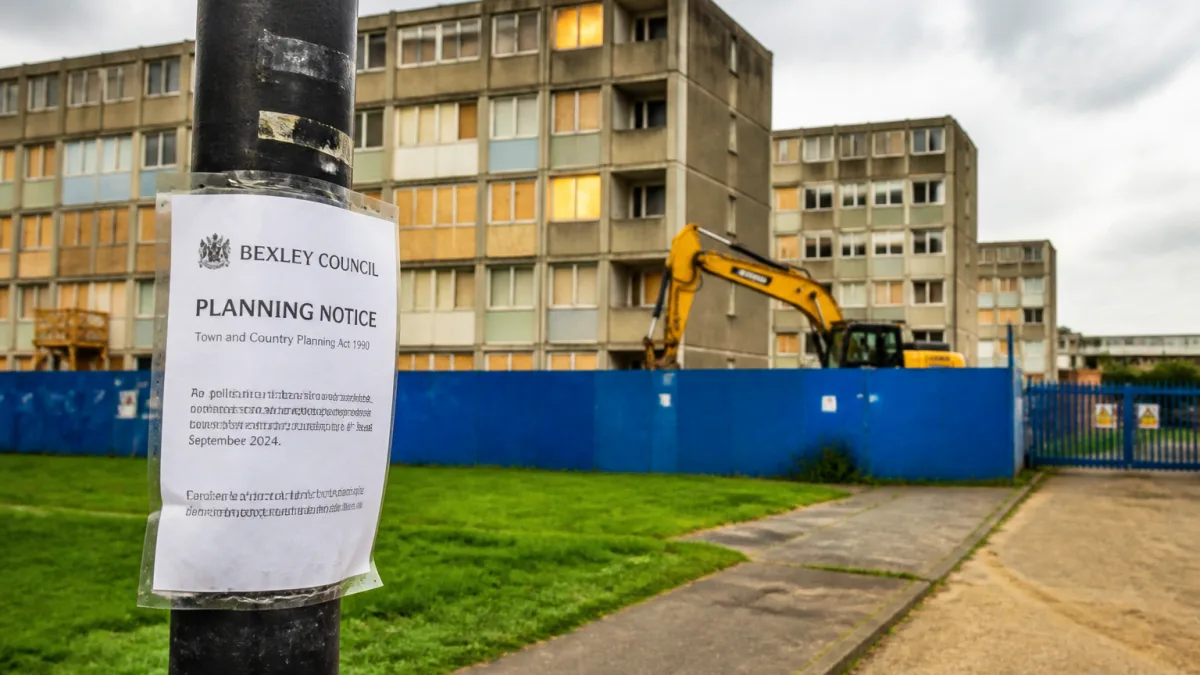
A legal attempt to halt the demolition of the Lesnes Estate in Thamesmead has suffered a major setback after a High Court judge declined to grant permission for a judicial review of Bexley Council’s decision to approve up to 1,950 new homes on the site. The case was brought by resident Adam Turk, one of the few remaining households on the 1960s-built estate.
Mr Turk issued proceedings earlier this year seeking to challenge the council’s approval of housing association Peabody’s regeneration proposals. The court, however, has refused permission on the papers. His legal team at the Public Interest Law Centre (PILC) has triggered a further mechanism allowing an oral renewal, with a one-hour hearing expected later this month. Mr Turk acknowledged the odds of overturning the initial decision are slim.
“It doesn’t look good. A lot of the laws are all against us. A miracle can happen, but I’ve been going through this for three years now and I’ve been looking at all the planning laws and different cases, and it just seems that they’ve got all the laws sewn up.”
Challenge centred on environmental impact of demolition
The judicial review application focused on the environmental consequences of demolishing the estate, arguing that planning documents accompanying the scheme understated greenhouse gas emissions associated with large-scale demolition and reconstruction. The court’s refusal to grant permission indicates the claim did not, on the papers, meet the threshold for a full hearing; however, the forthcoming short hearing will allow PILC to set out its case orally.
Mr Turk voiced dismay at the ruling and expressed concern about the broader direction of estate regeneration schemes, describing them as a gradual erosion of traditional council housing. He said the project represented a further step towards higher-priced developments while long-standing residents move on.
Estate with cultural footprint nears end of an era
Built in the 1960s and known for its brutalist architecture, the Lesnes Estate has a distinctive place in popular culture, having appeared in the 1971 film A Clockwork Orange. The estate has seen substantial out-migration ahead of demolition, with around 30 households believed to remain on site. The redevelopment was approved by Bexley Council as part of wider plans to reshape this part of Thamesmead.
For residents who have stayed, the uncertainty has been prolonged. While the proposed scheme would deliver significant new housing, it also brings questions about phasing, decanting and disruption that often accompany large-scale regeneration. The court’s provisional view means, in practical terms, the project has moved closer to implementation, pending the outcome of the brief hearing later this month.
What the decision means for Thamesmead
The judge’s refusal of permission does not finally dispose of the claim, but it substantially narrows the legal route available to opponents. If the oral renewal does not succeed, the court proceedings will end and the planning permission remains in place. That would allow Peabody and its partners to proceed to subsequent steps required to bring forward the development.
Residents and local stakeholders following the case may wish to note the following:
- The court has refused permission for a full judicial review at the first stage.
- An oral renewal hearing of approximately one hour is due later this month.
- The claim focused on the climate and environmental impacts of demolition and construction.
Key facts at a glance
| Item | Detail |
|---|---|
| New homes approved | Up to 1,950 |
| Era of original estate | 1960s |
| Households remaining (approx.) | ~30 |
| Cultural reference | A Clockwork Orange (1971) |
Next steps
The oral renewal will enable PILC to set out its arguments in person before a judge. Should that attempt fail, the permission refusal will stand. In the meantime, many residents have already left the estate, while those remaining face continuing uncertainty as the legal process reaches its final stages.
Peabody’s redevelopment plans and Bexley Council’s decision remain the framework within which the future of Lesnes is being determined. With the area’s built environment poised for significant change, the outcome of this last legal avenue will be closely watched by Thamesmead residents and housing campaigners across South East London.