
Patients in Ayrshire report barriers to a nationally approved treatment
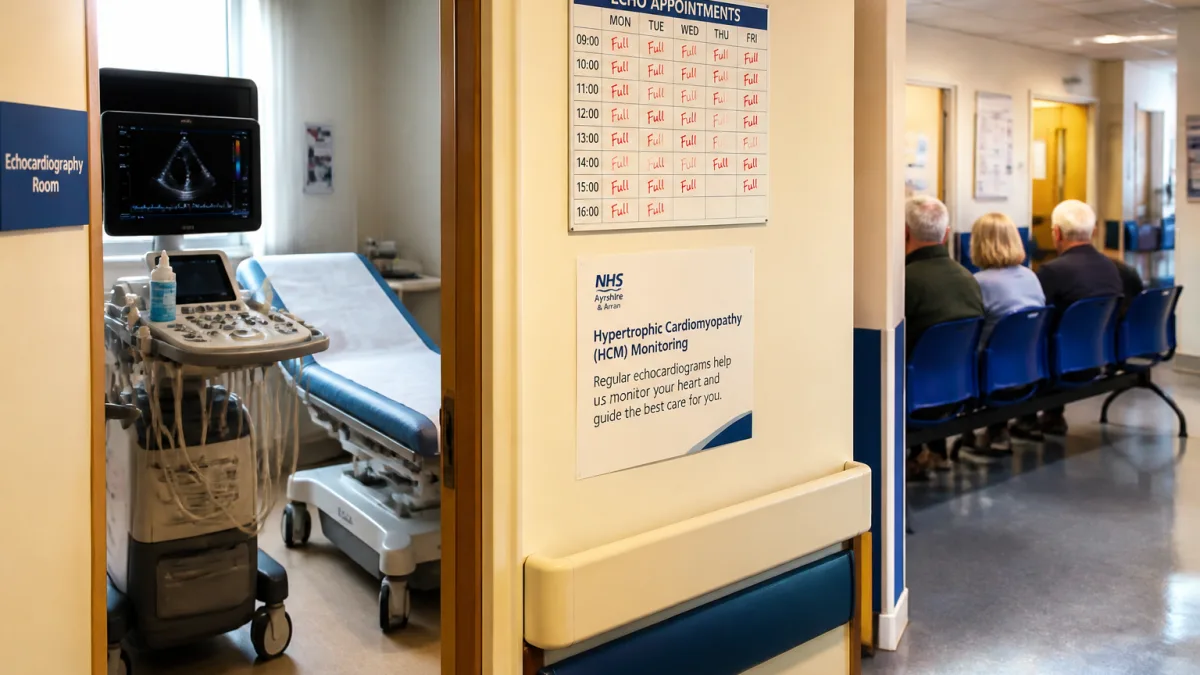
A South Ayrshire patient has accused NHS Ayrshire and Arran of leaving people with hypertrophic cardiomyopathy without timely access to a treatment endorsed in Scotland, citing a shortage of staff to provide the required monitoring. The health board has confirmed that the issue relates to capacity for repeated echocardiograms, an essential safety check when starting the medicine.
Simon Fraser, 47, from Troon, lives with hypertrophic cardiomyopathy (HCM), a condition in which the heart muscle becomes abnormally thick. Symptoms can include chest pain and breathlessness, and in severe cases some patients face invasive procedures. A medicine called Mavacamten has been cleared for use within NHS Scotland for suitable HCM patients, and is being prescribed by a number of boards elsewhere in the country.
However, Mr Fraser says he has been unable to start the therapy locally despite being approved for it last year. He told Ayrshire Weekly Press that although the medicine is funded, the health board has been unable to schedule the necessary series of heart scans at the start of treatment. He said the barrier is the availability of echocardiography staff, not the price of the drug.
“I was approved for treatment with Mavacamten last year. The NHS has agreed to fund the drug. But I am still unable to start therapy. The reason given by the health board is a lack of echocardiography staffing capacity to support the required monitoring… Approval without access is not real approval. It is hope offered and then withdrawn.”
HCM is estimated to affect roughly one in 500 people across the UK. Individual experiences vary widely, but Mr Fraser says his symptoms have led to repeat hospital visits. He believes other local patients could be similarly affected by the current position in Ayrshire and Arran, and argues that delayed access places extra strain on emergency services.
Board cites monitoring capacity as the constraint
According to Mr Fraser, the health board has explained that delivering the therapy safely requires a schedule of echocardiograms shortly after initiation. The local service has highlighted a lack of staffing to carry out that programme of checks.
- Condition: Hypertrophic cardiomyopathy (HCM) – a thickening of the heart muscle that can limit blood flow.
- Drug: Mavacamten – approved in Scotland for eligible HCM patients.
- Local barrier: Shortage of echocardiography capacity to complete early treatment monitoring.
While other health boards have begun prescribing, NHS Ayrshire and Arran has not yet implemented routine access. The board’s position, as described to the patient, is that repeated scans are essential to track how the heart responds during the initial phase of therapy. The absence of those appointments would compromise safe roll-out.
Why the monitoring matters
When this treatment is started, cardiology teams must confirm that the heart’s pumping function remains within a safe range. That requires ultrasound assessment by trained staff at set intervals soon after the first dose. In Ayrshire and Arran, the patient has been told those slots are currently limited.
| Monitoring step | Detail |
|---|---|
| Initial safety checks | Specialist cardiology review before starting therapy |
| Early follow-up | Four echocardiograms during the first four months of treatment |
| Ongoing review | Further scans as clinically indicated thereafter |
Mr Fraser praised the efforts of frontline clinicians and said his frustration is directed at system capacity rather than individual teams.
“All the cardiac staff have been amazing since I was diagnosed in 2021. It’s the NHS board and senior management who aren’t providing this funding.”
Impact on patients and services
Beyond personal symptoms, Mr Fraser says repeated emergency attendances reflect the wider cost of delayed access. He reported multiple A&E visits in the past month alone and argued that timely therapy elsewhere in Scotland reduces those pressures. He also suggested that “several hundred” people locally may have the condition, though that is his view rather than an official estimate.
Access differences between areas are often labelled a “postcode lottery” by patients. In this case, the disparity arises not from a funding refusal for the medicine, but from capacity in the diagnostic pathway that supports safe prescribing.
What patients can do
Individuals with HCM who have questions about their care should speak to their cardiology team or GP for advice on current pathways in Ayrshire and Arran, including the process for consideration of disease-modifying treatments and the monitoring requirements that accompany them.
InfoRadar has asked NHS Ayrshire and Arran for further detail on plans to address echocardiography capacity and when local patients might expect routine access to Mavacamten. We will report any update.