Council told masterplan needs update as views clash over state of town
Bridgend’s long-range blueprint to revive its town centre will be reviewed, with senior officers telling councillors the 10-year Masterplan, first published in 2021, must be refreshed to reflect how people now live, work and shop. The decision came during an update almost five years after the strategy was taken forward by the authority, and it prompted a tense exchange over the town’s current condition.
At the meeting, Councillor Owain Clatworthy described Bridgend town centre as a
“complete dump”, citing concerns about anti-social behaviour and the pull of higher-quality retailers away from the core streets. His remarks drew visible reactions from across the chamber, with colleagues defending businesses that continue trading and investing in the town despite difficult conditions.
Citing work already under way, officers reiterated the masterplan’s central aim: to make Bridgend a
“liveable and vibrant place”, with more people residing in the centre, better public spaces, and stronger support for enterprise, transport and local heritage.
Why a review now
The report to members characterised the document as a
“dynamic long-term planning document”requiring periodic updates. Since 2021, the council has implemented a new Local Development Plan, and broader shifts in the economy and consumer behaviour have reshaped town centres everywhere. Officers said these changes could steer Bridgend towards a more mixed-use future, blending homes, workspaces and services more closely.
Members heard that, while the original objectives still carry weight, the review will allow the authority to test assumptions and re-sequence priorities in light of what has changed on the ground and what is proving most effective at drawing footfall and investment.
Projects already moving
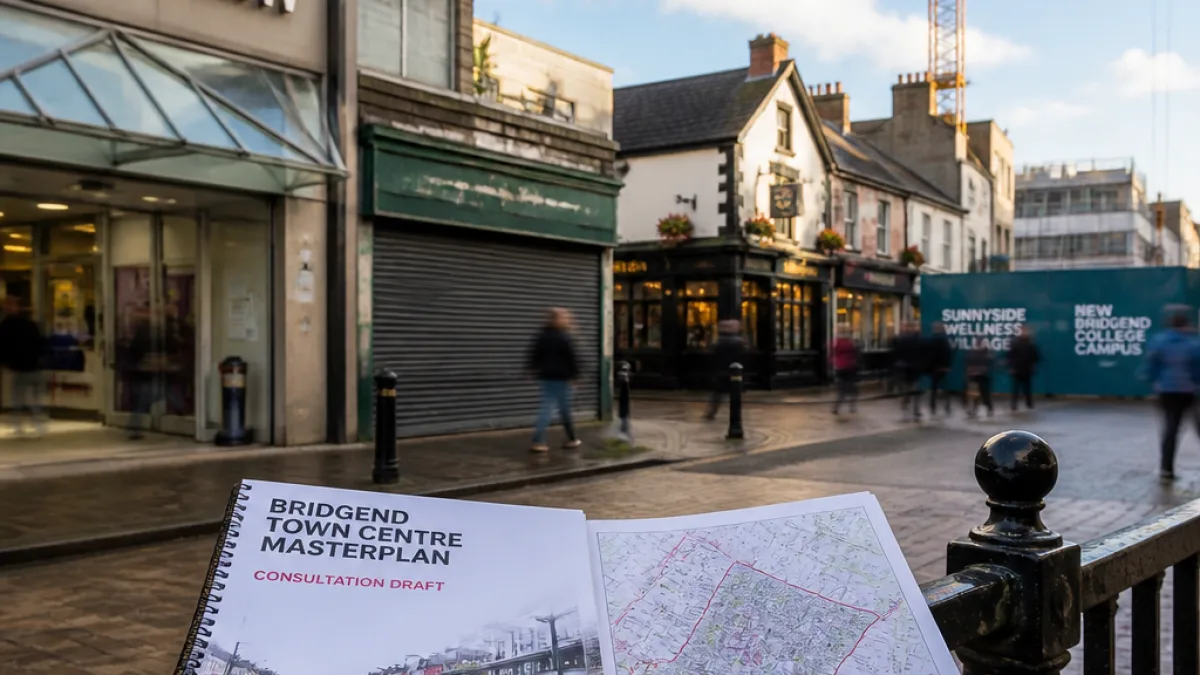
Officials highlighted a series of priority projects now progressing. These include a major education-led redevelopment, new health and wellbeing facilities, and the council’s strategic move to take control of a key shopping asset.
| Project | Focus |
|---|---|
| Bridgend College town centre campus | New £60m campus designed to bring students and staff into the heart of town |
| Sunnyside Wellness Village | Health and wellbeing hub to broaden day-time activity and services |
| The Rhiw shopping centre (council purchase) | Public sector acquisition to help shape the retail core’s future |
Officers said these schemes align with the plan’s intent to anchor daily activity in the centre and protect the town’s heritage and identity while improving connections.
Row over language and local effort
After Cllr Clatworthy’s remark, Councillor Jon-Paul Blundell countered that the description was unfair, noting that local traders are working hard to keep Bridgend a good place to work. Councillor Colin Davies also pointed to a thriving evening scene, underscoring that parts of the town centre are performing well even as others struggle.
The exchange laid bare the challenge at the heart of every regeneration plan: balancing frank recognition of problems with practical backing for businesses and residents still investing their time and money in the town.
What the masterplan set out to do
The 2021 document mapped out a broad agenda to stabilise and then grow the centre. Officers reminded members of its headline ambitions:
- Increase town centre living to support shops, services and safety throughout the day and evening.
- Upgrade public spaces so streets, squares and links feel cleaner, greener and more welcoming.
- Back local enterprise with space and support for independent and established businesses.
- Strengthen transport links and make it easier to move between key destinations on foot and by public transport.
- Protect heritage so historic assets remain part of a distinctive identity.
With retail patterns shifting and online shopping now deeply embedded, officers said the pivot to a broader mix of uses in central Bridgend is likely to become more pronounced as the plan is updated.
Next steps and local impact
While specific timelines were not set out in the update, councillors were told the review would reassess which interventions will best attract people into the centre throughout the week. In practical terms, that could mean giving greater weight to schemes that bring residents, students and health users closer to local shops and services, while still tackling the anti-social behaviour that undermines confidence.
For businesses already trading, the review signals continued attention on the basics: safe streets, active buildings and steady footfall. For residents, any refreshed focus on mixed-use neighbourhoods could translate into more amenities within walking distance and improved public spaces.
Members across the chamber appeared to agree on the need to keep momentum behind projects already in train, even as the council revisits the sequence and emphasis of the remaining programme.
Bridgend’s regeneration has rarely been a straight line. But with major investments such as the Bridgend College campus on course, the upcoming review offers a chance to align the next phase of work with how the town is actually being used — and to ensure that the centre feels less like a battleground of competing narratives and more like a shared project that works for those who live, study, work and spend time there.