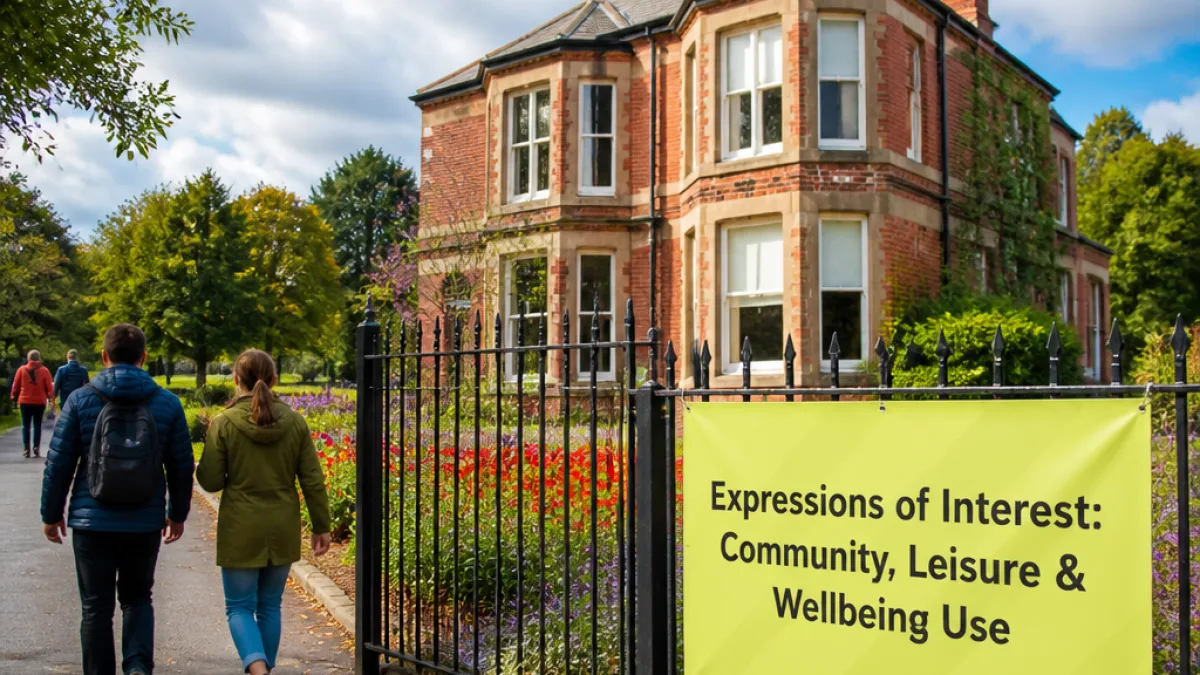
Cardiff Council has opened a formal call for expressions of interest to bring the historic Roath Park House back into use for the benefit of residents, community groups and visitors. The council is acting in its capacity as the sole trustee of the Roath Park Trust, which holds the land for public recreation, and will oversee a staged process culminating in consideration by the Charity Commission.
Heritage building with roots in city park history
Set within the Roath Pleasure Gardens, the two-storey property dates to 1897, when it was constructed as the residence of Parks Superintendent William Wallace Pettigrew. The Pettigrew family played a formative role in developing Cardiff’s parks and green spaces, and the house stands on land transferred by the Marquess of Bute in 1889 for the creation of public recreation grounds. The building, recently refurbished and offering around 1,220 sq ft of internal space plus extensive gardens, is being marketed on behalf of the trust by Cooke & Arkwright.
What the trust is seeking
The trustee is inviting proposals from individuals, social enterprises, charities and businesses that can credibly repurpose the property for community, recreation, leisure or wellbeing activities consistent with the trust’s charitable purposes. Submissions will be assessed against criteria aligned with public benefit and the site’s heritage and landscape setting.
- Eligible uses: Community, leisure, recreation or wellbeing activities compatible with trust purposes.
- Location: Within Roath Pleasure Gardens, adjacent to the wider Roath Park estate.
- Status: Property refurbished; expressions of interest now open.
- Marketing agent: Cooke & Arkwright (on behalf of the Roath Park Trust).
Key dates and governance steps
Cardiff Council approved the move earlier this year and set out a sequence to ensure transparency and regulatory compliance. After the submission window closes on 28 August 2026, proposals will be evaluated before a period of public engagement. A recommendation on the preferred future use will then be taken to the council’s Trusts Committee of Cabinet, established under revised governance arrangements to keep the trustee role distinct from the authority’s other statutory functions and to manage any potential conflicts of interest in line with Charity Commission guidance. Any final decision will be subject to the Commission’s approval.
| Milestone | Detail |
|---|---|
| Land transfer | Conveyed by the Marquess of Bute in 1889 for public recreation |
| House built | 1897, as residence for Parks Superintendent W. W. Pettigrew |
| Internal area | Approx. 1,220 sq ft plus generous outdoor space |
| EOI deadline | 28 August 2026 |
| Next steps | Evaluation → public engagement → Trusts Committee recommendation → Charity Commission decision |
Why this matters for Roath and the wider city
Roath Park House sits at the heart of one of Cardiff’s most visited green spaces, and any new tenant will need to respect both the site’s heritage and its role as a public amenity. A successful proposal could add space for local programming, low-impact leisure, or wellbeing activities, complementing existing park use. The trust framework means any occupation must advance the charitable purpose of public recreation and pleasure grounds, rather than purely commercial objectives.
The revised governance arrangements — notably the dedicated Trusts Committee — are designed to give residents confidence that proposals will be appraised on their alignment with the trust’s aims and the Commission’s rules, rather than broader corporate or political considerations within the council. The inclusion of a public engagement phase provides an opportunity for park users and neighbours to scrutinise ideas and raise operational issues such as access, hours of activity, and impacts on open space.
How to take part or submit a proposal
Prospective tenants are asked to register their interest and provide proposals through the appointed agent, Cooke & Arkwright, who are marketing the property for the Roath Park Trust. Interested parties should prepare evidence showing how their plans serve community, leisure, recreation or wellbeing uses consistent with the trust’s charitable purposes, and how they will manage the building and outdoor space responsibly in a sensitive park setting.
Residents and park users can expect further detail once the expression-of-interest phase ends and the council publishes information about the shortlisted options and the timetable for public engagement. The final decision will rest with the Charity Commission, following the committee’s recommendation.