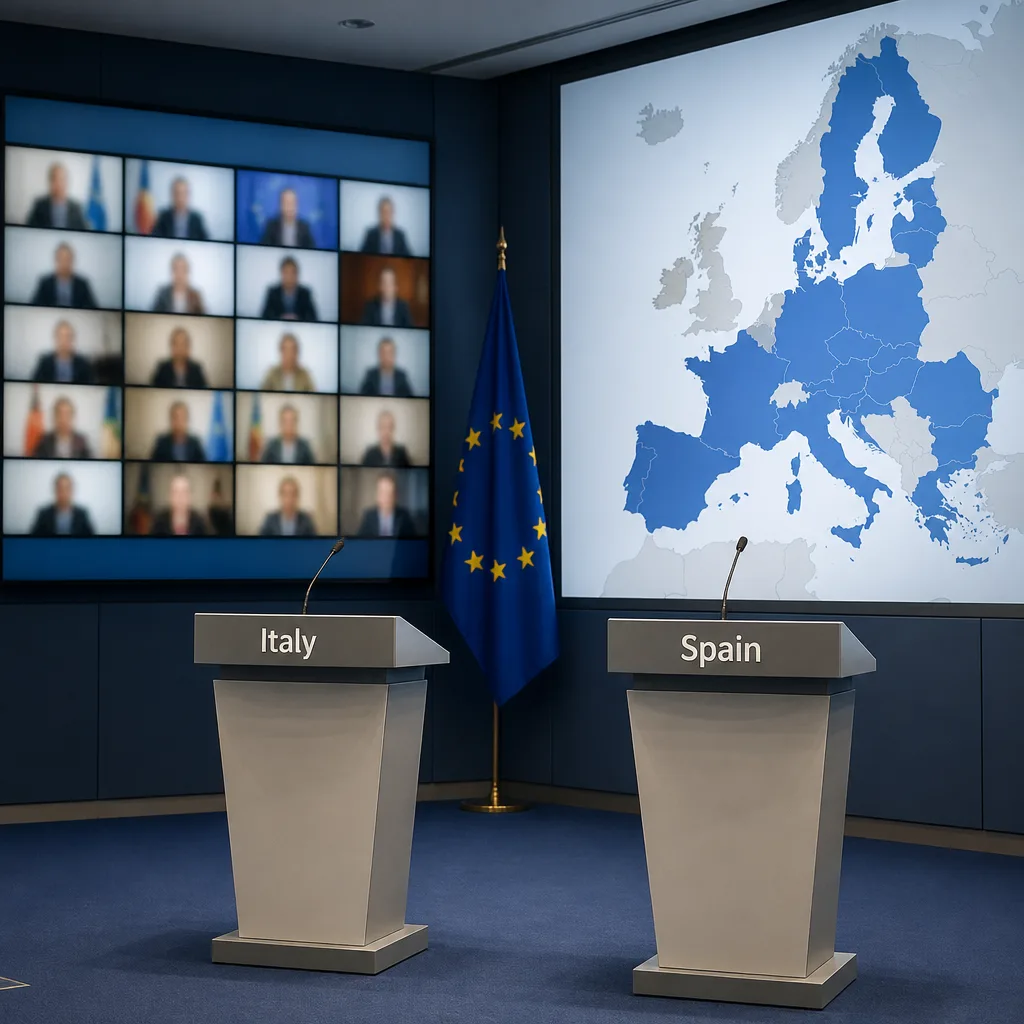
Home affairs ministers from across the European Union met online on Tuesday as diplomatic interventions attempted to calm a dispute triggered when Italy suspended Schengen cooperation with Spain following unrest linked to the Ceuta incident.
Diplomacy to steady fraying ties
The meeting followed a separate session of EU envoys on Monday, described in Brussels reporting as a largely therapeutic effort to lower temperatures between capitals. Officials at Coreper later conveyed words of solidarity to Madrid, though diplomats said the reassurances came only after an extended and heated intervention by Spain’s ambassador.
Sources in Brussels said the tone of the online ministers’ meeting depended in part on how the ministers from Italy and Denmark chose to position themselves. The dispute has at points risked turning into a broader clash between Spain and a coalition of right-leaning states over migration policy.
Contested interpretation of a joint letter
Last weekend, 22 countries sent a letter whose meaning has become politically charged. Italy’s Foreign Minister Antonio Tajani publicly interpreted that letter as endorsing Rome’s decision to suspend Schengen cooperation — a reading that diplomats described as an "analytical stretch" likely to unsettle some signatories who remain formally committed to Schengen.
"decision to suspend Schengen."
Institutional responses and forward agenda
The European Commission, ambassadors and the Irish presidency of the Council worked in unison on Monday to reduce tensions. Commission President Ursula von der Leyen was reported to have commended Spain’s handling of the crisis and conveyed solidarity with Madrid in a letter reported by Euractiv.
Ministers were expected to pivot from recrimination to a forward-looking plan to strengthen the EU’s migration architecture. Reported priorities included:
- Consolidating asylum processing outside the EU
- Measures to fight disinformation related to migration
- Broader efforts to shore up Schengen cooperation
Implications for Schengen and EU politics
Diplomats characterise Schengen as currently “battered”, with the episode exposing how fragile mutual trust can be among member states when migration crises arise. While political gestures of solidarity were eventually delivered to Spain, the timing and intensity of the dispute underline the difficulty of reconciling national security concerns with the collective management of free movement.
| Actor | Role in recent events |
|---|---|
| Spain | Subject of unilateral Schengen suspension by Italy; sought and later received pledges of solidarity |
| Italy | Suspended Schengen cooperation with Spain; asserted backing from a 22-country letter |
| European Commission | Worked to calm tensions; Commission President praised Spain’s handling of the crisis |
| Irish presidency | Helped coordinate diplomatic efforts to lower temperature at Coreper |
The episode demonstrates how quickly bilateral tensions can escalate into a challenge for EU-wide instruments when migration and border control intersect. The ministers’ choice to focus on policy measures rather than punitive action suggests an institutional preference for collective reform of migration procedures over ad hoc unilateralism — though whether that will suffice to repair faith in Schengen remains uncertain.
For now, Brussels officials appear to be opting for damage limitation while seeking to convert the confrontation into momentum for structural changes to the union’s migration and asylum arrangements.