Millions of households across the country are being moved onto a new digital telephone system as the ageing analogue network is gradually switched off, a national infrastructure change that councils and charities warn could leave some of the most vulnerable residents at risk if the transition is not handled with care.
Why the old network is being retired
The copper-based public telephone network, which has carried voice calls for decades, is being retired by the telecoms industry and replaced by calls made over a broadband connection. Providers have set a target of completing the move by the end of 2027, with the changeover already under way in parts of the country.
For most people the shift will be barely noticeable: a new handset plugs into a broadband router rather than a wall socket, and calls carry on as before. The regulator has said the upgrade is necessary because the old equipment is increasingly difficult and costly to maintain, with spare parts becoming scarce.
Concern for those who rely on care alarms
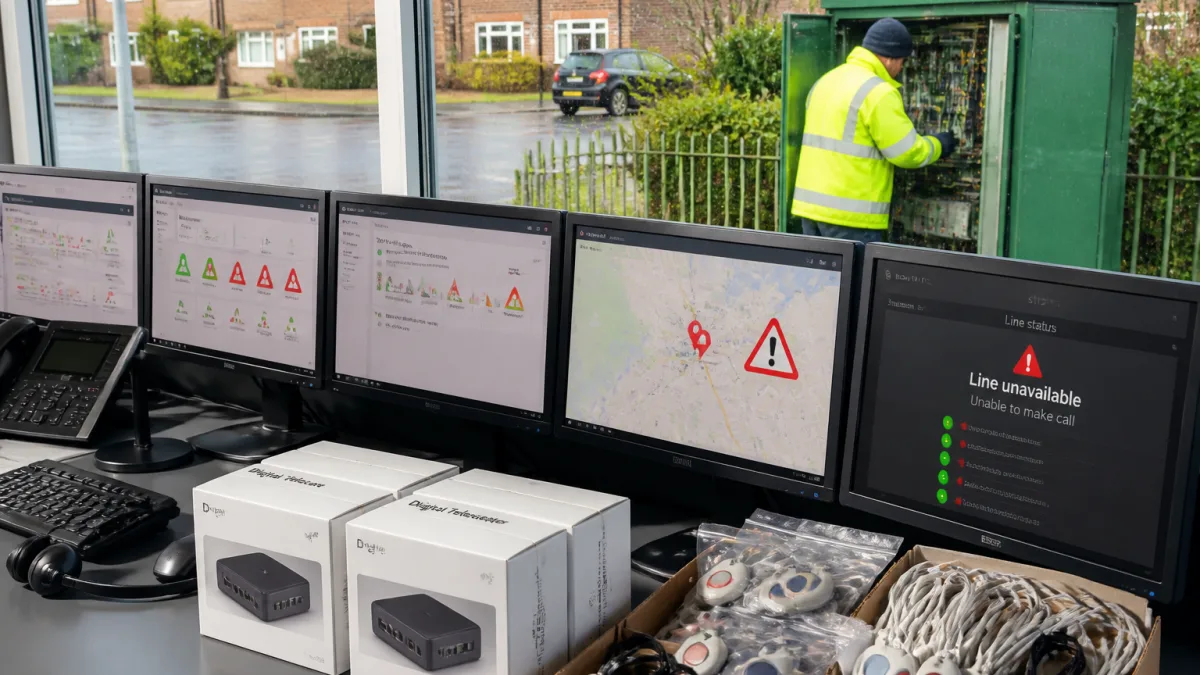
The worry centres on devices that quietly depend on the old line. Around two million people are thought to rely on telecare alarms — the pendant buttons and pull-cords that summon help after a fall or medical emergency — and many of these units were built for the analogue system. A digital line also depends on mains electricity, so a power cut can knock out a connection that once kept working on its own.
No one should lose their emergency alarm simply because their phone line was upgraded. The technology is moving forward, but it has to move at the pace of the people who depend on it most. — a spokesperson for a national older people's charity
Social care teams have reported cases where residents were switched over without anyone checking whether their alarm still worked afterwards. Following those incidents, providers agreed to pause non-voluntary migrations for customers known to use telecare while safeguards are strengthened.
Local authorities say the practical difficulty is simply knowing who has an alarm, because the devices are supplied through a mix of councils, housing associations and private firms, with no single register bringing that information together.
What households are being told
Officials are urging anyone with a personal alarm, a care line or other connected equipment to contact their telephone provider before any switch takes place, and to check on elderly neighbours and relatives who may not have registered as vulnerable.
- Tell your phone and broadband provider if anyone in the household uses a telecare alarm or other device that plugs into the phone line.
- Ask whether a battery back-up unit is available so the line keeps working during a power cut.
- Keep a mobile phone charged as a fallback where possible.
Charities working with older people say clear communication will be the deciding factor. With the deadline still some way off, they argue there is time to get the process right — provided no one is moved across without the checks that keep their safety net intact.