
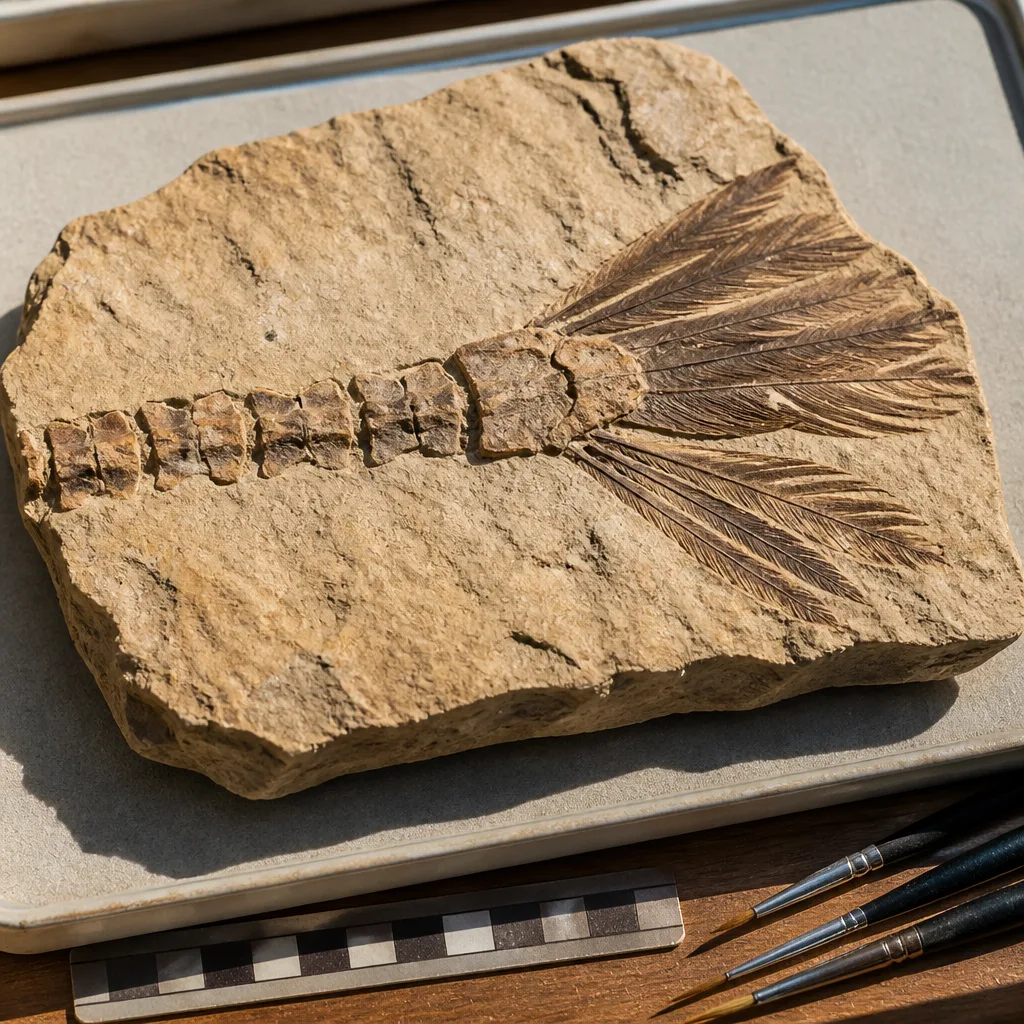
A recently published study of a fossil from China argues that the transformation of long, bony dinosaur tails into the short, feather-bearing structure seen in living birds took place in a sequence of evolutionary steps rather than a single abrupt change. The research, led by teams at the Chinese Academy of Sciences and the Fujian Province Geological Science Research Institute, was published on 1 July in the peer-reviewed journal Science Advances.
Why the tail matters
Modern birds possess a pygostyle, a short skeletal element created when the final caudal vertebrae fuse. This structure anchors tail feathers and associated musculature, enabling behaviour such as tail fanning and contributing to aerodynamic control. The new fossil, recovered from Chinese deposits, provides rare anatomical detail from an early-diverging birdlike form, helping to fill a persistent gap in the fossil record.
“The evolutionary assembly of the flight-adapted bird body plan encompasses some of the most profound morphological changes in terrestrial vertebrate history,”
The study’s authors emphasise that the move to a short, pygostyle-bearing tail was functionally and ecologically important for living birds, facilitating manoeuvrability in flight and altering how tail feathers were used.
Stepwise change, not sudden shift
Previous interpretations have sometimes treated the tail-to-pygostyle transition as a relatively rapid event. The new Chinese specimen supports a different picture: anatomical features indicate a gradual sequence of modifications. The researchers describe the process as a series of incremental skeletal and soft-tissue adaptations that cumulatively produced the tail plan seen in extant birds.
- Functional consequence: A shorter, fused tail provides a stable base for feathering that assists in aerodynamic control and display.
- Paleontological significance: Early-diverging bird fossils are exceedingly rare, so each new specimen can materially change interpretations of the evolutionary pathway.
- Evolutionary inference: The finding underscores the mosaic nature of major anatomical transitions — different parts of the body can change at different rates.
Comparing tail anatomy
| Feature | Non-avian dinosaurs / early birdlike forms | Modern birds |
|---|---|---|
| Tail length | Long, many caudal vertebrae | Short, reduced number of caudal vertebrae |
| Terminal structure | Individual vertebrae | Pygostyle (fused terminal vertebrae) |
| Functional role | Balance, display, locomotion | Anchoring tail feathers, aerodynamic control, manoeuvre |
Because specimens representing the earliest stages of avian evolution are scarce, the discovery adds a valuable datapoint. The authors caution that the fossil record remains incomplete; nonetheless, the specimen supports a narrative in which selection acted on tail anatomy in multiple, sequential ways to produce a flight-adapted morphology.
Taken together, the work reinforces the idea that some of the most consequential anatomical changes in terrestrial vertebrate history unfolded as a series of modifications, each with particular functional advantages. For palaeontologists and evolutionary biologists, the find offers a clearer window on how one of the hallmark features of modern birds — the pygostyle-bearing tail — came to be.