Virtual reality could offer behavioural scientists unprecedented control over experimental environments — but only if the field adopts shared standards, according to a new paper in the Proceedings of the National Academy of Sciences. An international team of 41 authors, working under the Openverse umbrella, set out a blueprint for making VR research more transparent, portable and methodologically consistent.
From excitement to rigour
VR lets investigators immerse participants in highly detailed, manipulable settings and hold many features constant in a way that traditional lab or field studies cannot. Yet the authors warn that enthusiasm for the technology risks outpacing methodological care. As hardware improves and prices fall, research practice is at risk of fragmenting into a “Wild West” of incompatible methods and undocumented procedures.
"VR research hasn't been held back by the technology. It's been held back by the absence of shared standards. These protocols give the field a common language for researchers, reviewers, and journal editors alike,"
The team has responded with a publicly accessible resource: an interactive checklist at www.vrprotocols.org designed to guide researchers through planning, conducting and reporting VR experiments in line with up-to-date standards.
Three core challenges
The paper frames the problem in three interlinked areas where practical intervention could improve reproducibility and accessibility:
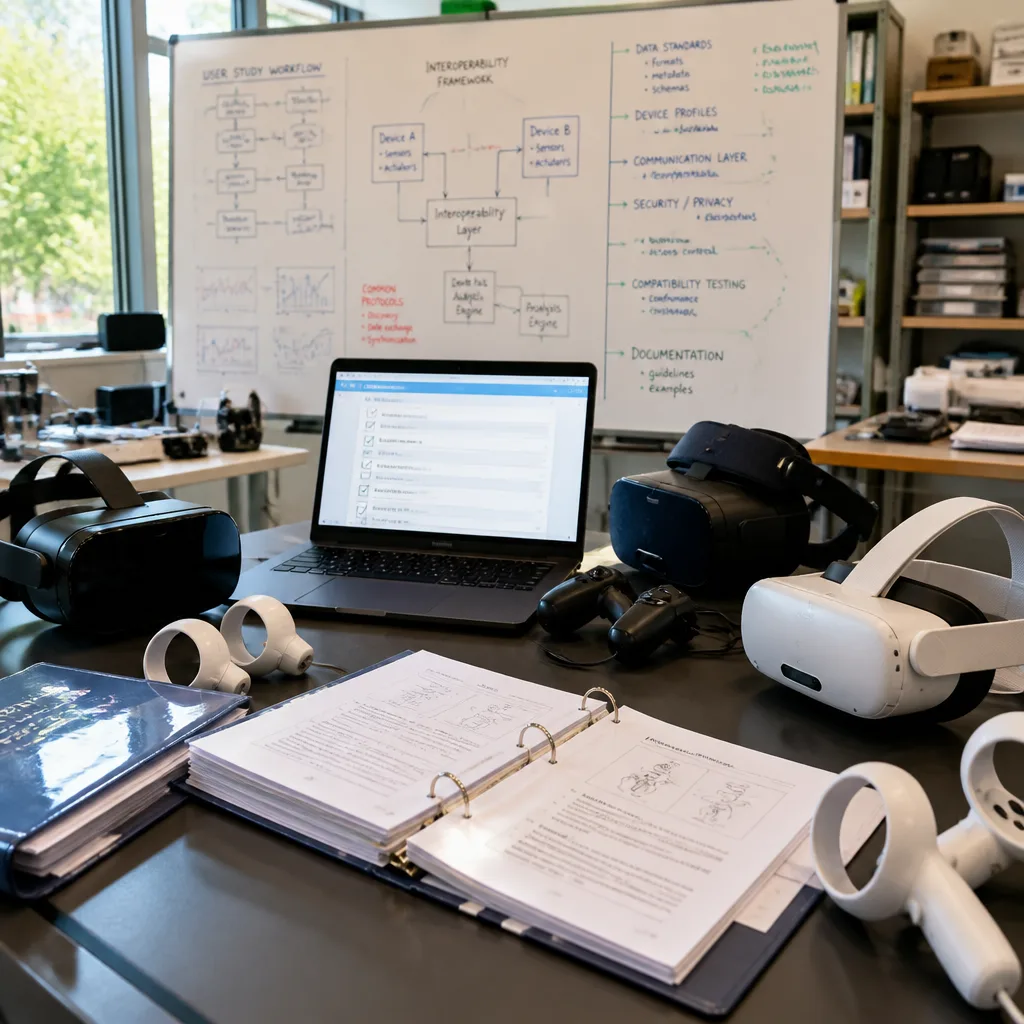
- Interoperability — preventing studies from becoming locked to a single make of hardware or a proprietary software stack.
- Procedural standardisation — ensuring that briefing, measures and participant interactions are consistent between labs.
- Ethics and accessibility — embedding shared approaches to participant welfare and inclusive design.
The authors call for common engines, open standards and clear licensing so that simulations can be transferred between teams and remain usable as platforms evolve. They also recommend adopting standard measures — the checklist explicitly cites measures such as VR presence — and shared reporting practices so results can be compared and replicated.
Practical tools and consequences
At its heart, the initiative is pragmatic: an interactive protocol that can be updated as the technology and consensus move forward. If adopted widely, these measures would reduce the need for laboratories to rebuild experiments from scratch when platforms or devices change, and would make peer review and meta-analysis of VR studies more straightforward.
| Issue | Recommended focus |
|---|---|
| Interoperability | Open engines, standard file formats, licensing clarity |
| Procedural standardisation | Shared briefing scripts, common measures (eg, VR presence) |
| Ethics & accessibility | Inclusive design and unified ethical guidance |
Adoption of these protocols would also change how journals and reviewers evaluate VR work; a uniform checklist provides a transparent yardstick against which methods can be assessed. The Openverse authors frame the move as enabling reviewers, editors and researchers to speak the same methodological language — a step that, they argue, is essential for VR to deliver on its promise for behavioural science.
For practitioners across the UK and internationally, the paper offers both a caution and a route forward: VR's experimental power is real, but realising it at scale requires open practices, shared metrics and attention to accessibility. The checkpoint-style resources at vrprotocols.org aim to give researchers a living instrument to keep pace with rapid technological change without sacrificing rigour.
As VR becomes more common in labs and classrooms, the extent to which the field embraces interoperable tools and agreed protocols will determine whether it becomes a reproducible research platform or a patchwork of incompatible methods.