
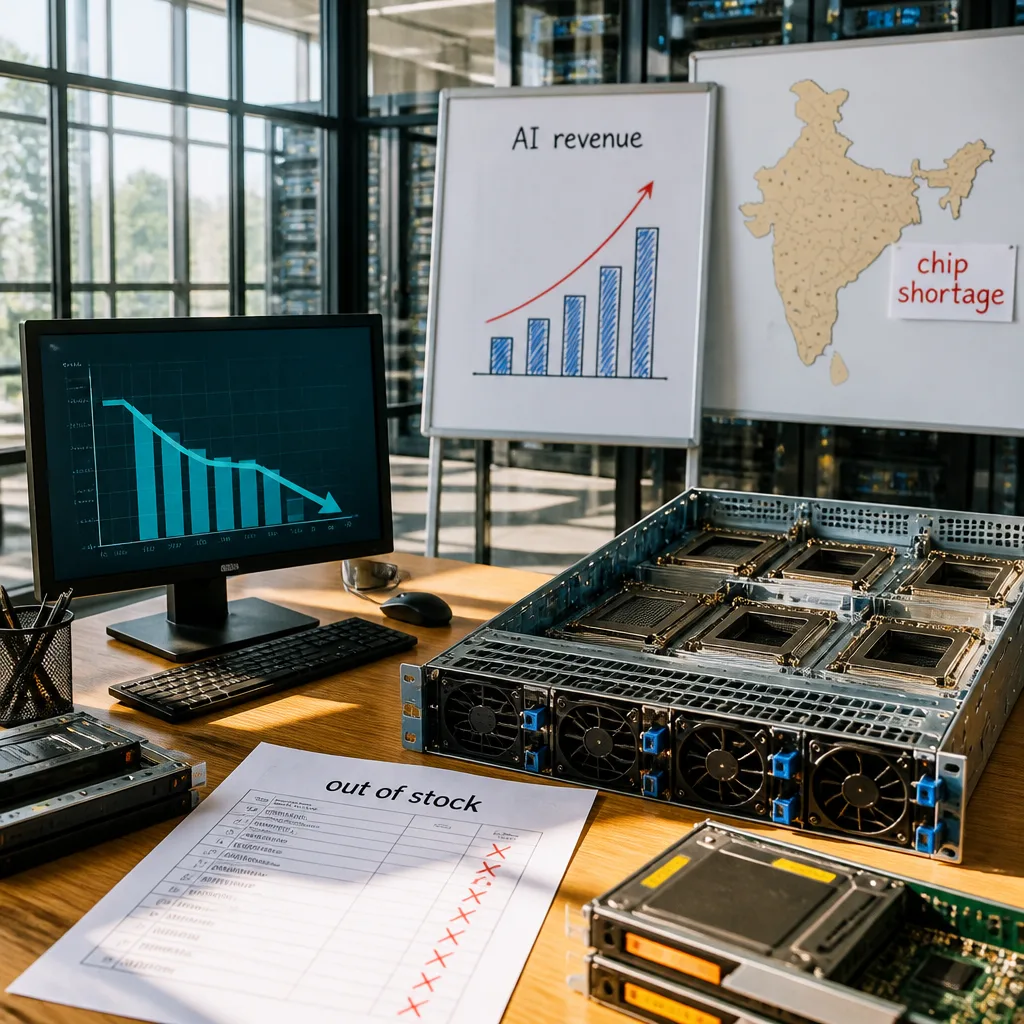
For the first time in two years of exuberant promises, this earnings season is surfacing recognised AI revenue on company ledgers rather than pipeline hype. At the same time, the competitive narrative in artificial intelligence is shifting from building ever-bigger models to delivering more capability per pound of compute. And in India—the world’s largest talent pool for developers—an intensifying chip shortage is testing ambitions for AI sovereignty.
AI finally shows up in the numbers
Tech strategist Dan Ives told CNBC’s Fast Money that major players are now reporting tangible income tied to AI products. That matters: enterprise buyers who delayed multi‑year platform bets while waiting for proof of value are being presented with exactly that—booked revenue—not just forward-looking claims. The result is a subtle but material change in risk calculus for CIOs and boards that have treated AI spend as an experiment rather than a core line item.
From size obsession to efficiency contest
CNBC reporting this week underscores a pivot away from headline‑grabbing parameter counts towards models and systems tuned for cost per inference. In plain terms, the economic metric that counts is no longer how gargantuan a model is, but how cheaply and reliably it can answer queries at scale. That reframes total cost of ownership for deployments and, crucially, rebalances negotiating power.
- Procurement leverage: Buyers locked into pricing models built for yesterday’s compute‑heavy architectures can press for terms that reflect today’s efficiency gains.
- Contract renewal checks: Vendor roadmaps should be interrogated for alignment with the efficiency trajectory—not just raw scale.
- RFP redesign: Criteria should foreground per‑request cost, throughput under constraint, and energy profile, alongside accuracy.
| Dimension | Previous cycle | Current cycle |
|---|---|---|
| Competitive focus | Model size & parameters | Cost per inference & efficiency |
| Buyer metric | Peak benchmarks | TCO at production scale |
| Contract posture | Vendor‑led pricing | Buyer leverage to reprice |
The structural driver is straightforward: training and operating massive models has run into practical cost ceilings across many commercial use cases. Vendors are now competing on how much useful capability they can deliver per unit of compute, rather than sheer scale. For enterprises, this accelerates a move towards techniques like model compression, retrieval‑augmented generation, and workload‑specific architectures that squeeze more from the same hardware budgets.
India’s AI trilemma: talent rich, infrastructure poor
Bloomberg’s Emerging series, hosted by Menaka Doshi, examined India’s constrained position in the global AI supply chain. Despite abundant engineering talent and strong demand signals, a lack of domestic access to advanced chips and supporting infrastructure is hobbling efforts to achieve AI sovereignty. With accelerators in short supply, India faces hard choices: rely on foreign cloud and hardware ecosystems, or marshal significant capital and policy support to build capacity—both scenarios with strategic trade‑offs.
That supply‑side pinch reverberates beyond India. It concentrates bargaining power with a handful of chipmakers and hyperscalers, shapes where AI workloads can be hosted, and influences pricing globally. For multinational enterprises, especially those with large engineering teams in India, constraints on accelerator access translate into schedule risk, higher cloud dependence, and hurdles to on‑premises or sovereign deployment strategies.
Why this inflection matters for UK enterprises
For British organisations weighing AI rollouts, the dual shift—proven revenue cases and an efficiency race—changes both timing and tactics:
- Commercial validation: Recognised AI revenue in vendor reports supports business cases for moving pilots into production, provided unit economics are clear.
- Pricing dynamics: As competition centres on per‑query cost, expect renewed room to renegotiate usage tiers, burst pricing, and minimums.
- Vendor diligence: Prioritise suppliers whose roadmaps explicitly target lower inference costs and energy draw, not only larger models.
- Supply risk: Chip scarcity in major engineering hubs like India raises delivery risk and may warrant dual‑sourcing models and regions.
The takeaway is pragmatic: AI is moving from promise to P&L, but the winners will be those who can deliver reliable performance at the lowest marginal cost—and do so despite uneven access to compute. Procurement teams should refresh benchmarks, demand transparent per‑inference pricing, and require evidence that vendor architectures track the efficiency curve, not just the scale curve. Meanwhile, policymakers—and boardrooms with large India footprints—must factor chip availability into any talk of sovereignty or on‑shore control of critical AI workloads.