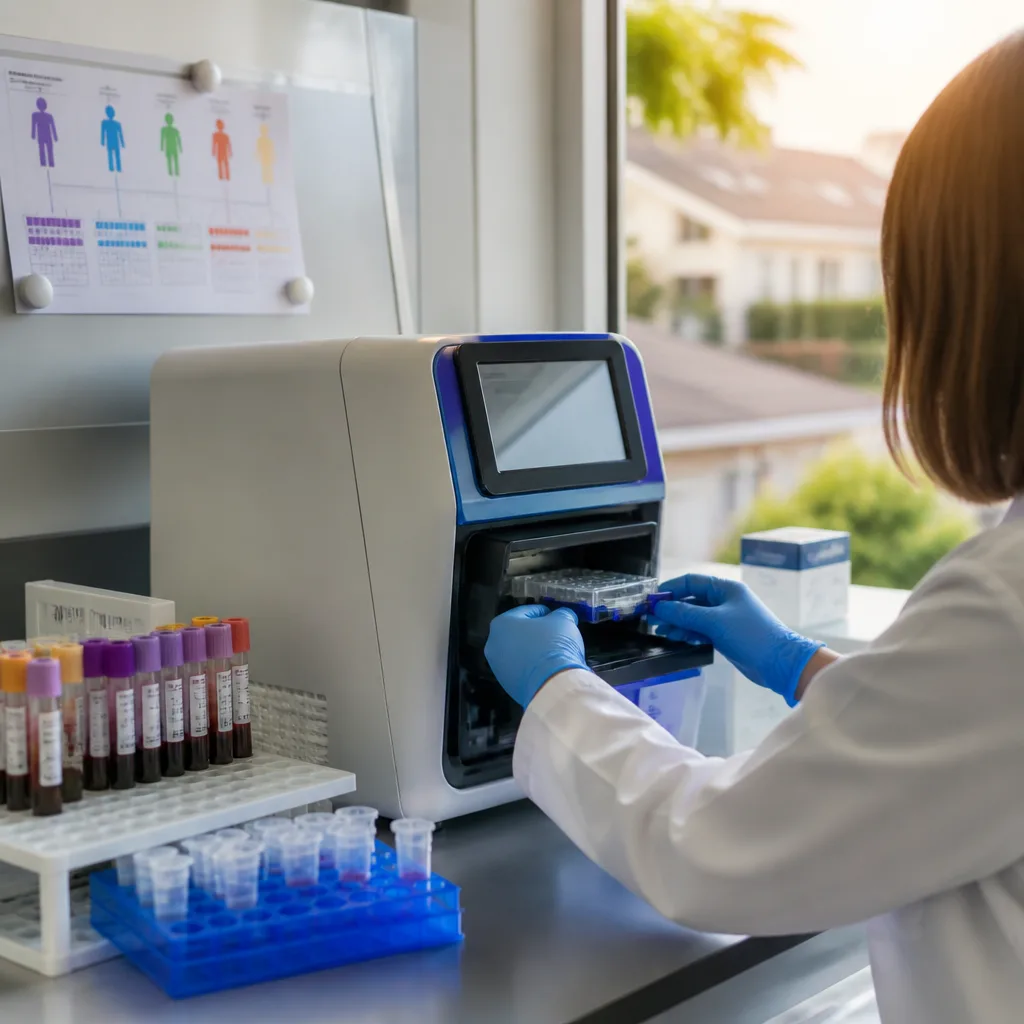
Emerging laboratory technologies may soon allow ultra-sensitive detection of cancer’s minimal residual disease (MRD) using much smaller, cheaper equipment, according to a summary shared by a senior AstraZeneca scientist. If the claimed performance gains hold up, community oncology centres could run tests that today require large centralised sequencers and specialist facilities.
What was reported
James Hadfield, who leads ctDNA and epigenomics translational work at AstraZeneca, published a post outlining several advances he says could “fundamentally democratise MRD testing.” The technologies he highlights aim to reduce sequencing depth, shorten turnaround times for personalised panels, preserve methylation signals without destructive chemistry and dramatically increase the amount of circulating tumour DNA (ctDNA) recovered from a routine blood draw.
“What if ultra-sensitive cancer detection no longer needed a room-sized sequencer?”
The specific innovations and their claimed benefits
- Biofidelity Enspyre — presented at AACR 2026; reported to cut sequencing requirements by roughly 98%, potentially enabling use of benchtop sequencers such as a NextSeq-class instrument.
- Twist Bioscience MRD Express — a workflow promising a 24‑hour personalised panel turnaround, narrowing the time gap between tumour-informed and tumour-naive test approaches.
- Syndex Bio — a methylation-preserving PCR technique that avoids bisulfite conversion, the step criticised as destructive to DNA and a bottleneck for methylation-based assays.
- Amplifyer Bio — an engineered in vivo priming agent that the post says can deliver up to a 100‑fold increase in ctDNA recovery from a standard blood draw.
Why this matters for patients and services
MRD assays aim to detect tiny amounts of tumour-derived DNA left after treatment, helping clinicians identify relapse earlier or confirm remission. Currently, ultra-sensitive MRD testing is typically concentrated in specialist centres because of the high sequencing depth and complex sample processing required. The combination of lower sequencing needs, faster personalised panel creation and higher ctDNA yield could change that equation: tests become cheaper, faster and feasible on smaller sequencers found in many hospital molecular pathology laboratories.
Open questions and practical considerations
Hadfield frames one critical unknown: whether stacking these technologies produces simply additive improvements or a truly multiplicative leap in sensitivity. That distinction matters for how dramatically clinical practice might change. Even if individual components deliver the reported gains, integration into robust diagnostic workflows will require regulatory review, clinical validation across diverse patient cohorts and adaptation of laboratory quality controls.
| Technology | Reported benefit |
|---|---|
| Biofidelity Enspyre | ~98% reduction in sequencing needs |
| Twist MRD Express | 24‑hour personalised panel turnaround |
| Syndex Bio | Methylation‑preserving PCR (no bisulfite) |
| Amplifyer Bio | Up to 100× increase in ctDNA recovery |
These technologies could be compared to contrast agents in imaging: a reagent that boosts signal so that standard instruments reveal details previously hidden. The analogy used in the post emphasises that improvements at the sample-preparation and capture stage can be as transformative as advances in sequencing hardware.
For the UK health system and similar national services, the promise is twofold: faster results for clinicians and patients, and less reliance on centralised sequencing hubs. But moving from promising laboratory reports to routine clinical use will require transparent datasets, peer-reviewed clinical studies and a clear pathway through regulatory and reimbursement frameworks.