Reinforcement learning trailblazer breaks new ground
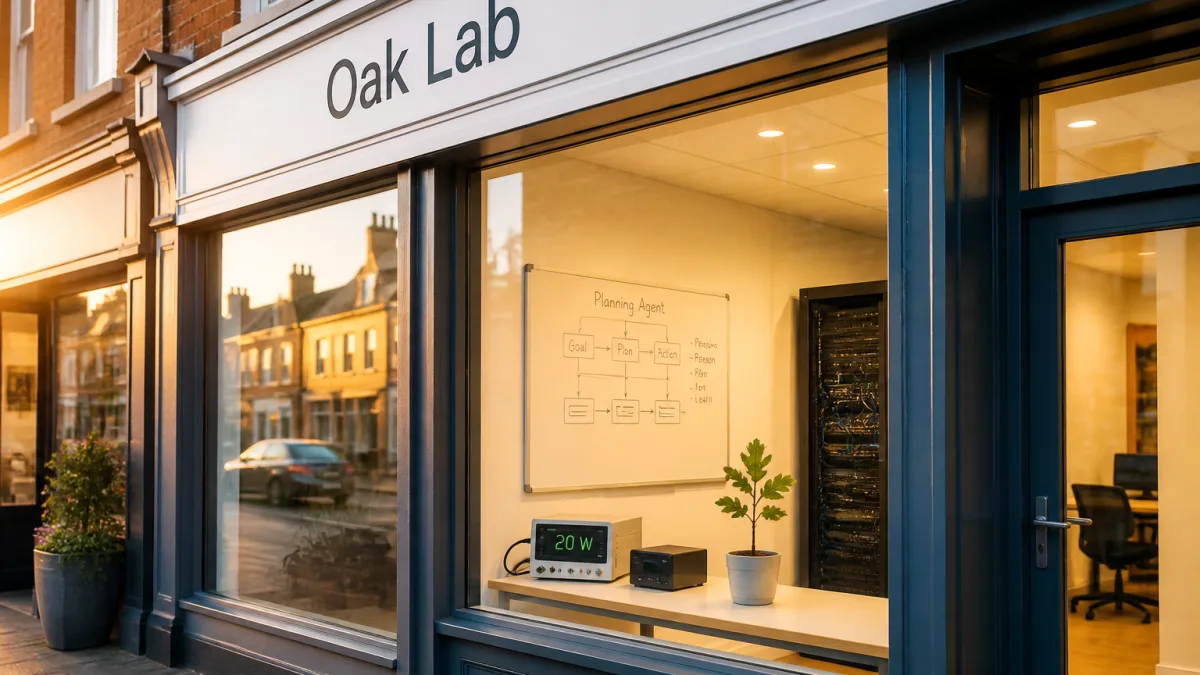
Richard Sutton, a central architect of modern reinforcement learning and recipient of the 2024 Turing Award, has left Keen Technologies to establish a new venture, Oak Lab, alongside long‑time collaborator Khurram Javed. The move signals a decisive bet on a different path to general‑purpose AI: systems that learn and plan on the fly while consuming roughly the power of a human brain.
At 69, it’s the perfect age to create!
Sutton is widely credited with foundational contributions that underpinned contemporary advances in machine learning. His work on temporal‑difference methods and co‑authoring the textbook Reinforcement Learning: An Introduction helped set the field’s direction over four decades. He has served at GTE Labs and AT&T Labs, and since 2003 has been a full‑time professor at the University of Alberta, where he founded the Reinforcement Learning and Artificial Intelligence Laboratory. From 2017 to 2023, he was a Distinguished Research Scientist at DeepMind, helping establish the DeepMind Edmonton research team.
Why the split — and what changes
In announcing the break from Keen Technologies, founded by John Carmack, Sutton argued that prevailing deep learning practices are inefficient and unlikely to yield the next leap toward general intelligence through incremental scaling alone. Instead, he is calling for new foundations and a redesign of how intelligent agents learn and plan.
Oak Lab’s headline ambition is stark: build an agent with around one trillion parameters capable of real‑time learning and planning at a power budget of 20 watts. That target mirrors estimated energy use for the human brain. It stands in contrast to an industry trend focused on ever‑larger GPU clusters and expanding data centres.
A different benchmark: power, not just scale
The centrepiece of Oak Lab’s pitch is that efficiency must be treated as a first‑class constraint. Rather than relying on more compute and data alone, Sutton’s approach prioritises learning mechanisms that adapt continuously and plan effectively within tight power limits. In practical terms, that would mean systems capable of changing behaviour during deployment without retraining cycles that demand vast server resources.
- Target capability: real‑time learning and planning
- Model scope: approximately one trillion parameters
- Power envelope: about 20 watts
Career lineage and mentorship
Over four decades, Sutton has supervised and mentored a generation of researchers who have since led high‑profile AI efforts. Among them are David Silver (lead designer behind AlphaGo), Doina Precup (head of DeepMind Montreal), and Michael Bowling, a prominent figure in game AI research. Co‑founder Khurram Javed is part of that lineage, now joining him to build the new venture.
| Role | Organisation | Period/Note |
|---|---|---|
| Professor; RLAI founder | University of Alberta | Since 2003 |
| Distinguished Research Scientist | DeepMind | 2017–2023; helped start Edmonton team |
| Industry research | GTE Labs; AT&T Labs | Early career |
| Turing Award recipient | — | 2024 |
What this signals for the next AI phase
Sutton’s critique of current deep learning is not new, but Oak Lab frames it with an engineering target that is easy to measure: useful intelligence at brain‑like power. If realised, that would mark a shift from centralised training regimes to agents that make and refine decisions continuously in their operating environment. It would also raise questions about hardware design, given the emphasis on low‑power operation rather than peak throughput.
For a field accustomed to benchmarking progress by parameter counts and training FLOPs, the proposition reorders priorities. Sutton’s emphasis on planning and learning in real time suggests renewed attention to algorithms inspired by reinforcement learning’s roots, while challenging the assumption that bigger datasets and larger compute budgets are the only reliable path forward.
Setting expectations
Specific timelines, product milestones and funding details were not disclosed in the announcement. What is clear is the research direction: challenge the energy and efficiency profile of today’s systems and attempt to deliver comparable, perhaps superior, capability within a 20‑watt ceiling. In a sector dominated by expensive infrastructure, the effort will be closely watched for signs that an alternative approach can scale in practice.