Thousands of young demonstrators who gathered in New Delhi earlier this month to protest an alleged examination leak have expanded their target beyond ministers and police to include India’s mainstream television networks, accusing them of distortion and complicity with the state.
What happened
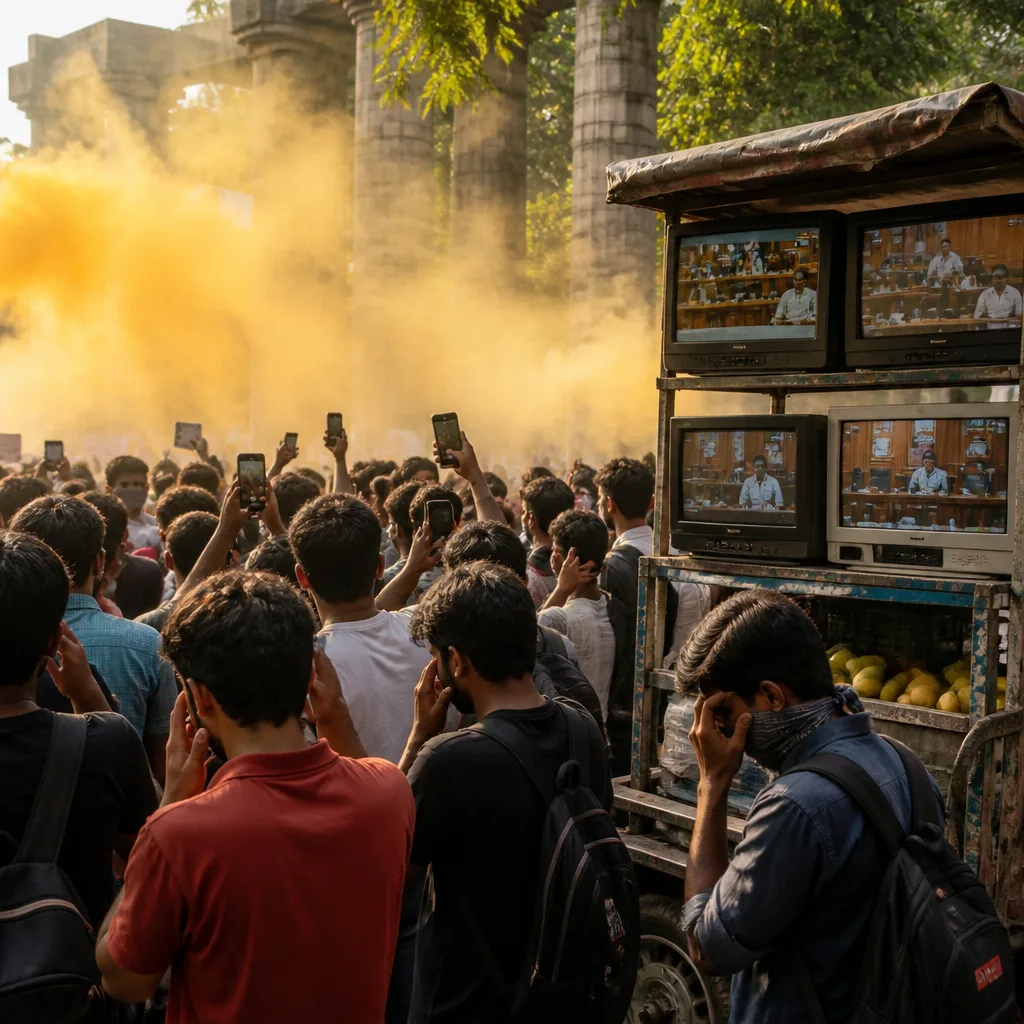
At Jantar Mantar — the capital’s long‑established protest site — Gen Z activists staged large demonstrations, chanting for accountability and demanding the resignation of the education minister, Dharmendra Pradhan, over the leaked exam paper. The protests escalated when law enforcement used teargas, pellet guns and batons to disperse crowds.
“The police beat us so badly. Some had blood flowing down their skulls and the
For those who were not present, social media footage presented a starkly different picture from what appeared on television screens. Protesters derided prime‑time channels as “godi” media — a Hindi term that translates roughly as ‘lapdog’ — and many reporters working for mainstream outlets were heckled, chased off or physically attacked at the demonstrations.
Why the media became a target
The confrontation reflected a widening gap between the lived experience of protesters and the narratives relayed by several television channels. Where on‑the‑ground participants reported heavy-handed policing, some televised coverage either downplayed the scale of unrest or emphasised orderly elements, prompting accusations that broadcast media were misrepresenting events to suit political narratives.
- Protesters: Young people mobilised around the examination leak and broader grievances, using social platforms to amplify live images.
- Mainstream TV: Experienced intense pushback for allegedly sanitising or reframing what was happening on the streets.
- Police and authorities: Deployed teargas, pellet guns and batons; their tactics became central to the dispute over what actually transpired.
Context and consequences
The episode illustrates two broader trends. First, a digitally fluent generation is increasingly able to bypass traditional gatekeepers, using smartphones and online networks to document events in real time and to challenge official or editorial accounts. Second, the clash points to rising distrust of established broadcasters among younger audiences who believe television can be co‑opted by political power.
For British readers, the significance is twofold. Democracies worldwide are grappling with the same dynamics: a shrinking trust in legacy media, the weaponisation of television narratives, and younger citizens turning to alternative channels for information and mobilisation. How governments, broadcasters and civil society respond to those pressures will shape public debate and trust in institutions across democracies.
| Actor | Role in events |
|---|---|
| Gen Z protesters | Mobilised protests, recorded events, challenged media narratives |
| Mainstream television | Accused of downplaying or reframing the demonstrations |
| Police | Used teargas, pellet guns and batons to disperse crowds |
The friction between street reporting and prime‑time coverage will likely intensify unless broadcasters and regulators reckon with declining credibility among younger viewers. For journalists, the episode is a reminder that absence or distortion on mainstream platforms can be swiftly exposed by citizen footage — with significant political ramifications.
As protests continue to influence public discussion in India, the struggle over who sets the narrative — television editors or smartphone‑armed demonstrators — will remain a central theatre in which the country’s future media ecosystem is contested.