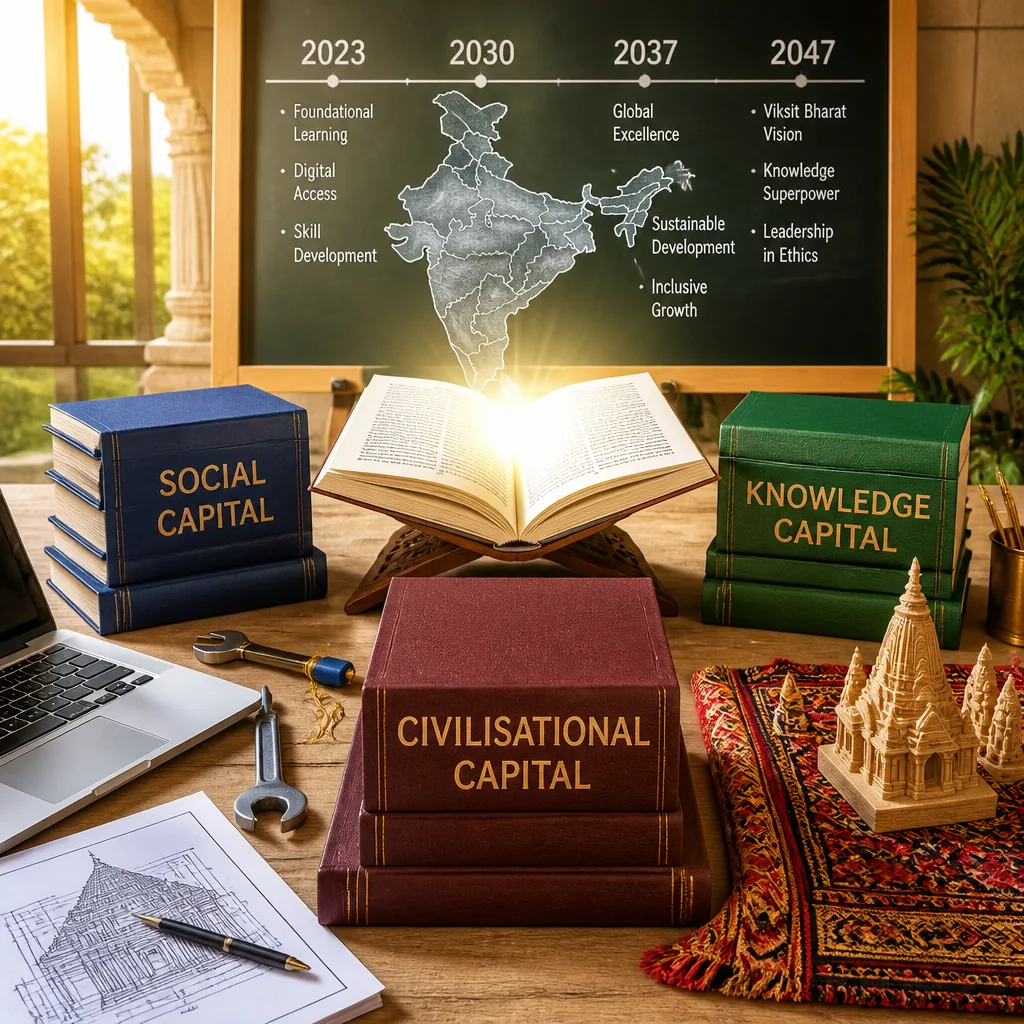
The strength of a future "Viksit Bharat" rests not only on economic expansion but on the development of three intertwined forms of national capacity, according to an analysis of education’s role in long‑term development. The piece identifies Social Capital, Knowledge Capital and Civilisational Capital as the foundations that education must cultivate if India is to meet its stated aim of becoming a developed nation by 2047.
What the three capitals mean
The commentary sets out distinct but overlapping roles for each capital:
- Social Capital: collective responsibility, trust, cooperation and citizen participation that enable societies to progress together.
- Knowledge Capital: the capacity to generate, preserve, disseminate and apply new ideas for national development.
- Civilisational Capital: traditions, value systems and cultural self‑confidence that foster social cohesion and ethical continuity while modernising.
These categories are presented as outcomes that educational institutions can and should actively produce, rather than incidental by‑products of growth in GDP or infrastructure.
Implications for education policy and the labour market
The analysis highlights a central tension for policymakers: India’s demographic dividend will not automatically translate into national development. Without a "strategic link" between education and employability, a large youth cohort risks becoming a developmental liability. Education is positioned as the mechanism that turns population potential into productive human capital by equipping young people with skills, creativity and civic confidence.
That argument reframes familiar policy debates about growth and infrastructure by placing equal weight on human, cultural and intellectual development. It also points to the role of indigenous knowledge systems — described as Bharatiya traditional knowledge — in nurturing long‑term capabilities needed for Atmanirbhar (self‑reliant) development.
Consequences and next steps
Framing education around these three capitals has several practical consequences for planners and educators:
- Curriculum design will need to balance technical and vocational skills with citizenship education and cultural literacy.
- Assessment of national progress should include measures of social trust, knowledge diffusion and cultural resilience as well as GDP.
- Policies aimed at employment must be integrated with education reform to ensure young people gain jobs that make use of their capabilities.
| Capital | Primary focus |
|---|---|
| Social | Trust, cooperation, civic participation |
| Knowledge | Innovation, preservation and dissemination of ideas |
| Civilisational | Values, traditions and cultural continuity |
The analysis does not prescribe specific reforms but emphasises that national development indicators — manufacturing output, digital infrastructure or military capability — are ultimately outcomes of deeper educational and cultural processes. For parents, students and educators the message is clear: investments in learning that build ethical agency, technical skill and cultural confidence are central to achieving the broader national ambitions set for 2047.