
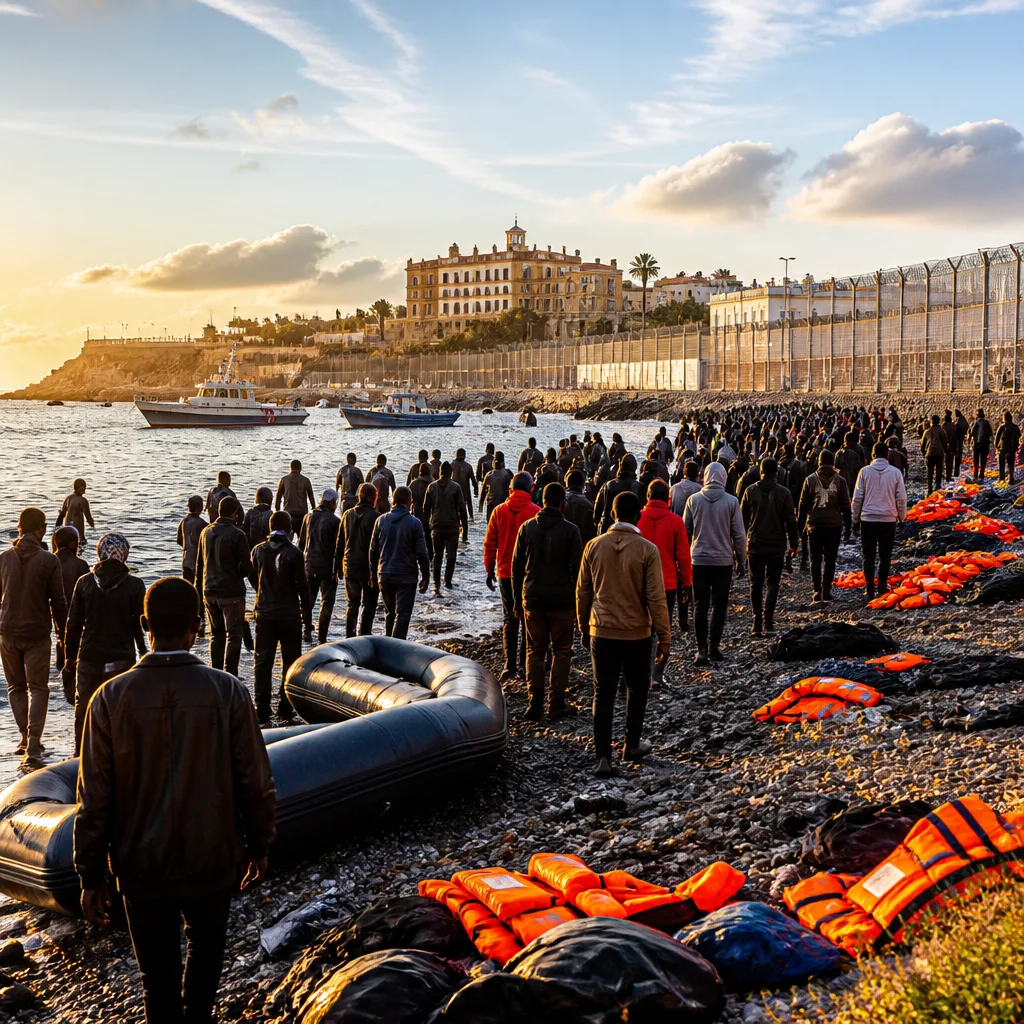
Roughly 60,000 people entered Spain’s north African enclave of Ceuta from Morocco in a mass movement that Spanish and EU leaders described as a serious challenge to border control and public order. The influx has prompted urgent diplomatic contact, including between the UK and Madrid, and raised questions about how authorities will process asylum claims and secure the external border of the European Union.
How officials are reacting
Spain’s prime minister characterised the arrivals as an assault on the country’s territorial integrity and pledged to mobilise “all the resources of the state” to restore security and coexistence. European Commission president Ursula von der Leyen urged rapid returns to Morocco, while international partners — including the UK — have sought clarity on the situation and offered support.
“An attack on Spain’s territorial integrity,”
The UK prime minister said the chaotic scenes along Ceuta’s shores were a “cause for concern” and that London had contacted Spanish authorities to understand the implications and to provide assistance. Finland’s foreign minister stressed the need for swift returns, saying that, with EU backing, Spain must protect the union’s external border.
Practical and legal challenges
Ceuta shares a land frontier with Morocco but is separated from mainland Spain by the Strait of Gibraltar. Although it is Spanish territory, Ceuta sits outside the normal Schengen arrangements, meaning people arriving there do not automatically gain free movement into the rest of Europe; they would face additional border checks before travelling onward.
Under ordinary circumstances, people who claim asylum in Ceuta should have their claims examined. Officials have warned, however, that the arrival of such a large number at once could overwhelm local capacity to register and process applications. It remains unclear whether Spanish authorities will attempt to process asylum claims on site or pursue returns to Morocco without full asylum procedures.
Numbers and immediate developments
- Approximate arrivals: 60,000 people entered Ceuta in the influx.
- Voluntary returns: Local officials reported more than 25,000 people had returned to Morocco voluntarily by Friday afternoon.
- Diplomatic actions: EU and individual member states have pressed for swift returns and closer cooperation with Morocco; the UK has contacted Madrid to offer support.
| Actor | Position / Action |
|---|---|
| Spain (Prime Minister) | Described influx as attack on territorial integrity; vowed to use state resources to guarantee security |
| European Commission (President) | Called for swift returns and relied on partnership with Morocco to deliver results |
| UK (Prime Minister) | Expressed concern; contacted Madrid to understand implications and offer support |
What this means for the UK and Europe
The episode underlines the fragility of external borders in a region where territory, migration routes and diplomatic relations intersect. For the UK, the immediate step was to seek information from Spanish authorities and to indicate readiness to assist — the wider implications will depend on how Spain and its EU partners manage returns, process asylum applications and coordinate with Morocco.
If authorities pursue large-scale returns to Morocco, the action will hinge on bilateral cooperation. If asylum processing is prioritised, agencies face the practical challenge of registering and assessing thousands of claims simultaneously. Either pathway will have political consequences across Europe as governments balance border security, legal obligations and humanitarian considerations.
The situation in Ceuta remains fluid. Authorities’ next steps — whether mass returns, staggered processing of claims or additional security measures — will determine how the crisis evolves and how much immediate impact it has beyond the enclave’s borders.