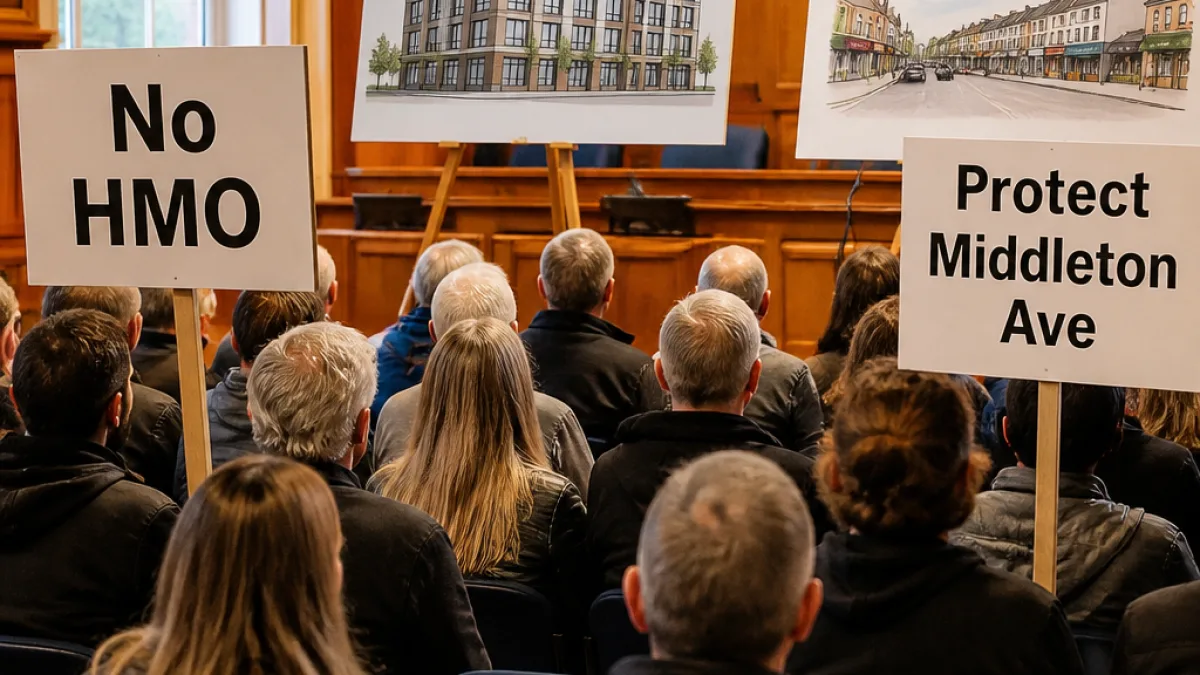
Derby City councillors have refused an application to convert a site on Middleton Avenue in Littleover into a three‑storey house of multiple occupation (HMO) after a heated public meeting on 16 July which saw loud support for opponents in the council chamber.
What was proposed
The original planning submission envisaged a large shared housing block containing 17 bedrooms and accommodation for 23 people. The developer later submitted revised drawings reducing the proposed occupancy to 21 people but keeping the 17-bedroom layout. Planning officers advised councillors that the amended scheme would provide additional residential accommodation and described it as an "acceptable form of sustainable development" whose benefits would outweigh any adverse impacts.
| Original proposal | Revised proposal | |
|---|---|---|
| Bedrooms | 17 | 17 |
| Occupants | 23 | 21 |
Residents and councillors raise quality concerns
Despite officers' recommendation to approve, a large number of local people attended the meeting and spoke against the scheme. Concerns focussed on the scale of the building in a residential street close to the local shopping precinct, the internal size of rooms and whether the unit would provide an acceptable standard of living for future occupiers.
- Opponents said the development represented an overintensive use of the site and that the changes did not address the core issues raised when the application was deferred the previous year.
- Speakers argued that dividing the property into a single shared unit across all floors — rather than smaller self‑contained units — would increase pressures on local services and on parking and change the area’s character.
- The council chamber erupted into applause and calls to "turn it down" as residents made their cases to the committee.
"A new set of plans [have been made] which can be best described as the same but different," said local resident Nick Bush, who described the scheme as a "massive overdevelopment" for the area.
Decision and likely consequences
Councillors voted to refuse the application. The rejection underscores tensions between the council’s stated need to deliver more housing and neighbourhood concerns about the suitability and scale of some developments. The decision will be seen by some as a victory for local campaigners who argued the amended plans failed to resolve previously identified problems with room sizes and massing.
Planning officers had argued the scheme would deliver much‑needed accommodation within Derby and that its benefits outweighed the negative impacts. With the refusal now recorded, developers may consider whether to submit further amendments to address the panel’s concerns, or whether to pursue an appeal against the decision.
The outcome is likely to prompt renewed debate in Littleover and across Derby about how the city balances housing supply targets with neighbourhood character, amenity and standards for shared living accommodation.