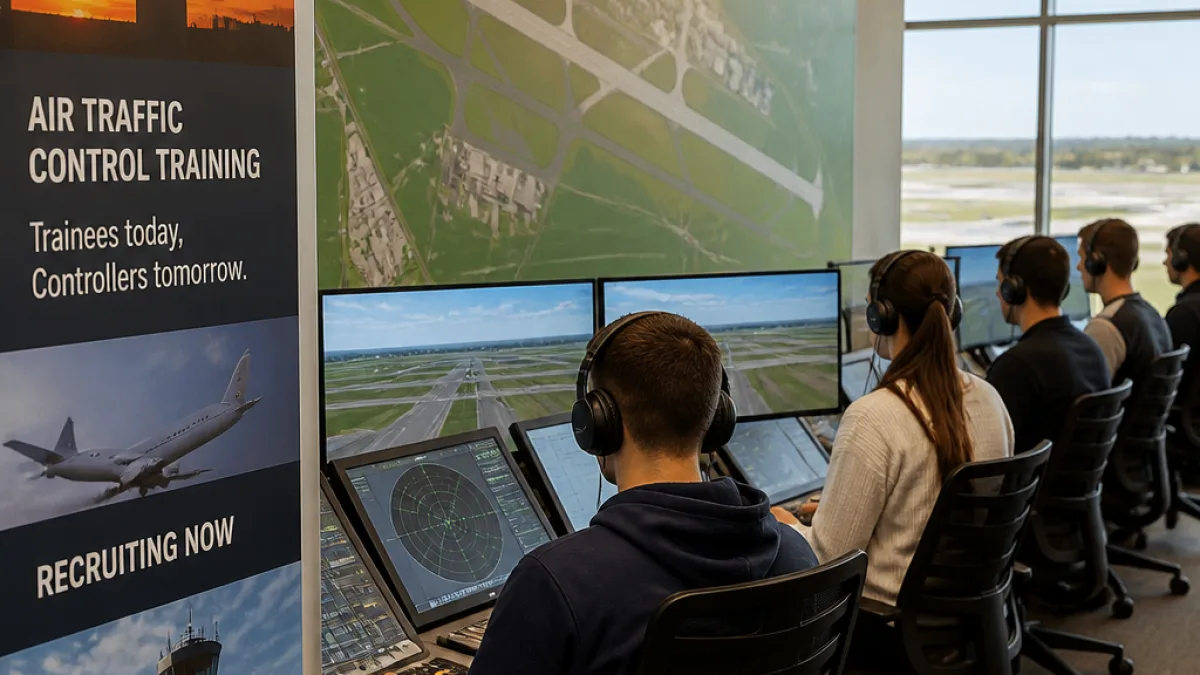
Doncaster Sheffield Airport has taken a visible step towards reopening by installing a state-of-the-art air traffic control simulator to support training for new staff. The move forms part of a recruitment drive as the airport prepares for freight operations in 2027 and passenger services the year after.
Recruitment and training: numbers and roles
More than 20 people have so far been recruited into air traffic control and related services, with seven vacancies still advertised. Nine of the recruits are currently in training, working to achieve both tower and radar qualifications so they can manage flights both on the ground and in the air.
| Area | Number |
|---|---|
| Recruited to air traffic and services roles | 20+ |
| Current vacancies | 7 |
| Undergoing training | 9 |
What the simulator does
The simulator provides an immersive training environment, combining 3D visual scenes with radar displays so trainees can practise realistic scenarios. Airport managers say having both tower and radar training available on site will allow staff to develop skills across both disciplines — an approach they describe as offering improved career progression.
- Immersive simulated environment with 3D visuals
- Radar displays for real-time procedural practice
- Training aimed at dual tower and radar qualifications
"Because both tower and radar operations will be based on site, our people can develop their skills across both disciplines," said Andy Hudson, Head of Air Traffic Services at DSA.
Airport executives say each new appointment and technological investment brings the site closer to reopening. Simon Hinchley, DSA's Executive Director Airport Operations, described the mix of experienced staff and trainees coupled with new training tools as building confidence in the airport’s readiness to return to commercial flights.
Phased reopening and local implications
DSA plans a phased return: freight flights in 2027 followed by passenger services in 2028. The recruitment and training push is part of the operational groundwork needed before the Civil Aviation Authority considers the airport's airspace application — a process for which DSA has launched a consultation, with public feedback due from October.
For Doncaster residents this process has two local consequences. First, it signals the growth of skilled jobs in the area as air traffic staff are hired and trained. Second, the airport’s reopening could affect local transport links and the regional economy — though financial uncertainties around the airport remain, and the timeline depends on regulatory clearances and successful recruitment and training outcomes.