A wartime institution that adapted to changing local needs
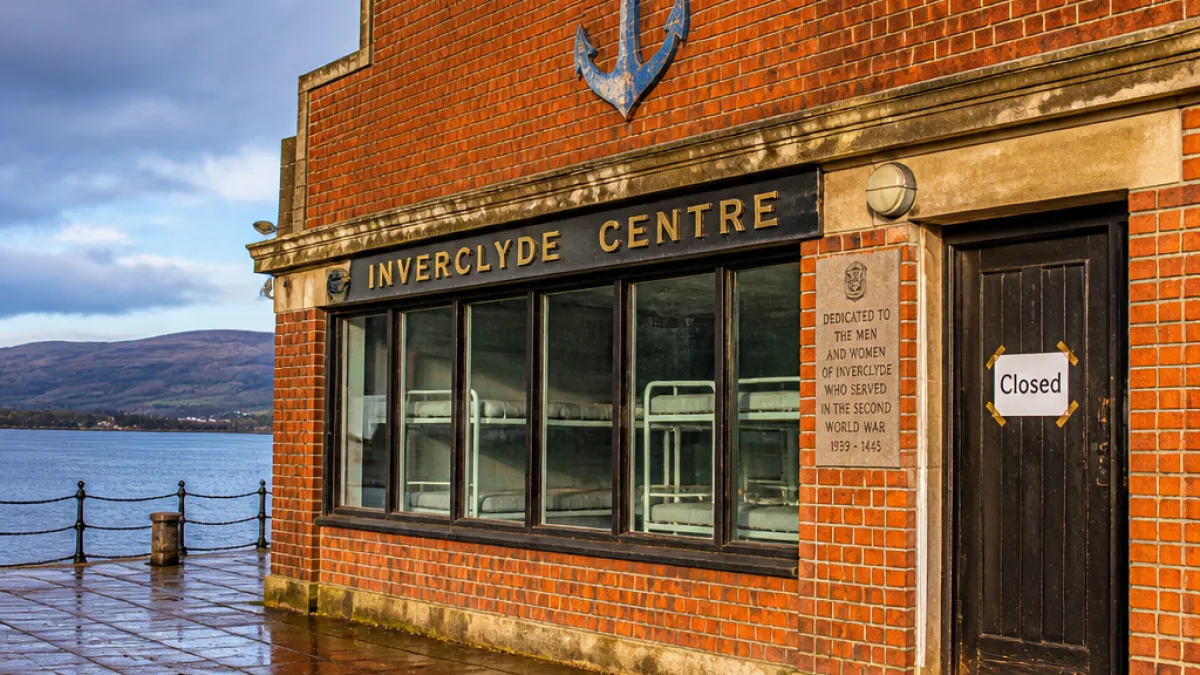
One of Inverclyde’s longest-serving civic institutions, the Inverclyde Centre, has closed after more than 80 years of continuous service, drawing a line under a chapter that began amid the demands of the Second World War and evolved through decades of social change. First opened in March 1944 by Princess Marina, Duchess of Kent, the building started life as the Inverclyde Sailors’ Centre, created to provide accommodation and welfare support for men of the Royal Navy and Merchant Navy.
Backed by the British Sailors’ Society and named in honour of Lord Inverclyde (John Alan Burns, 4th Baron Inverclyde) for his leading role in the project, the centre was financed through a £19,200 fundraising drive towards an overall project cost of around £40,000. Within its first two years it had become a bustling fixture of wartime and post-war life, serving hundreds of thousands who passed through the Clyde.
Scale of early operations
The centre rapidly established itself as a high-capacity welfare hub for seafarers. Contemporary figures reported shortly after the war illustrate the breadth of activity:
| Service (first two years) | Recorded usage |
|---|---|
| Meals served | 500,000+ |
| Hot drinks | 750,000 |
| Sleeping accommodation users | 140,000 |
| Letters received for residents | 15,000+ |
| Telephone calls made from kiosk | 21,000+ |
| Bathing facilities used by visiting sailors | 20,000 |
Although maritime traffic on the Clyde slowed after 1945, the centre continued to serve hundreds of sailors each week. Its operational focus then shifted gradually as the decades progressed, mirroring wider changes in the local economy and public services.
From seafarers to families in need
By the late 1980s, after refurbishment by Inverclyde District Council, the building was converted into self-contained accommodation, providing temporary housing for individuals and families experiencing homelessness. It offered 25 flats of varying sizes and became a familiar point of contact for people in crisis. Its continuing connection to the sea never entirely disappeared: in 1998, for instance, a group of 40 French sailors from patrol vessels L’ Aventure and L’ Agile were welcomed for a dance during a local visit.
The centre’s later configuration settled into a 24-person supported accommodation unit, a model that prioritised on-site support within a single facility. That approach, however, has in recent years been reassessed locally and nationally. The building and the support model it represented were ultimately judged to be outdated and in need of replacement, leading to this week’s closure.
Why the closure matters now
The decision closes a service lineage stretching back to wartime welfare provision, and it raises practical questions for residents about where help will now be found. The centre’s history charts a notable arc in Inverclyde’s story: from hosting crews as the Clyde bustled with naval and merchant shipping, to sheltering local households between tenancies or in the wake of personal upheaval.
While the reasons given for shuttering the building focus on the age of the premises and the suitability of the accommodation model, the immediate concern for the community is continuity of support for those who would previously have turned to the centre. Details of replacement arrangements were not set out in the historical account of the closure, but officials have indicated the model was due for an overhaul. The test in the coming months will be whether updated provision can maintain — or ideally improve — the accessibility, safety and dignity that people expect when they need urgent housing support.
Lives touched over eight decades
Beyond the statistics, the building became the setting for countless personal stories. In 1988, the Harrington family were able to spend Christmas together at the centre rather than facing the streets, a snapshot of the role the facility played at critical moments in people’s lives. Such accounts help explain why its closure resonates widely, even among those who may never have used the service directly.
What we know — and what comes next
Although shipping patterns changed and homelessness services have evolved, the centre’s legacy is substantial. It provided hot meals and safe beds to tens of thousands of sailors in its first years, then, later, a roof and support to households who needed time and stability to move on. As the building closes, attention naturally turns to how Inverclyde will deliver the next phase of support.
- The centre opened in 1944 for seafarers and was named for Lord Inverclyde.
- It transitioned by the late 1980s into temporary accommodation, later becoming a 24-person supported unit.
- The building and its service model were deemed outdated; a replacement approach is anticipated.
For now, the end of the Inverclyde Centre invites a moment of reflection: a modest building that began as a wartime sanctuary evolved into a shelter for local families, sustaining a civic mission that remained remarkably consistent — practical help in difficult times — even as the community’s needs changed.