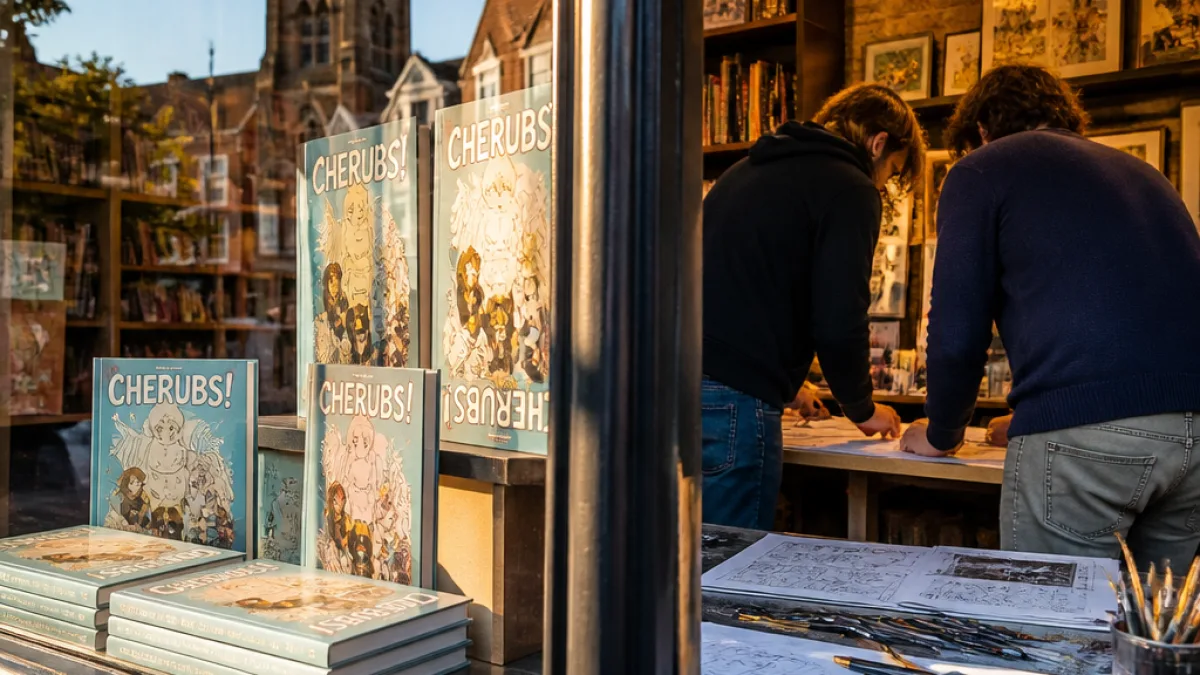
Fans of adult comics and surreal British humour have renewed reason to look again at Cherubs!, the two-part graphic novel that pairs writer-artist Bryan Talbot with cartoonist Mark Stafford. Although best known for his varied single-author projects, Talbot here collaborated with Stafford, whose distinctive cartooning provides much of the title’s energetic visual identity.
Origins and publishing history
Cherubs! was published initially in two instalments, with the first volume released in 2007 and a collected edition appearing in 2015. The book mixes urban fantasy with broad farce and satirical set-pieces, sending its protagonists through a sequence of improbable environments — from Limbo to New York’s supernatural underworld and onward to mythic circles of Hell.
| Element | Detail |
|---|---|
| First part | Cantica I — 2007 |
| Collected edition | 2015 |
| Notable contributors | Bryan Talbot (writer), Mark Stafford (artist) |
Style, tone and influences
The creators and reviewers place Cherubs! at the intersection of irreverent British comedy and American adult animation. That blend underpins the book’s pace and its willingness to shift register—mock-spectacle, musical interlude, and apocalyptic set-piece all appear within the story’s arc. While Talbot is widely praised for his visual invention across varied works, this project foregrounds Stafford’s cartooning as the hand that gives the comedy its tempo and texture.
- Collaboration: Talbot wrote; Stafford supplied the principal art.
- Genre: Urban fantasy with broad comedic influences from British and American traditions.
- Publication: Initial release in 2007; collected edition in 2015.
"Talbot, a creator so quintessentially British, tackled a story so utterly American that it ended up rivalling the best of what American adult animation had to offer at the time."
For readers in Staffordshire interested in contemporary British comics, Cherubs! represents a notable example of cross-cultural pastiche — a homegrown writer exploring a transatlantic idiom in collaboration with a prominent indie cartoonist. The book’s mixture of mythic stakes and bawdy humour may not be to every taste, but it illustrates how British creators continue to experiment with form and tone.
Local comics shops, libraries and arts venues that programme graphic-novel evenings would find Cherubs! a suitable title for discussion: its layered references and tonal shifts encourage close reading and debate about authorial voice, illustration style and the mechanics of genre blending. For readers approaching Talbot’s wider oeuvre, the book also offers a compact demonstration of his willingness to hand creative reins to another artist while retaining a strong authorial imagination.