
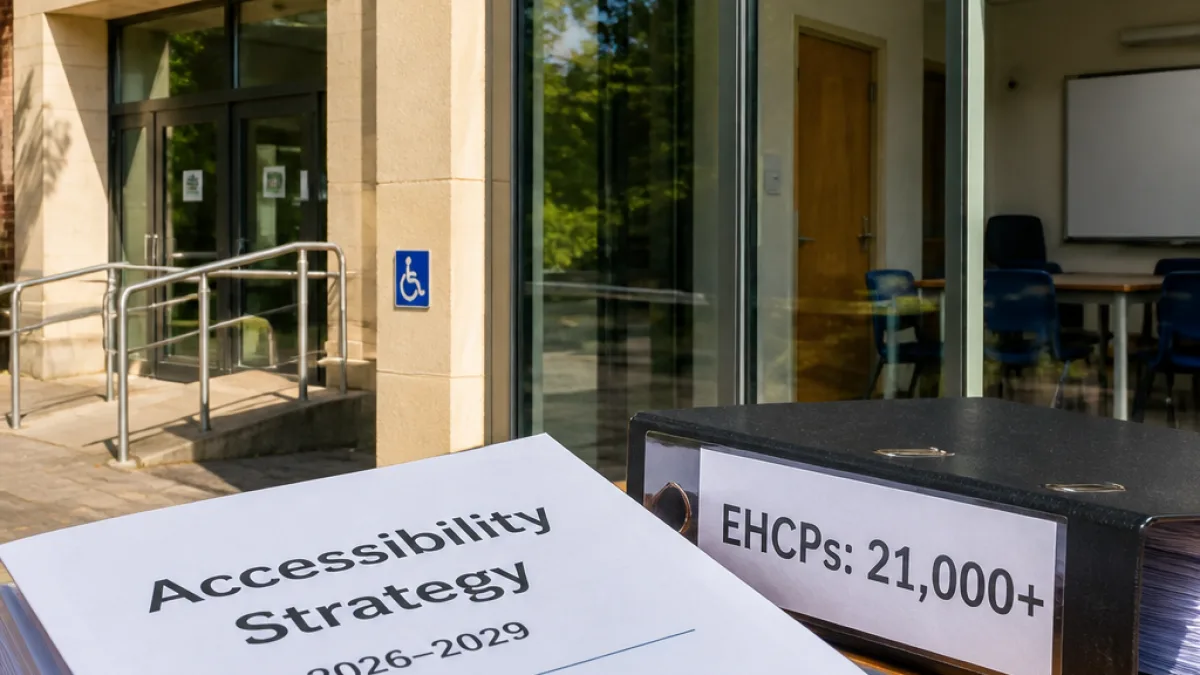
Hampshire County Council has published a statutory accessibility strategy for education settings after discovering it had not fulfilled a legal obligation under the Equality Act 2010. The omission came to light while officials were preparing the authority’s SEND reform plan.
Scale of demand and the gap identified
Council officers say the absence of a published strategy coincided with growing demand for special educational needs and disabilities (SEND) support across the county. There are now more than 21,000 education, health and care plans (EHCPs), representing 7.4% of Hampshire’s school population.
A report to the council’s leadership from director of children’s services Steph How explained that action was taken swiftly to address the shortfall once it was uncovered.
What the new strategy covers
The 25‑page document, approved on 30 July, sets out how the authority intends to improve access across four areas: curriculum and learning, physical environments, information and communication, and fair access through admissions.
“When thinking about accessibility in this context it is a focus on learning and curriculum, access to physical environments, information and communication, and fair and equitable access through the admissions process,”
The comment came from Laura Hamson, county education manager for SEN resources and access, who said the strategy complements wider work to support inclusion rather than operating in isolation.
Consultation and next steps
Before approval, the council consulted with education settings, surveyed children and young people with lived experience of SEND, and considered feedback from parents and carers. The strategy will now be published on the council’s website and applied over the period 2026–2029.
- Over 21,000 EHCPs in Hampshire
- EHCPs account for 7.4% of pupils in the county
- New accessibility strategy covers 2026–2029 and is 25 pages long
| Measure | Figure |
|---|---|
| EHCPs | 21,000+ |
| Proportion of school population | 7.4% |
Roz Chadd, the councillor responsible for children’s services, approved the strategy at a decision‑making meeting on 30 July. The council described the previous absence of a published accessibility policy as an "omission" discovered during internal work on SEND reform.
For families and schools, the publication is intended to provide a clearer framework for ensuring children with SEND have equitable access to education and related services. The council will be expected to monitor progress against the aims set out in the strategy over the coming months and years.