
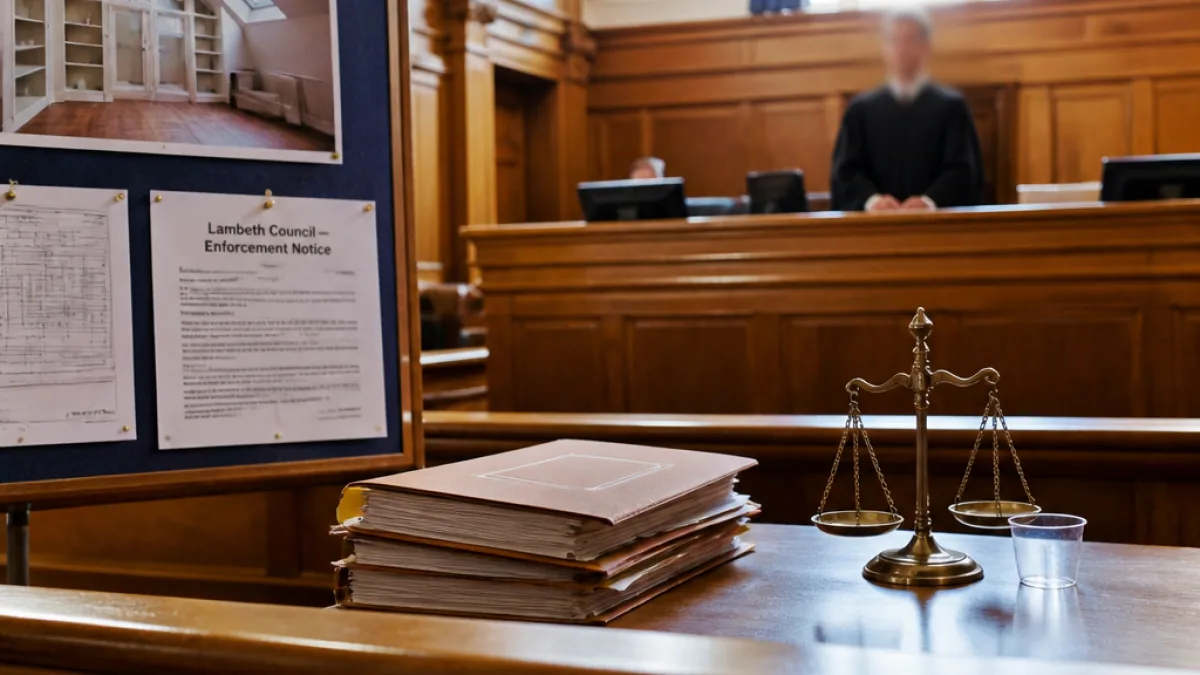
A High Court deputy judge has ordered a fresh determination of an appeal over an enforcement notice issued by Lambeth Council relating to an attic conversion carried out without planning permission.
Background and judgment
The case concerns a woman who became owner of an attic flat as part of a divorce settlement after her ex-husband converted roof space into a separate dwelling. The council issued an enforcement notice requiring the removal of the extension and reinstatement of the original roof arrangement after refusing retrospective planning applications and a subsequent certificate of lawful use.
Jonathan Moffett KC, sitting as a deputy High Court judge, found in favour of the appellant on two legal grounds and allowed her appeal under section 289 of the Town and Country Planning Act 1990. The judge concluded the planning inspector had not given adequate reasons for the decision and had made an error of law when assessing whether an assured shorthold tenancy had been rolled over.
“I should be very slow to conclude that the decision gives rise to a substantial doubt as to whether the inspector fell into error in his application of the test which he had identified to the evidence before him.”
Dispute over continuous use
The central factual issue for Lambeth Council was whether the attic flat had been in continuous use as a separate dwelling for more than four years, which would affect whether the conversion became immune from enforcement action. The council relied on electoral registers and council tax records to argue continuous residential use had not been demonstrated.
The appellant countered that the periods covered by successive assured shorthold tenancy agreements showed uninterrupted residential occupation. The judge found there were legal shortcomings in the inspector’s analysis of that point and in the explanation given for his decision.
What this means locally
- The High Court ruling does not overturn the enforcement notice; it requires the appeal to be reconsidered because of legal errors identified by the judge.
- Lambeth Council will need to reassess the evidence on continuous use and tenancy arrangements when the appeal is redetermined.
- The case illustrates the complexities of retrospective planning, certificates of lawful use and the weight of electoral and council tax records in enforcement disputes.
Property owners in Lambeth who are involved in similar disputes over unauthorised conversions should note that the legal threshold for immunity from enforcement is precise: typically, continuous use or substantial completion of works for a period of four years (for certain breaches) is central to such claims. Documentation such as tenancy agreements, council tax entries and electoral registration can each carry significance, but the court’s intervention shows how questions of interpretation and reasoning by inspectors can be decisive.
| Key dates | Event |
|---|---|
| September 2019 | Retrospective planning application to Lambeth refused |
| July 2023 | Application for Certificate of Lawful Existing Use or Development refused |
| 2026 | Deputy High Court judge allowed appeal grounds and ordered redetermination |
The appeal will now return for further consideration. Lambeth Council and the Secretary of State for Housing, Communities and Local Government were the respondents in the judicial review. The court’s decision is narrowly focused on the adequacy of reasons given by the inspector and the legal test applied to the tenancy evidence rather than a final determination on the planning merits.
For local residents, the judgement is a reminder that planning enforcement can turn on detailed documentary records and legal interpretation. The council will be expected to revisit the matter and set out clearer reasoning when the inspector reassesses the facts.