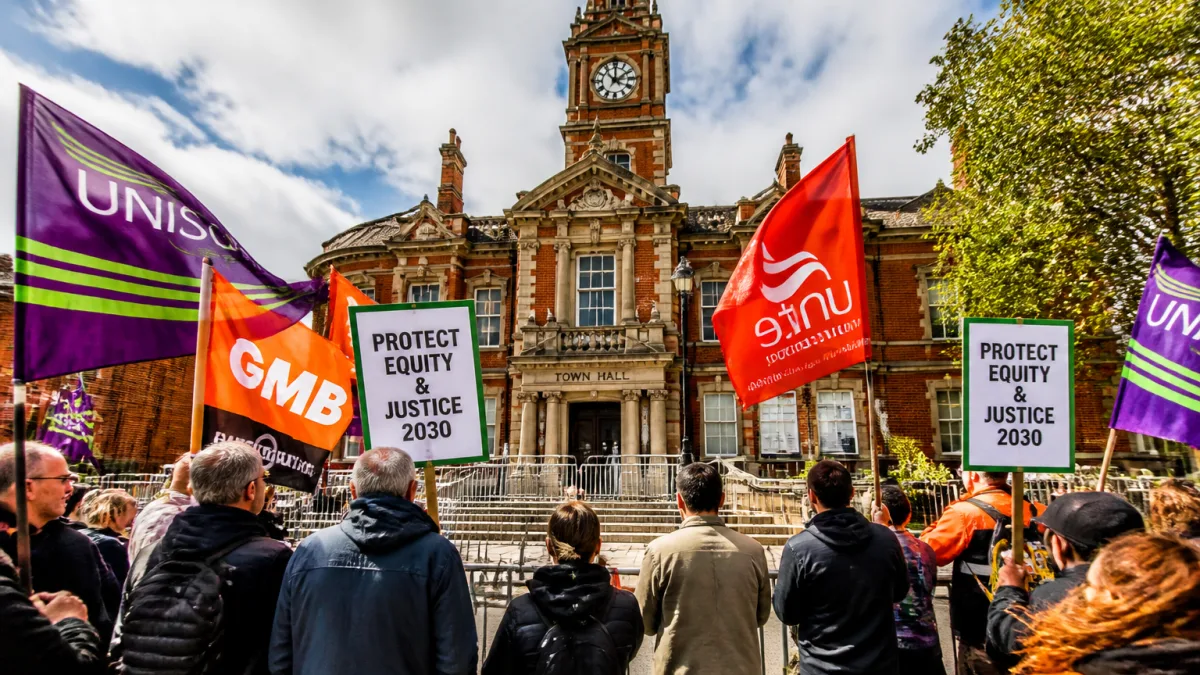
Unions call protest as Council’s 2030 equity pledge questioned
Three major trade unions will gather outside Lambeth Town Hall on Wednesday 15 July to challenge what they describe as the Council’s retreat from its stated ambition to become a “Borough of Equity and Justice” by 2030. The demonstration, organised by UNISON, Unite and GMB, follows moves within the authority to remove its dedicated Equity and Justice function and earlier reductions to senior leadership aligned with that work.
The unions argue the Council’s recent internal changes amount to a serious loss of strategic capacity to deliver on a promise that many staff and residents have invested time and trust in. They say the function in question has provided the organisational expertise to translate policy into practice across departments, and that dismantling it leaves the 2030 pledge in doubt.
“With a decision to remove the Equity and Justice function, employees and residents are asking how that promise will now be delivered.”
What the dispute is about
At the heart of the row is the role the Council’s equity and justice specialists have played in shaping decisions, commissioning and service design. Supporters see it as a borough-wide capability rather than a niche team, intended to ensure every service — from housing to adult social care — actively considers barriers faced by residents and removes them early.
Union leaders point to the widely used example of the kerb‑cut effect: features originally created to meet a specific access need end up benefiting many more people beyond the intended group. Their contention is that an embedded, expert function helps deliver those whole‑borough gains by hard‑wiring inclusion into decision‑making.
Concerns over capacity and direction
According to the unions, the Council has already scaled back the strategic leadership driving the 2030 vision over the past year, and the latest removal of the dedicated function marks a further step away from its declared path. In their joint statement, they question whether the authority can retain the “strategic capability needed to turn ambition into action” without the structure that has previously pushed for change.
They warn that without clear ownership and dedicated expertise, departments risk drifting back to business as usual, undermining progress on fairer outcomes. The concern extends to trust: the Council explicitly asked staff and residents to buy into a long‑term equity mission, and campaigners argue those supporters now need clarity on how the work will continue.
Why this matters locally
In a borough as socially and economically varied as Lambeth, residents often experience public services very differently. An equity and justice approach aims to close those gaps. Unions say the now‑scrapped function has historically supported:
- Better‑informed leadership decisions by testing policies against real‑world impacts on different communities.
- More inclusive service design that anticipates need and reduces barriers up front.
- Stronger organisational culture, with practical guidance for teams on fair practice.
- Policy and commissioning that are grounded in evidence and resident insight.
Advocates argue that removing that core capability makes it harder to deliver consistent improvements across areas like housing, employment support and neighbourhood services — the everyday touchpoints where residents feel whether a fairness pledge is more than words.
What’s happening and when
The unions are inviting staff, residents and community groups to join the protest outside the Town Hall. As of publication, the organisers have highlighted the location and date but have not provided a publicised start time.
| Event | Details |
|---|---|
| Demonstration | Union rally over Lambeth’s equity and justice commitment |
| Date | Wednesday 15 July |
| Location | Lambeth Town Hall, Brixton |
| Organisers | UNISON, Unite, GMB |
The unresolved questions
The immediate issue is practical: how the Council intends to meet its 2030 goal without a dedicated equity and justice unit. The unions say residents and staff deserve a clear plan for where responsibility now sits, what resources will support it, and how progress will be tracked in public. In their words, you cannot remove the engine that has driven organisational change and expect the journey to continue unaffected.
For Lambeth, which has openly positioned equity and justice as core to its identity, the stakes are as much about credibility as delivery. The response in the coming days — and whether alternatives are set out — will shape confidence across the workforce and among communities who have counted on the Council to lead by example.