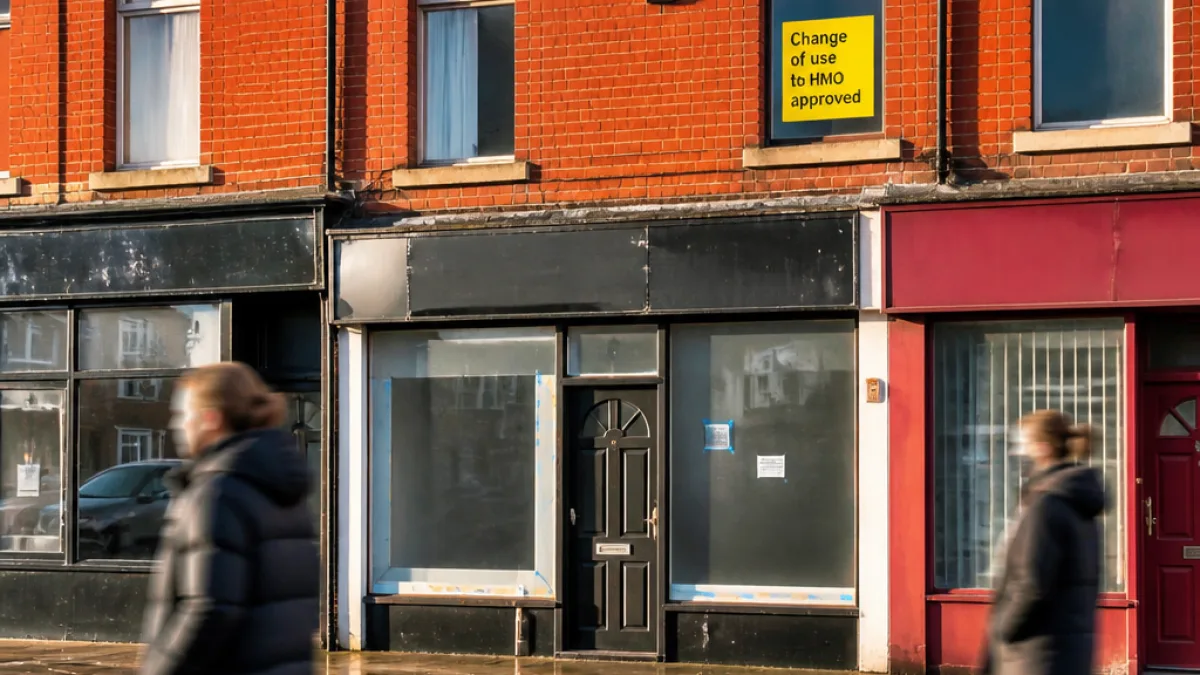
Appeal ruling clears the way for new town centre HMO
An independent planning inspector has approved a proposal to convert vacant first-floor offices on Redcar High Street into an eight-bedroom house in multiple occupation (HMO), overturning a unanimous refusal by Redcar & Cleveland Council’s regulatory committee last year.
The scheme — brought forward by RES Property Surveyors Limited — will reconfigure space above existing retail units to provide shared accommodation, including a communal kitchen, two bathrooms and a utility room. The inspector found that the conversion would not harm the character of the high street and would meet acceptable accommodation standards.
Why the council said no — and why the appeal succeeded
Councillors had rejected the bid amid concerns about an over-concentration of HMOs in and around Redcar’s town centre, potential noise and disturbance, and the cumulative effect on appearance and amenity. That decision went against the professional advice of a planning officer, who had advised approval on the basis that while Coatham has the borough’s highest number of HMOs, these are largely clustered around Coatham Road and Queen Street rather than on the High Street itself.
The inspector drew on the council’s own data, noting the relatively low recorded level of HMOs in the ward and concluding that the proposal would not tip the balance.
“I consider that the appeal proposal would not result in an over-concentration of HMOs in the area due to the existing low percentage present.”
The inspector also stressed the high street’s mixed character and the minimal physical changes proposed. Externally, the only change cited is the removal of a ground floor shutter and installation of a front door to serve the accommodation, which the inspector considered would preserve the existing street scene.
What will change on the High Street
- Conversion of former office space above shops into eight bedrooms with shared facilities.
- Only a modest alteration at street level — adding an entrance — with no major facade changes.
- Use deemed compatible with the High Street’s "varied character", according to the inspector.
| Element | Details |
|---|---|
| Accommodation | 8 bedrooms; shared kitchen; 2 bathrooms; utility room |
| External works | Remove shutter; install new front door |
| Council decision | Refused unanimously by regulatory committee (last year) |
| Appeal outcome | Allowed by planning inspector |
Context: HMOs, housing mix and town centre living
HMOs typically offer individual bedrooms with shared facilities and are often used by single workers, students or those seeking more affordable options. Local authorities weigh such proposals against amenity, design, management, and the cumulative effects of clustering. In this case, the inspector placed weight on ward-level evidence supplied by the council, highlighting that only 1.04% of homes recorded in that area were known HMOs with planning consent.
For Redcar, the decision underscores a policy tension: town centre regeneration ambitions on one hand, and concerns about the balance of housing types on the other. The inspector’s emphasis on actual distribution — with concentrations cited away from the High Street — suggests future applications may hinge on granular mapping of existing HMOs and demonstrable management arrangements to mitigate noise and disturbance.
What residents and applicants should note
While every planning case turns on its merits, this ruling indicates that:
- Evidence of existing HMO percentages and their spatial distribution can be decisive.
- Where external changes are minimal and character is mixed, town centre HMOs may be viewed as compatible.
- Committees departing from officer advice will need robust, site-specific grounds supported by data to withstand appeal.
The conversion will now be able to proceed in line with the approved plans and any standard conditions arising from the inspector’s decision. Prospective tenants, neighbouring traders and residents can expect the frontage to remain broadly unchanged, aside from the dedicated access door.
Next steps and implications for planning in Redcar
This appeal outcome will likely be noted in subsequent determinations where similar concerns are raised about over-concentration and character in the town centre. It may prompt the council to review how it tracks HMOs and how it presents evidence on cumulative impact. For applicants, it reinforces the value of detailed statements on design, layout and amenity standards, and of demonstrating that proposed conversions add active use to long-vacant space without detracting from the high street’s appearance.
With pressure to make better use of under-occupied premises, the ruling also aligns with broader attempts to bring people back into town centres by diversifying uses. The balance between mixed-use vitality and neighbourhood amenity will continue to define future planning debates in Redcar.