Council backs legislative push amid exploitation concerns
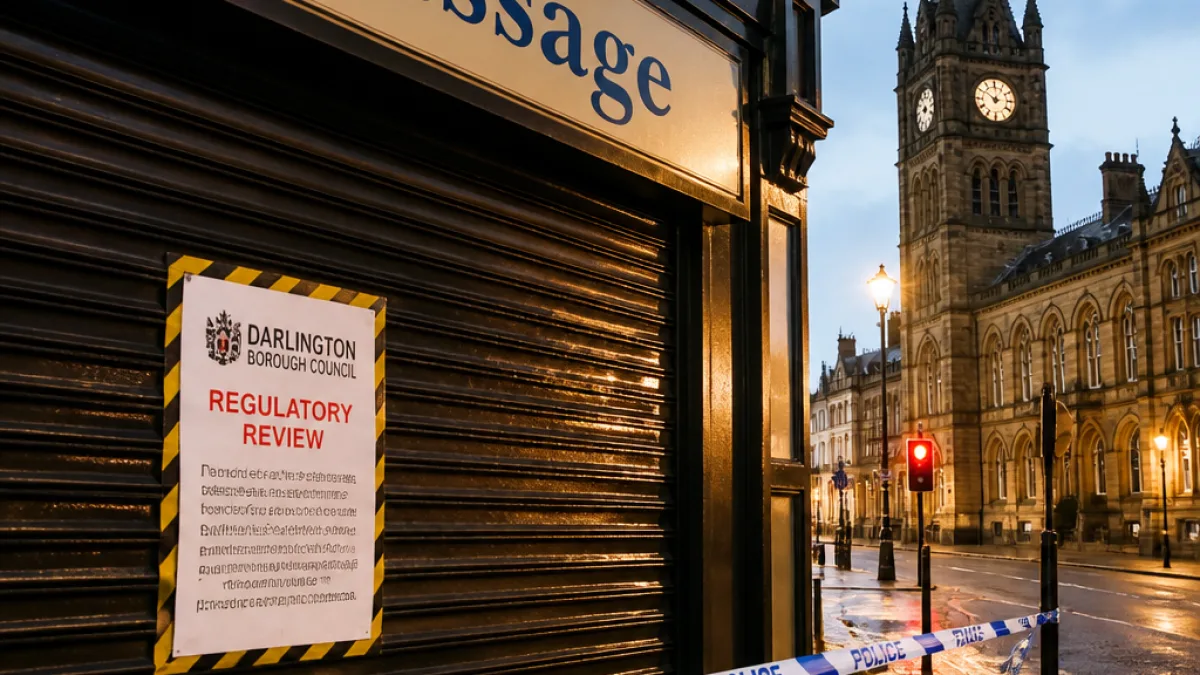
Darlington Borough Council has thrown its weight behind calls for tighter national rules governing massage parlours, after police raids at three town addresses led to eight arrests and raised fresh concerns about potential modern slavery and exploitation.
At a full council meeting on Thursday, members approved a motion urging ministers to review the legal framework. Proposers argued that most such businesses operate outside consistent regulation, leaving gaps that can be exploited by organised criminal networks.
Labour councillor Sajna Ali, representing Northgate ward, told colleagues that local authorities required clearer powers and earlier intervention tools to protect people who may be at risk. In a pointed message from the chamber, she said:
“As councillors, we have a duty to protect the most vulnerable. Many victims of modern slavery are frightened, isolated and controlled. They cannot simply ask for help. We need legislation that gives local authorities, working alongside police and safeguarding partners, the tools to identify exploitation earlier and intervene where necessary. We are sending a clear message that Darlington will not turn a blind eye to modern slavery and that we want stronger powers to protect victims and support enforcement agencies.”
Police operation preceded the debate
The vote followed a targeted operation by Durham Constabulary, which executed warrants at premises in Parkgate, Thompson Street East and Stonebridge. Officers acted on intelligence and concerns that individuals could be subject to exploitation linked to suspected modern slavery.
| Location raided | Area/Street |
|---|---|
| Premises 1 | Parkgate |
| Premises 2 | Thompson Street East |
| Premises 3 | Stonebridge |
While enquiries continue, councillors framed the enforcement action as evidence of the need for clearer, consistent oversight of the sector to support both victim safeguarding and legitimate operators.
Focus on closing regulatory gaps
The motion was submitted by Cllr Nick Wallis and seconded by Cllr Sajna Ali. It highlighted inconsistencies in the current system, noting that some authorities — such as those in parts of London and Nottinghamshire — have local powers to regulate massage parlours, whereas councils elsewhere do not. According to the motion, that patchwork approach creates room for criminal exploitation, including offences linked to sex trafficking, prostitution and money laundering.
Backers of the move said a national review would help align powers, improve safeguarding pathways and clarify responsibilities across agencies. They argued that giving councils defined licensing or regulatory tools would support earlier detection of harm, whilst enabling legitimate businesses to operate within a clear framework.
Letters to MPs and Police and Crime Commissioner
Following the vote, the council will write to Darlington’s MPs, Lola McEvoy and Matt Vickers, both identified in the motion as supporting a review, as well as to Durham’s Police and Crime Commissioner, asking them to press ministers for action.
- Request a government review of massage parlour legislation.
- Seek powers for councils to intervene earlier with police and safeguarding partners.
- Write to local MPs and the Police and Crime Commissioner to escalate the issue nationally.
Local impact and next steps
For Darlington residents, the council’s stance signals an intent to strengthen safeguards where there are signs of coercion or exploitation, and to work more closely with law enforcement. The motion’s supporters say that a firmer legal footing would assist multi-agency teams to identify risks sooner and act consistently, rather than relying on uneven local arrangements across the country.
Those backing the review stress that most establishments seek to operate lawfully, but argue that the absence of uniform regulation leaves scope for serious criminality to take root. A clearer, nationally consistent framework, they say, would help honest operators distinguish themselves from illegitimate fronts and would give councils defined levers to close down or challenge premises where exploitation is suspected.
The outcome now rests with ministers and national bodies. In the meantime, the council has reiterated that potential indicators of exploitation should be reported through established safeguarding routes and to the police, so that intelligence can be assessed and appropriate support offered to those at risk.