Children in West Cork who wish to continue their education through Irish at second level are facing daily return trips of up to 160km — and, for some communities, as much as 266km — due to the absence of any Irish-medium secondary school in the region.
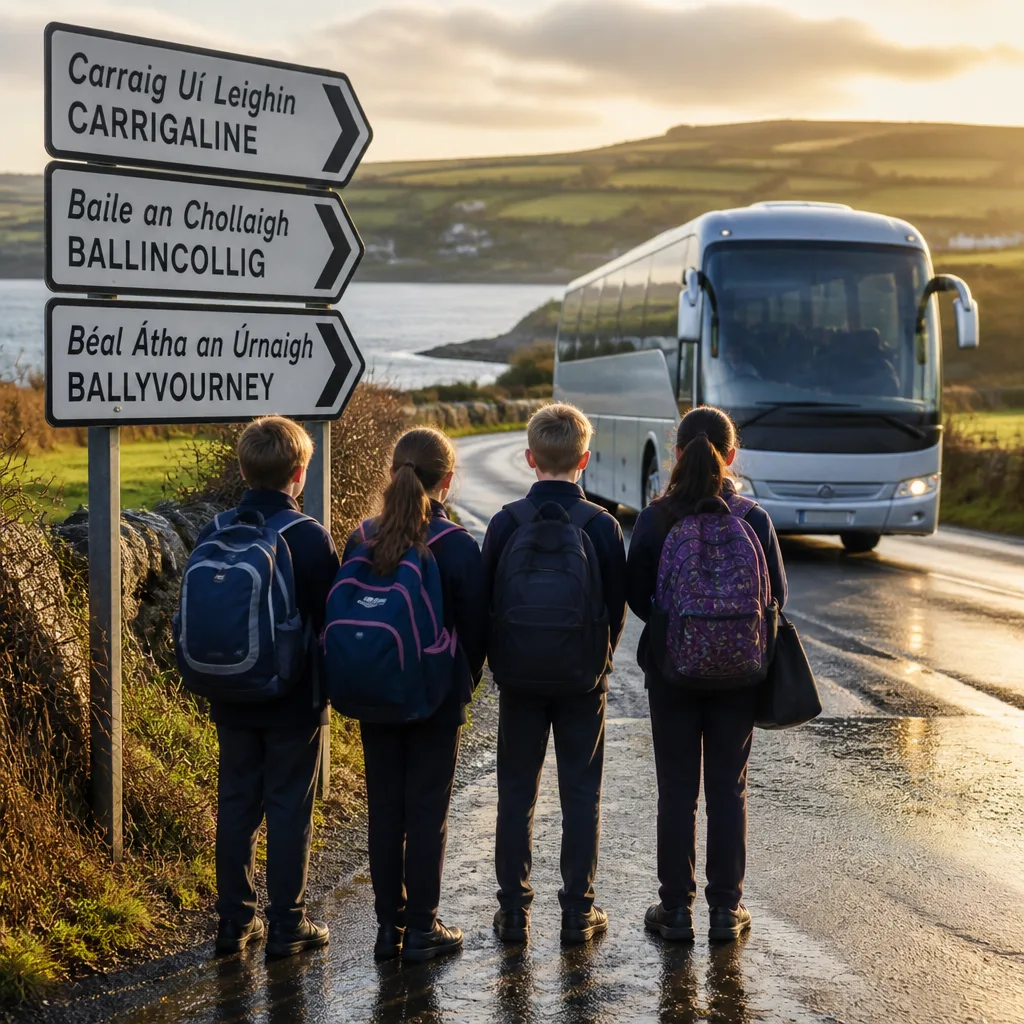
There are currently four Gaelscoileanna (Irish-medium primary schools) in Bandon, Clonakilty, Skibbereen and Oileán Chléire (Cape Clear Island), with an estimated 625 pupils enrolled. On completing primary, those aiming to remain in Irish must secure places in Gaelcholáistí outside the area, travelling to Ballyvourney, Ballincollig or Carrigaline.
Families facing long distances to stay in Irish-medium education
Fianna Fáil councillor Deirdre Kelly told a recent County Hall meeting that pupils committed to Irish-medium learning are being placed at “a distinct and unfair disadvantage” by the lack of a local second-level option. She highlighted the scale of travel now required for some pupils:
“So, for example, if a child in Skibbereen was accepted into a school in Carrigaline for second level education this would involve a 160km roundtrip,”
She added that journeys can be even longer from the peninsula communities to the west. If a child from the Beara Peninsula secures a place in Carrigaline, she said, the daily travel would total 266km.
| Origin | Destination (Gaelcholáiste) | Indicative daily round trip |
|---|---|---|
| Skibbereen | Carrigaline | 160km |
| Beara Peninsula | Carrigaline | 266km |
Demand signals and planning pressure
According to Ms Kelly, a local lobby group has surveyed families to assess appetite for a dedicated Irish-speaking secondary school in West Cork. Responses came not only from the four towns with Gaelscoileanna — Bandon, Cape Clear, Clonakilty and Skibbereen — but also from the Beara Peninsula, Dunmanway, Rosscarbery and Schull, indicating interest across a wide catchment.
She pointed to the council’s County Development Plan, which forecasts a 20% population increase by 2034 in West Cork. In her view, that growth will intensify the need for local Irish-medium secondary provision and could encourage even more primary schools beyond the immediate area to sustain Irish-medium learning if a Gaelcholáiste were established closer to home.
Where could a school go?
Fianna Fáil councillor Gillian Coughlan, who chairs the Cork Education and Training Board (ETB), said the most suitable site for a new Irish-speaking secondary school would be Clonakilty. She intends to table a formal proposal at the Western Division, signalling a push to move the discussion from problem description to potential siting.
What it means for parents and students
For families, the current set-up raises practical and pastoral concerns. Daily journeys of the scale cited can mean early starts, late returns, and higher transport costs, with practical knock-on effects for attendance, participation in after-school activities, and family routines. For older pupils, long commutes can compress study time and limit access to extracurricular learning or part-time work, while for younger pupils the day length may be a factor in wellbeing and engagement.
- Choice: Pupils wishing to remain in Irish-medium education must currently leave the region daily or change language track at secondary level.
- Access: Transport logistics to Ballyvourney, Ballincollig or Carrigaline become central to school selection and family planning.
- Planning: Forecasted population growth and survey responses suggest sustained demand that local authorities and providers will need to consider.
Next steps to watch
The councillors’ interventions bring renewed focus on whether, where and how a Gaelcholáiste could be delivered to serve West Cork’s Irish-medium primary cohort. Any move would require coordination between the ETB, potential patrons of an Irish-speaking secondary school, and local and national authorities to assess viability, demand and siting. While parents continue to navigate existing routes to Irish-medium places outside the region, the coming proposals — including the suggested focus on Clonakilty — will be watched closely by families across the west of the county.
As Ms Kelly put it, a local solution could also have a wider effect by supporting schools even further afield to continue teaching through Irish at primary level if there is a realistic pathway into nearby Irish-medium secondary education.