The University of Leicester will lead an eight-year research programme to investigate why some children are born with underdeveloped central vision, after a grant of just over £2 million from the Wellcome Trust.
Focus on the fovea and childhood vision
The award will fund work to understand how the fovea—a pinhead-sized area at the centre of the retina responsible for sharp, detailed sight—normally forms, and why it sometimes fails to mature, producing a condition known as foveal hypoplasia. Children with the condition can be partially sighted or registered blind, and the researchers say the programme is designed to move from basic understanding to possible routes for intervention.
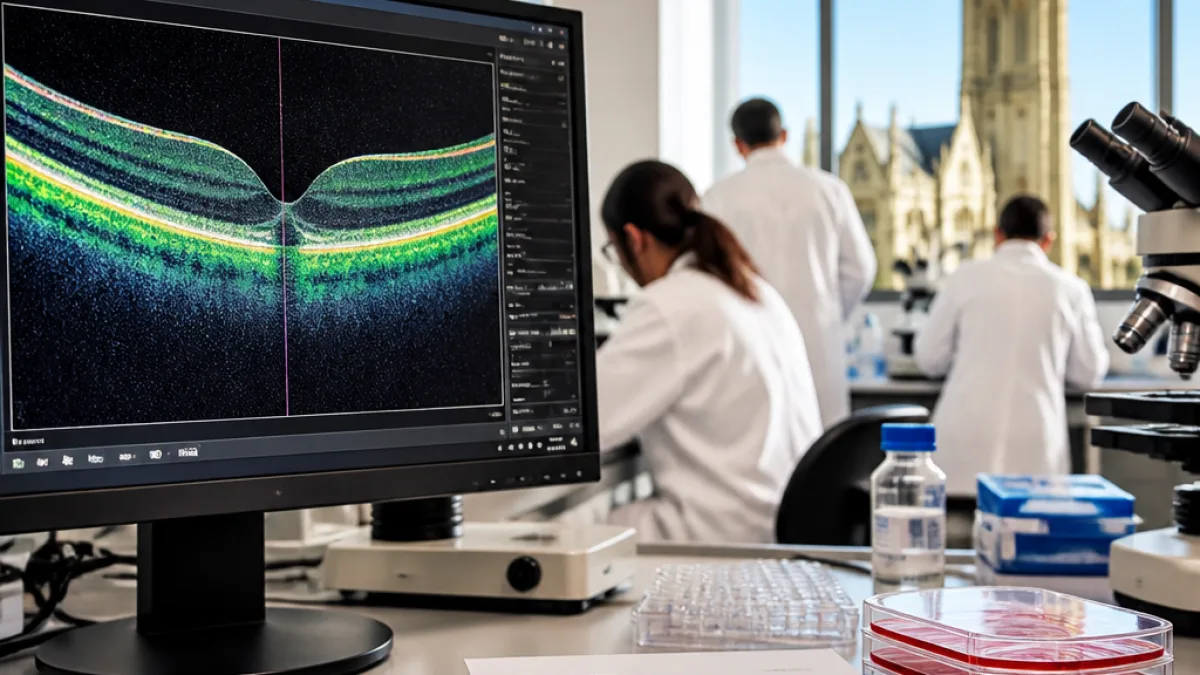
Clinical Associate Professor and Honorary Consultant Ophthalmologist Dr Mervyn Thomas, Clinical Lead at the Ulverscroft Eye Unit, will lead the Leicester-based project. The funding will support laboratory models that mimic human foveal disorders, experiments to test whether correcting faulty biological pathways can restore development, and the use of a bespoke ultra-high-resolution eye scanner to image patients at a level not previously possible in routine clinic settings.
“I hope that by the end of this programme, when a family sits in front of me and asks why this happened to their child, I will finally have an answer,”
Dr Thomas added that an immediate objective is to discover whether there is an early developmental window in which treatments could be effective and, if so, which biological mechanisms should be targeted. He said those are questions the team cannot yet answer but hopes the research will enable them to ask them properly for the first time.
What the grant will support
- Creation of novel laboratory models to reproduce human foveal disorders.
- Testing whether restoring selected biological pathways can rescue normal foveal development.
- Clinical imaging of patients using a custom-built, ultra-high-resolution eye scanner for detailed study of the fovea.
Locally, the award strengthens Leicester’s clinical research capacity in paediatric ophthalmology and builds on work carried out at the Ulverscroft Eye Unit. Parents and clinicians in the city will be watching the programme closely, as its findings could alter how some cases of childhood sight loss are understood and managed.
| Item | Detail |
|---|---|
| Funding body | Wellcome Trust |
| Value | Just over £2 million |
| Duration | Eight years |
| Main focus | Normal and abnormal foveal development; potential early intervention targets |
For families in Leicester and the wider county who face childhood sight impairment, the research offers a prospect of clearer answers and, in time, more targeted treatment strategies. The programme is a long-term commitment; practical clinical outcomes, if achievable, are likely to emerge over several years rather than immediately.
Local clinicians and parent support groups will be among those who may be involved in patient recruitment or in discussions about the ethical and practical implications of any future interventions stemming from the research. For now, the award secures funding for sustained investigation into a little-understood cause of childhood visual impairment based at a Leicester clinical centre.