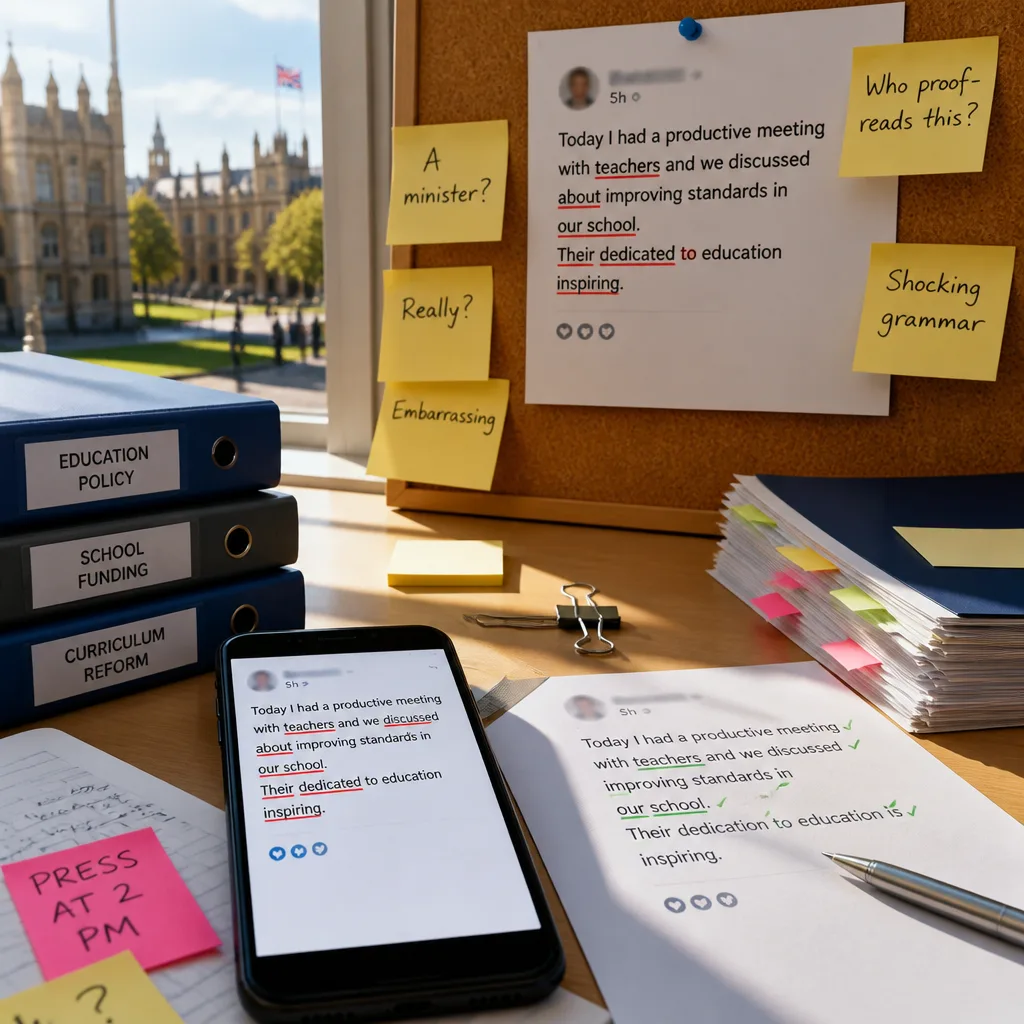
Lucy Powell, who took charge this week as the UK’s Education Secretary for England, was subject to public ridicule by Conservative politicians after a social media message from her account contained several grammatical errors.
What happened
The mistake appeared in a post outlining the new department’s priorities for schools and skills. The Conservatives circulated screenshots of the message on X (formerly Twitter) and accompanied them with a mocking assessment of the post.
"Labour’s new Education Secretary is off to a flying start… 3/10. See me after class!"
The screenshot and comment were widely shared on social media, turning the grammatical slip into a political talking point within hours. The post was subsequently corrected.
Political responses
Conservative MPs seized on the error to argue the minister overseeing England’s schools should demonstrate a high standard of written communication. Labour responded to the Tory post by pointing out apparent mistakes in the Conservative party’s own message, saying they had misspelt words in their post and suggesting the Tories should not be quick to criticise.
Labour said the Conservatives had spelled "Labour's" and "Britain" incorrectly in their post.
The exchange illustrates how minor mistakes on social accounts are rapidly amplified and used in political exchanges by both parties.
Why it matters for schools, parents and ministers
For parents, teachers and pupils the episode is notable less for its substance than for what it reveals about the scrutiny ministers now face. Communication from the Department for Education sets expectations and signals priorities; errors attract attention and can become distractions from policy announcements.
- Timing: The error occurred a day after Powell's appointment to the post.
- Visibility: Social media amplification turned a small slip into a wider political exchange.
- Response: The post was corrected and Labour pushed back by highlighting perceived mistakes in the Conservative response.
Immediate consequences and context
The immediate effect has been reputational rather than policy-based: a short-lived row that may complicate early optics for the new Education Secretary. The exchange also underlines a broader point about digital communications teams working for ministers — accuracy and proofing are now central to how departmental messages are received and interpreted.
| Event | Detail |
|---|---|
| Appointment | Lucy Powell became Education Secretary this week |
| Post published | Social media post outlining priorities contained grammatical errors |
| Political reaction | Conservatives mocked the post; Labour countered by flagging Tory misspellings |
| Aftermath | Post was corrected; episode went viral on social platforms |
Ministers’ communications are routinely scrutinised by political opponents, journalists and the public. For the new Education Secretary, attention will now return to substantive policy announcements, but this episode is a reminder of the reputational risks that accompany a high-profile ministerial role.