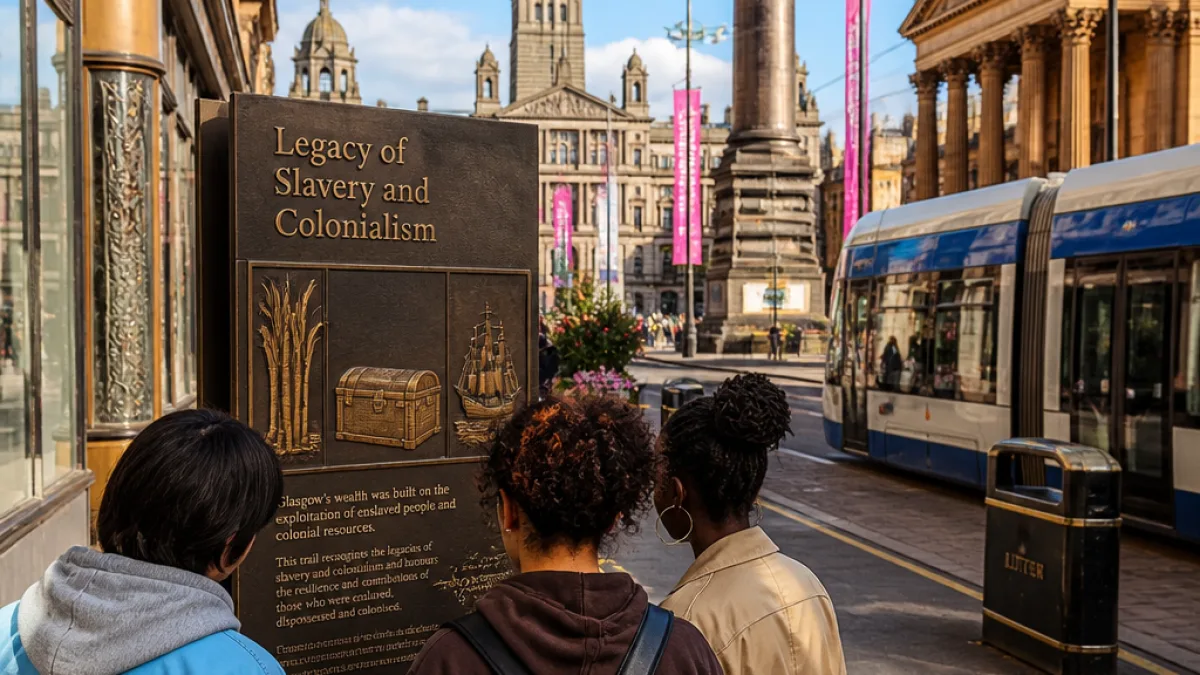
A newly opened walking trail in Glasgow aims to bring long-overlooked chapters of the city’s past into everyday view by mapping the civic landscape shaped in part by slavery and colonial exploitation.
Trail seeks to recast familiar streets
The Legacy of Slavery and Colonialism Trail sets out through a first phase of city-centre sites, inviting residents and visitors to consider how fortunes built on tobacco, sugar and cotton influenced Glasgow’s economic, physical and social growth. The route includes a sequence of prominent locations often taken for granted in ordinary city strolls.
- City Chambers
- Merchant City
- Trongate
- Gallery of Modern Art (GoMA)
Councillor Susan Aitken, leader of Glasgow City Council, said the initiative was intended to make the city’s full history more visible and accessible and to prompt informed discussion about the consequences of that past.
"Glasgow’s history is rich, complex and, at times, deeply uncomfortable… By making our whole history more visible and accessible, we can support greater understanding and encourage informed discussion."
Research and context
The trail draws on academic research into the city’s Atlantic connections. Work by Dr Stephen Mullen, a lecturer in History specialising in the legacies of Atlantic slavery at the University of Glasgow, underpins interpretation for the route. The project also builds on educational activity carried out by the Coalition for Racial Equality and Rights (CRER), whose Black History Month tours have helped raise public awareness of Glasgow’s links to the transatlantic slave trade.
Programme material for the trail highlights the ways in which wealth generated from plantation commodities — notably tobacco, sugar and cotton — underpinned investment, urban development and civic institutions in Glasgow. Those profits, historians point out, were inextricably connected to the labour of enslaved people in the Americas and Caribbean.
Complexities of civic memory
Council leaders have emphasised the dual nature of the city’s history: Glaswegians were active in abolitionist campaigns and hosted figures such as Frederick Douglass, yet the city also accommodated a powerful pro-slavery lobby and benefited materially from trade linked to slavery. The trail aims to present these competing threads rather than offer a single narrative.
Local education and heritage groups are likely to use the trail as a resource for school groups, community organisations and visitors seeking a fuller picture of how global systems shaped Glasgow’s local institutions and built environment.
What this means for residents and visitors
The route provides a way for people to re-examine familiar landmarks with added historical context. It offers:
- an accessible, walkable introduction to the city’s Atlantic connections;
- a framework for discussions around commemorations, place-naming and civic memory;
- an educational tool for teachers and community groups exploring local histories of empire and migration.
| Aspect | What it highlights |
|---|---|
| Primary sites | City Chambers, Merchant City, Trongate, Gallery of Modern Art |
| Research partners | Dr Stephen Mullen (University of Glasgow), CRER |
The council has framed the trail as part of a broader effort to ensure Glasgow’s public history acknowledges both the city’s role in the abolition movement and the economic benefits it reaped from slavery-related commerce. By situating those histories in the streets and buildings people pass every day, the trail seeks to prompt reflection and informed public conversation.
Further phases and any accompanying interpretation materials have not been detailed in the material provided to the press. Local schools, community groups and cultural organisations will likely be watching closely for developments and opportunities to incorporate the trail into educational programmes.