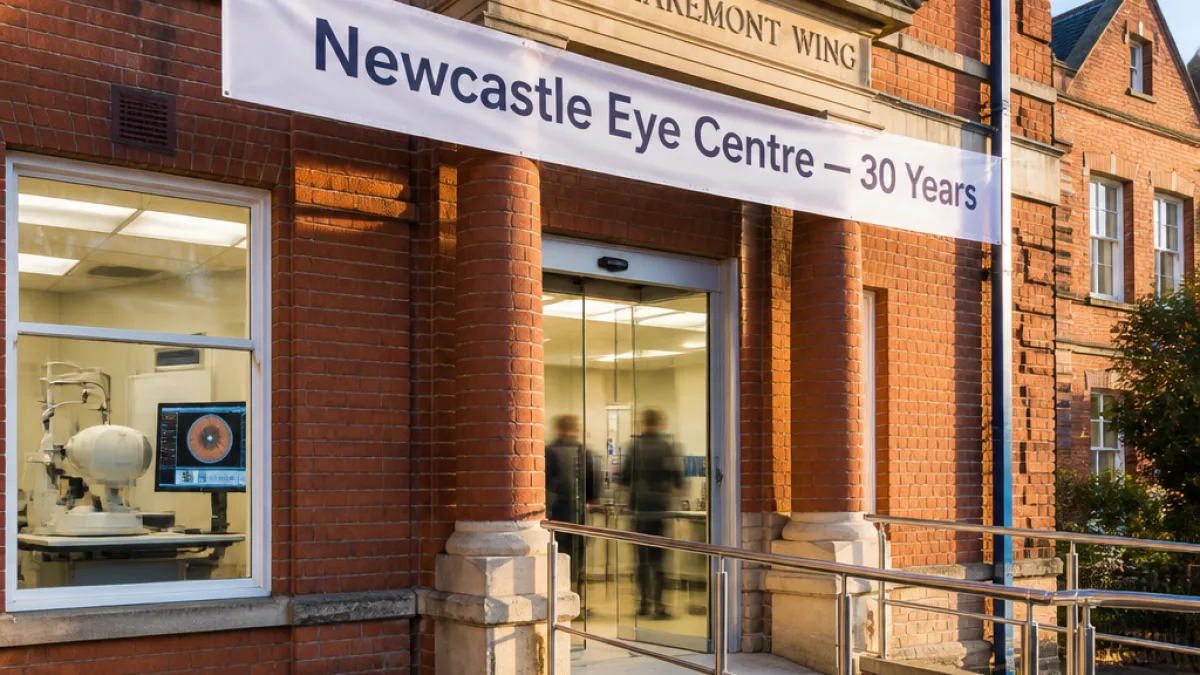
The ophthalmology service based in the Claremont Wing of the Royal Victoria Infirmary has this year marked 30 years since its relocation and development into a regional centre for eye care and research. Since moving in 1996 the Newcastle Eye Centre has combined clinical services with trials and technology adoption that staff say have changed how sight is preserved for patients locally and beyond.
From clinical trials to cutting-edge surgery
Over the last three decades the unit has led or participated in multiple pieces of research. The centre’s corneal team alone has been involved in 21 clinical trials, helping to bring sight-preserving treatments into routine use internationally. Alongside specialised corneal work, the service treats a wide range of conditions from cataracts to macular degeneration, while orthoptists manage childhood issues such as lazy eye and squints.
- 1996 — Relocation to the Claremont Wing at the RVI
- 21 — Number of clinical trials carried out by the corneal service
- First in the country — Adoption of a 3D imaging system for retinal surgery
Staff point to both service reorganisation and technology as drivers of change. The trust became the first in the UK to introduce a 3D imaging system for retinal operations, a step that clinicians say supports more precise surgery.
Voices from the department
"The equipment was much much newer too - and we have also see how we deliver care change so much in the years since, too,"
The quotation above comes from Aedheen Regan, the unit’s head optometrist, who has worked at the service for over 30 years and recalls the move from the old General Hospital site. She highlights how the advent of virtual consultations — accelerated by the Covid pandemic — has increased capacity and allowed the centre to reach more patients.
What this means locally
For people in Newcastle, North Tyneside and surrounding areas, the centre’s progress translates into access to advanced diagnostics and treatments closer to home. The combination of specialist clinics, orthoptic care for children and research activity means the unit serves both immediate clinical needs and contributes to longer-term improvements in ophthalmic practice.
| Service | Local impact |
|---|---|
| Corneal trials | Introduced sight-saving products used worldwide |
| Retinal 3D imaging | Enhanced precision in complex surgery |
| Orthoptics | Treatment for childhood squints and amblyopia |
As the Newcastle Eye Centre reflects on three decades at the RVI, staff stress the continuing importance of research, modern equipment and flexible models of care to meet growing demand. For patients, the changes over 30 years are visible in quicker diagnoses, a broader range of treatments and greater use of remote appointments where appropriate.