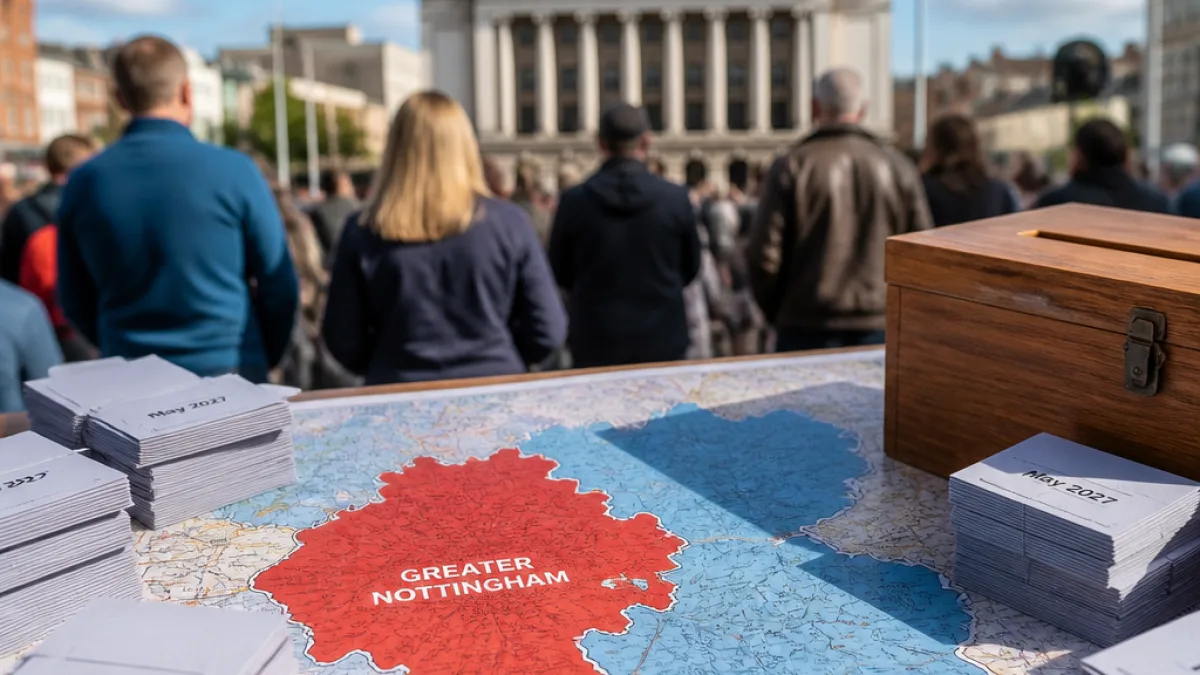
The county and city will go to the polls in May 2027 to elect councillors to two newly created unitary authorities, marking the biggest change to local government boundaries in around 50 years. Voters will choose 99 members for each of the two new councils — the Greater Nottingham Council and the new Nottinghamshire Council — under the government’s local government reorganisation (LGR) programme.
What the changes mean
The LGR programme replaces the existing two‑tier structure of county and district councils with single councils responsible for all local services in their areas. In Nottinghamshire this will mean the abolition of the nine current councils that serve the city and county and their replacement by the two new authorities.
The government says the reorganisation is intended to simplify local government and deliver savings for taxpayers by removing overlap between district and county responsibilities. In practical terms, services that are currently split between district councils such as Gedling, and Nottinghamshire County Council will be combined under a single authority for each area.
Boundary review still to come
The new arrangements will not be the final word on lines of representation. After the May 2027 elections the two councils will operate as shadow authorities for a year, before officially assuming responsibility in 2028. At that point the Local Government Boundary Commission will begin a further review of ward boundaries, with up to four years to complete its work.
"The boundary commission doesn't come in now. It comes in once you've gone to the election, and then it has four years to get them right."
The city successfully argued against a single, large county authority covering all current Nottinghamshire borders, winning government approval for plans that expand Nottingham into parts of Broxtowe, Gedling and Rushcliffe. That settlement produced the two‑authority model that is now being implemented.
Key dates and implications
Residents will therefore face several milestones over the next two years that will affect how services are governed and how they are represented at local level:
- May 2027 — Elections for 99 members on both new councils.
- 2027–2028 — Elected members sit as shadow authorities to prepare for the handover of responsibilities.
- 2028 — New councils take full control; a formal boundary review by the commission follows, with up to four years for completion.
| Item | Detail |
|---|---|
| Number of new councils | 2 (Greater Nottingham Council; Nottinghamshire Council) |
| Councillors to be elected | 99 for each council |
| Shadow operating period | 1 year (post-May 2027) |
| Full implementation | 2028 |
Local leaders and residents will need to monitor the boundary review that follows implementation. Changes to ward lines can alter electoral contests, council majorities and how local services are delivered. The expanded footprint of Nottingham into neighbouring boroughs is also likely to prompt discussion about service hubs, council tax harmonisation and local identity.
More detailed information about electoral arrangements and the precise warding patterns will be published as the Boundary Commission begins its statutory work after the 2027 elections. Until then, prospective candidates and concerned residents should watch for council briefings and the commission’s consultations once the shadow year concludes.