County planners sign off amended farm infrastructure after enforcement prompt
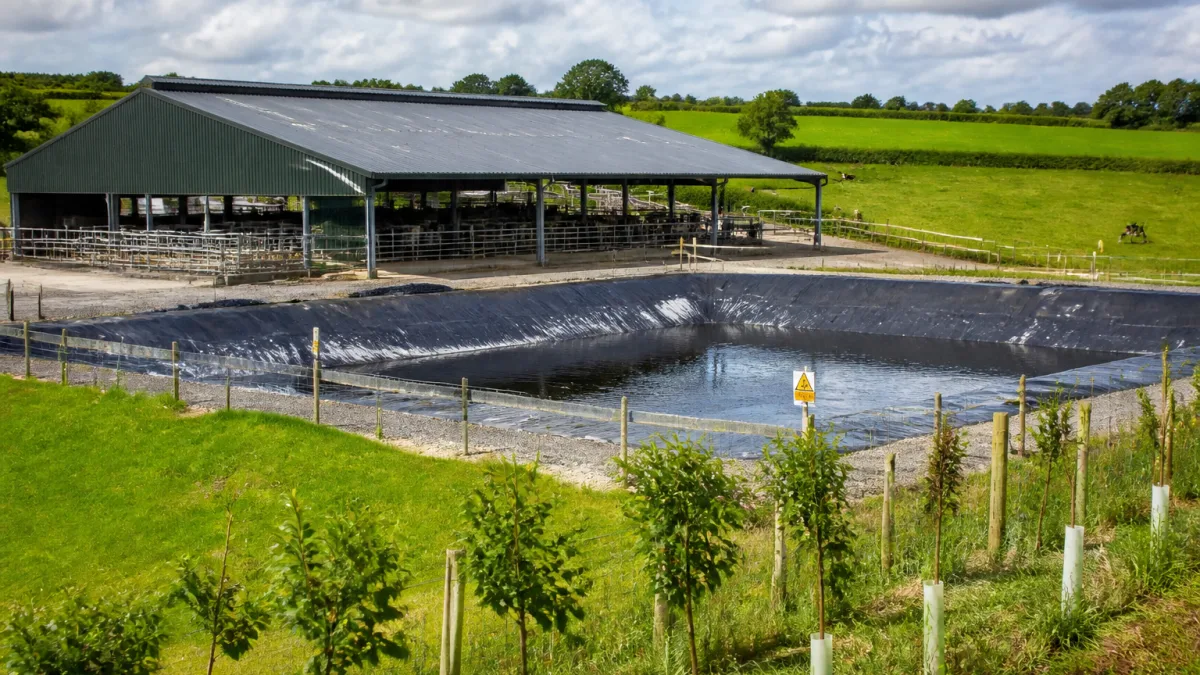
Pembrokeshire County Council has approved a retrospective application to regularise a replacement cattle building and a slurry lagoon at Talybont Farm, Llawhaden, after planning enforcement officers queried whether the structures matched previous consents. The application was lodged by Bill Ridge, trading as Vaynor Farm Ltd, which operates a grass-based, spring-calving dairy system supporting approximately 700 cows across 645 acres of owned and rented land.
According to documents submitted through agent Cynllunio RW Planning Ltd, the cattle housing has been built as a replacement for a previous structure on site. The slurry lagoon, described as similar in overall dimensions and capacity to an earlier consent, was found to differ in its precise position and orientation when compared with plans approved in 2022.
What has been approved
The council’s officer report recommended approval following amendments made during the application to bolster green infrastructure proposals on the farm. Information submitted also confirmed that the works were not intended to increase the farm’s stocking rate.
| Element | Stated details |
|---|---|
| Replacement building | Approx. 22.72m x 13.33m; to house dairy replacement heifers |
| New slurry lagoon | Similar size/depth to previous approval; stated as providing 4,500 square metres of storage |
| Existing storage (Vaynor) | 6,900 cubic metres |
| Total storage coverage | Combined provision to exceed 170 days of slurry storage |
The retrospective element arose after the council’s planning enforcement team wrote to the applicant, highlighting that the as-built cattle building required explicit permission and that the lagoon appeared not to align with the 2022 approval.
“All development is reasonably required for the purpose of agriculture.”
The planning statement also underlined that the applicant does not intend to raise stocking levels as a result of the works.
Why this matters locally
Slurry storage and handling remain key issues in West Wales’ dairy heartlands. Adequate storage capacity is central to good manure management, allowing farms to spread at appropriate times and conditions, and to reduce run-off risks. While Natural Resources Wales regulates pollution incidents, the planning process scrutinises the siting, scale and landscaping of farm infrastructure and its relationship to nearby land, watercourses and settlements.
In this case, the council indicated that the proposal had been adjusted to improve on-site green infrastructure—typically encompassing planting, habitat features or drainage measures—to help integrate new structures into the landscape and manage environmental impacts.
Retrospective planning: what residents need to know
Retrospective applications are a common route where structures have been built either without permission or in a manner that diverges from an earlier consent. Approval does not negate the oversight role of planning enforcement; rather, it formalises an assessment against policy and any required mitigation.
- Residents can view plans, officer reports and decision notices via the Pembrokeshire County Council planning portal.
- Conditions often accompany approvals to manage landscaping, drainage or external finishes.
- Any future expansion or material change of use would require a fresh application.
Next steps and ongoing oversight
With permission now granted for the structures as built at Talybont Farm, the focus shifts to implementation of any agreed landscaping or environmental measures set out in the amended plans. The applicant’s indication that there will be no increase in stocking rate provides an assurance that additional slurry production is not anticipated as a result of these works.
The decision underlines the council’s dual approach: enabling necessary agricultural development while seeking improvements to environmental performance and alignment with current planning policy. For rural communities around Llawhaden and the wider dairy sector, it is a reminder that compliance, transparency and design-quality expectations apply equally to as-built schemes when they come under enforcement scrutiny.