A heartfelt deep-dive into a modern musical pioneer
Southwark Playhouse Borough has opened its doors to The Jonathan Larson Project, a carefully woven evening of music that peers directly into the working notebook of one of late 20th-century musical theatre’s defining voices. Rather than retell the well-worn biography behind RENT, this limited-run tribute pieces together unreleased songs and material that lived in workshops and cabarets, shaping them into a warm, quietly affecting portrait of an artist whose creative momentum continues to ripple through the industry.
Jonathan Larson’s legacy hardly needs introduction among theatre-goers. His work embodied a bohemian restlessness, railing against complacency while holding tight to compassion. His sudden death on the morning of RENT’s first preview is a loss still keenly felt three decades on. Yet this project, conceived by Jennifer Ashley Tepper and brought to the UK by Thomas Hopkins Productions with SAMS Entertainment, shifts the spotlight from the mythology around the man to the day-to-day graft of his songwriting: the drafts, experiments, and orphans of bigger shows that reveal how a distinctive voice is forged.
“the opposite of war isn’t peace, it’s creation.”
That line, written by Larson, hovers over the evening like a guiding star. This is not a linear biography or a stitched-together jukebox affair; it is a curated sequence of musical fragments that evokes the creative mind at work. Director John Simpkins has the unenviable task of turning standalone numbers into a conversation, and does so with restraint and sensitivity. The result feels purposeful but unfussy, allowing the textures of the music and the candour of Larson’s ideas to carry the energy of the piece.
Design that echoes the workbench
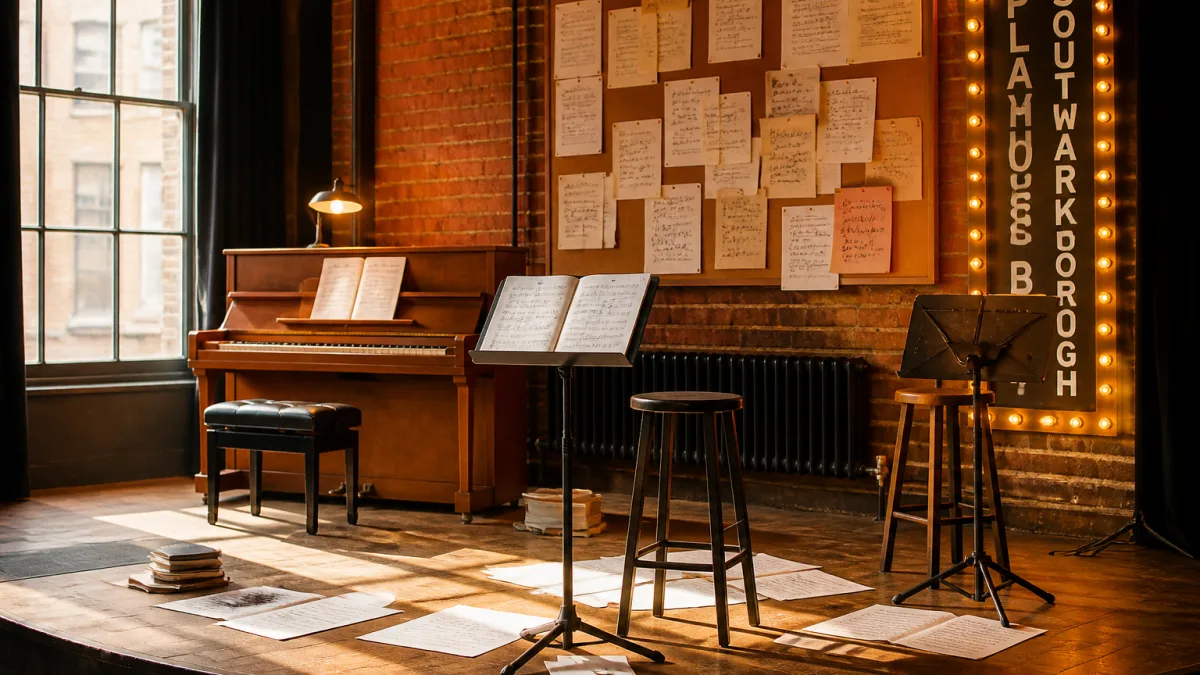
The staging leans into the notion of a studio in progress. Nate Bertone’s set uses scaffolding and exposed brickwork to conjure up that downtown, work-in-progress atmosphere—somewhere between rehearsal room and loft, a place where late-night ideas are tried, scrapped, and tried again. It’s an apt frame for music that often began life unshaped by a final script. The environment gives audiences the feeling of being invited behind the curtain, to witness how melody and lyric might have met before they were pressed into service for a finished show.
Musically, the evening moves from pop-inflected sketches to songs that were later repurposed, or cut entirely, from better-known titles. The value here is less about unveiling a string of undisputed ‘greatest hits’ than about tracing the line of a mind in motion—how a turn of phrase is tested, how a rhythm is tightened, and how ideas that never found a full home can still spark with life when offered the right care. It’s a reminder that even the most admired composers write pieces that don’t quite land, and that the road to a cultural landmark like RENT runs through plenty of side streets.
Why it matters in Southwark now
For local audiences, this project doubles as a lesson in creative process and a chance to encounter material that otherwise sits beyond public view. In an area rich with small to mid-scale theatre, Southwark Playhouse continues to champion work that interrogates how stories are made, not just how they look when finished. The show’s intimacy suits the Borough venue, giving the songs space to breathe and inviting listeners to lean into the detail of Larson’s craft—melodic hooks, lyrical wit, and that steady drumbeat of empathy for struggling artists and chosen families.
The evening also gestures outward, towards the lineage of musical theatre that Larson both inherited and helped to refresh. Generations have their torchbearers—Rodgers & Hammerstein, George Gershwin, Stephen Sondheim, and now, for many, Lin-Manuel Miranda. This programme positions Larson squarely among them, not as a monument on a plinth but as a working composer mid-thought. Seen this way, the familiar question—what might he have created had he lived longer?—shifts from lament to invitation. The answers aren’t definitive, but the hints are compelling.
What audiences can expect
- A revue-style format built from Larson’s archived songs, rather than a plot-driven biography.
- Thoughtful direction that threads discrete numbers into a cohesive evening without heavy narration.
- An industrial, in-progress aesthetic that reflects the workshop origins of much of the material.
There is something disarming about hearing ideas presented without the varnish of a finished book. Numbers sit beside each other in conversation, guided by mood and theme more than story mechanics. The effect is quietly revelatory, particularly for listeners who know Larson chiefly through his blockbuster title. In place of spectacle, the focus rests on musicianship and lyrical detail—on the itch to write, the courage to cut, and the rare satisfaction of finding the exact right note.
Creative team at a glance
| Project conceived by | Jennifer Ashley Tepper |
| Director | John Simpkins |
| Producers | Thomas Hopkins Productions; SAMS Entertainment |
| Set design | Nate Bertone |
| Venue | Southwark Playhouse Borough |
As a local night out, it’s a gentle, generous watch—one that trusts audiences to appreciate process as much as polish. You come away with a richer sense of how Larson thought and what he was reaching for, and with renewed respect for the quiet industry that underpins any musical that finally makes it to a marquee. At Southwark Playhouse Borough, those fragments have a home for now, and in their gathering, they make a persuasive case for creation as an act of care.