Community sport with lifesaving roots faces dwindling numbers
A call has gone out from Cornwall’s surfboat community as local teams warn that participation is falling to levels that threaten the future of the sport on the county’s beaches. The discipline, which grew out of volunteer lifesaving and remains closely linked to surf lifesaving clubs, sees crews row through surf and then harness the power of a breaking wave to return to shore. While it retains a strong following in Australia, organisers say engagement in Cornwall has declined markedly in recent years.
Kim Marie Jackson, chair of the UK Surf Rowers League, said the sport in the UK is at a tipping point unless new participants step forward.
“It’s kind of got to a critical point where if we don’t build the numbers now and recruit more people it’s going to die as a sport.”She described surfboat rowing as one of the most exhilarating activities available on the coast and urged anyone interested to try a taster session.
Perranporth club opens doors to first-timers
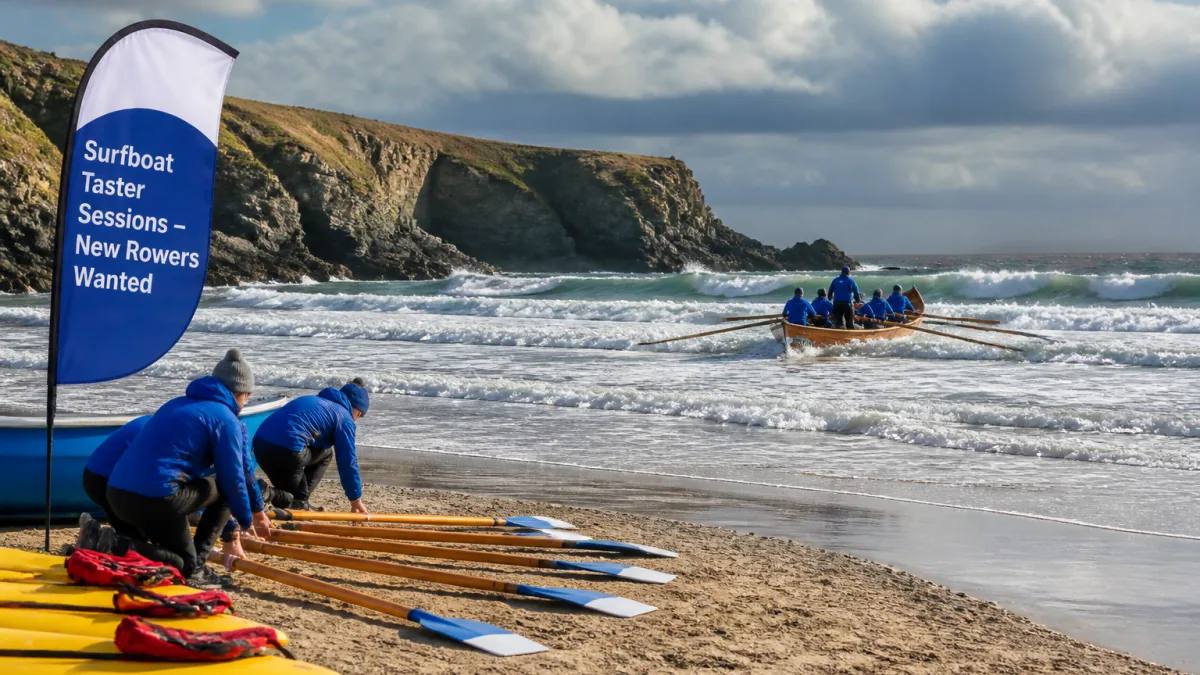
Perranporth Surf Lifesaving Club is offering introductory sessions aimed at people who have not rowed before but are confident in the sea and keen to test themselves in surf conditions. Crews typically comprise four rowers and a sweep, working the boat through white water before setting up to ride a wave back to the beach. The club hopes that giving people a safe, structured first experience will convert curiosity into commitment.
New recruit Sian Kirby, who joined the Perranporth team this year and has already competed, said the appeal is immediate once you feel a boat lift onto a swell.
“When you’re catching a wave back in all the hard work to get out there is worth it.”She added that the club environment has been supportive for newcomers building skills in the surf.
From peak participation to steady decline
According to Jackson, surfboat rowing in the UK saw stronger participation two decades ago, with notably fuller race line-ups. She recalled that in 2006, typical events might have fielded around 15 men’s crews and approximately 12 women’s crews. Over subsequent seasons, the number of active teams has reduced. While organisers did not set out precise current totals, they say the trend is unmistakable, and that without fresh interest from coastal communities like those in north and south Cornwall, the sport risks fading.
| Period | Men’s crews (avg.) | Women’s crews (avg.) | Status |
|---|---|---|---|
| 2006 (recalled) | ~15 | ~12 | Competitive and growing |
| Recent years | Not stated | Not stated | Participation has diminished |
Ken Croft, who leads the National League of Surf Rowers, said Cornwall’s coastline gives it a natural advantage and scope for more clubs and casual participation than currently seen. He highlighted that the county’s accessible beaches and varied breaks mean the boats do not need consistently large surf to train and race safely.
Why it matters for Cornwall’s coast
Surfboat rowing emerged alongside surf lifesaving as a way to keep crews fit for rescues before the widespread arrival of powered craft such as RIBs and jet skis. Although modern lifesaving technology has changed the rescue toolkit, the rowing discipline retains practical value for building sea fitness, teamwork and surf awareness among volunteers. For seaside towns, the sport also contributes to seasonal events, club culture and youth pathways into beach safety roles.
Organisers argue that, with Cornwall’s long Atlantic-facing coastline and established lifesaving clubs, there is significant untapped potential. If numbers continue to drop, however, fixtures could be scaled back and expertise lost from local communities. Conversely, even a modest intake of new participants could restore depth to training squads and ensure that mixed, women’s and men’s crews can be fielded more consistently at competitions.
How to get involved
- Taster sessions: Introductory opportunities are being run through Perranporth Surf Lifesaving Club for prospective rowers with a good level of water confidence.
- What to expect: Crews of four row beyond the break, then use timing and teamwork to catch a wave back to shore under the guidance of a sweep.
- Who it suits: People who enjoy endurance sports, team environments and the challenge of working in dynamic surf conditions.
Jackson said it would be a “shame” to see an activity with such deep Cornish connections decline when there are so many beaches suitable for training. Croft echoed the message, encouraging curious residents to visit their local club and see a session first-hand. With recruitment now a priority, the coming months will be key in determining whether the sport re-establishes itself on Cornwall’s beaches or continues its recent contraction.