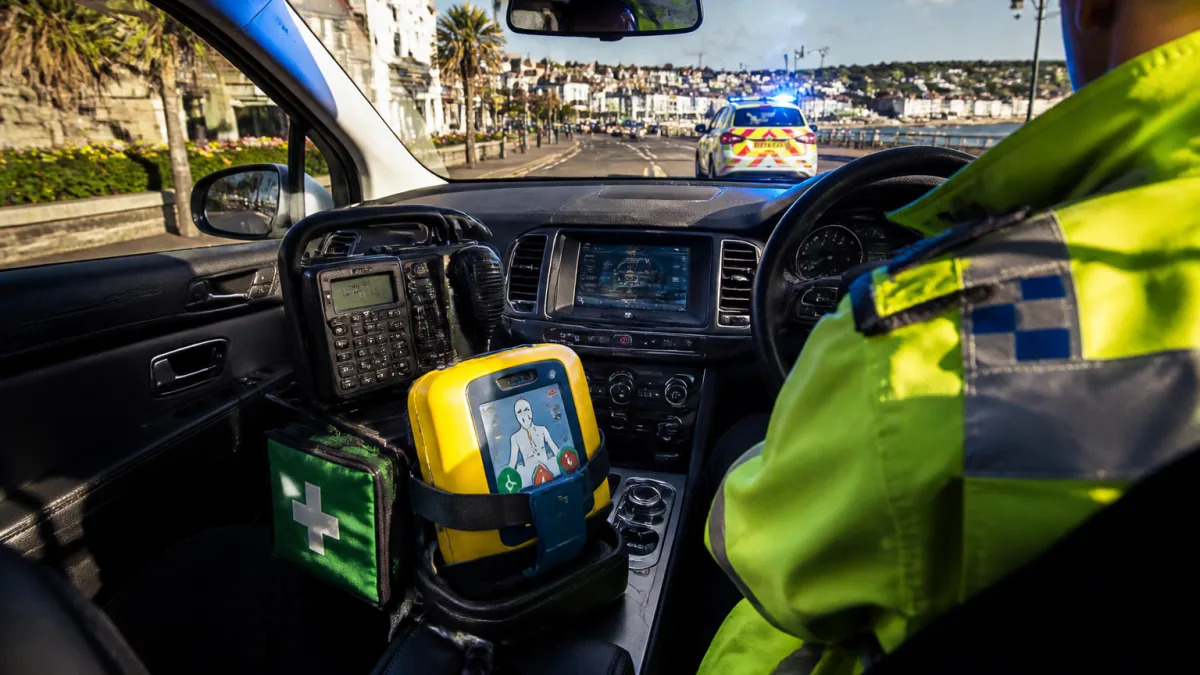
Torbay’s MP has called for every operational police vehicle in the UK to carry a defibrillator, arguing the change could save lives when officers reach emergencies before paramedics. Ministers say the idea is under consideration with police forces nationwide.
Call from Parliament after tragic case
Speaking in a Westminster debate, Liberal Democrat MP Steve Darling highlighted the death of Jamie Rees Issitt, who suffered a cardiac arrest. Officers arrived ahead of the ambulance but, without a device on board, could not deliver a potentially life-saving shock. Darling paid tribute to Jamie’s mother Naomi Rees Issitt, whose charity Our Jay has campaigned to widen access to defibrillators.
He stressed the importance of speed in cardiac arrests, noting that a person’s chances of survival can fall by around 10% for every minute without defibrillation. He also warned of patchy coverage of publicly accessible devices, particularly in rural and more deprived areas.
“I want to pay tribute to the amazing charities Our Jay and Jay's Aim for their stellar work. Anyone can use a defibrillator, so the police would not require any extra training. Many lives could be saved with this change. That's why I'm pushing for every police car to carry a defibrillator.”
Charities and early results elsewhere
Darling pointed to progress achieved by Our Jay, which has supported the fitting of defibrillators in police vehicles in Bedfordshire and Warwickshire, with reports that they were used to save lives within days of being installed. The South West charity Jay’s Aim has also raised concerns, saying officers in Devon and Cornwall often rely on community devices they installed because police cars are not routinely kitted with their own.
| Issue | Detail |
|---|---|
| Survival drop without defibrillation | ~10% per minute |
| Forces cited with police-car defibrillators | Bedfordshire, Warwickshire |
| Local charity concerns | Officers frequently use public devices due to lack on vehicles |
Government response
A minister responding to the debate confirmed the proposal is being examined in consultation with police forces across the country and said an update would be provided to Darling. While there is no timetable yet for any rollout, the acknowledgement that the idea is actively being explored will be noted by campaigners and emergency responders alike.
Why it matters in Torbay
Police are often the first to reach an incident, especially at busy times or in locations where ambulance crews face travel or demand pressures. Having a defibrillator on board would mean officers could begin treatment while paramedics are on their way. For residents across Torquay, Paignton and Brixham, quicker access to a shock during a cardiac arrest could make a decisive difference.
Darling’s intervention also touches on a broader concern: the uneven spread of life‑saving equipment in public places. In coastal and rural areas, and in neighbourhoods facing disadvantage, access to a nearby device can be more limited, lengthening the time before help arrives.
What to do in a cardiac emergency
Campaign groups and emergency services share consistent advice for bystanders. If someone collapses and is not breathing normally:
- Call 999 immediately and start chest compressions as instructed by the call handler.
- Ask someone to fetch the nearest defibrillator (AED) if there is one nearby; follow the device’s voice prompts.
- Do not wait for an expert — modern AEDs are designed for public use and guide the user step by step.
The thrust of Darling’s proposal is straightforward: put that capability directly into the hands of officers already on the road. With ministers now weighing the plan, Torbay’s emergency responders — and the communities they serve — will be watching for the promised government update.