Ancient skull reshapes local prehistory
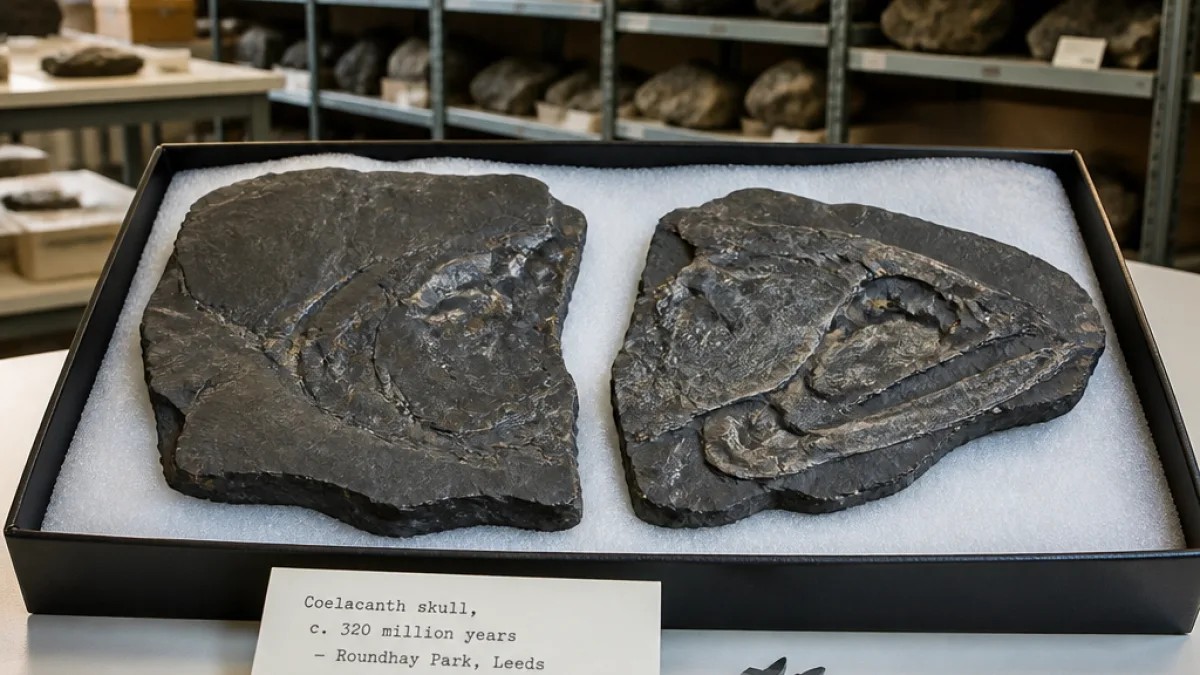
A fossilised skull bone belonging to a coelacanth — a lineage of fish once thought to have vanished from the planet — has been discovered in Roundhay Park, Leeds. Experts say the specimen, dated to around 320 million years ago, is the oldest example of the species yet identified in the region and offers a rare window into what is now West Yorkshire when it lay beneath a tropical lagoon.
The find was made by Ru Smith of the Yorkshire Geological Society during a guided geology walk in the park. He split open a piece of shale within a well-known mussel-bearing layer and immediately recognised the distinctive features of a large prehistoric fish skull.
"I knew straight away this was something different and very rare,"
Smith said, describing the moment he opened the rock and saw the bone. He added that the discovery underscores the capacity of field geology to transport observers back to radically different landscapes that once existed on the same ground.
From tropical lagoon to museum collection
The specimen has been transferred to Leeds Museums and Galleries and is now part of the natural sciences collection at the city’s Discovery Centre. Curators say the fossil dates to the Carboniferous period, a time when the global climate was warmer and the vast supercontinent Pangaea was taking shape. That era predates the first dinosaurs by about 90 million years.
To protect Roundhay Park’s landscape and discourage fossil hunting at sensitive exposures, the exact spot where the fossil was found is not being disclosed. The careful handling and documentation of the specimen will allow researchers and the public to examine it safely while preserving the site.
Coelacanths: a living link with deep time
Coelacanths occupy a distinctive branch of the vertebrate tree. Long known from the fossil record, they were widely presumed extinct until a living specimen was caught off South Africa in 1938. That unexpected discovery redefined scientific understanding of the group and turned these fish into emblematic symbols of evolutionary persistence. Although today’s living coelacanths are marine, the Leeds fossil was preserved in sediments that accumulated in a lagoonal setting, reflecting the region’s very different ancient geography.
Smith encountered the skull within a rock bed that also preserves Carbonicola freshwater mussels — a marker horizon used by geologists to identify and correlate layers. As he explained, the combination of the mussel bed and the shale provided the conditions in which delicate skeletal material could be captured and mineralised.
Local significance and public benefit
Leeds Museums and Galleries staff have described the find as remarkable, not only for its age and rarity but also for what it contributes to the city’s collections. By entering the Discovery Centre’s holdings, the fossil will be available for research and potential future display, supporting school visits, volunteer projects and public learning programmes across the district.
Roundhay Park is one of the city’s best-known green spaces, and the discovery highlights the educational value embedded in its geology. The park’s bedrock has long drawn interest from local groups and academics examining Carboniferous ecosystems, from plant fossils to invertebrates. This new specimen adds a vertebrate dimension that strengthens Leeds’ position in regional palaeontology.
What we know about the Leeds specimen
- The fossil is a skull bone attributable to a coelacanth.
- It is approximately 320 million years old, from the Carboniferous period.
- Discovered by Ru Smith of the Yorkshire Geological Society during a geology walk.
- Recovered from shale associated with Carbonicola freshwater mussel beds.
- Donated to Leeds Museums and Galleries and added to the Discovery Centre collection.
- The precise findspot in Roundhay Park is being withheld to protect the site.
Context at a glance
| Detail | Information |
|---|---|
| Species group | Coelacanth (lobe-finned fish) |
| Age | ~320 million years (Carboniferous) |
| Regional status | Oldest coelacanth fossil yet found in the area |
| Finder | Ru Smith, Yorkshire Geological Society |
| Collection | Leeds Museums and Galleries – Discovery Centre |
For residents, the discovery reinforces the value of responsible engagement with local geology. Smith emphasised the thrill of encountering evidence of life from long before the age of dinosaurs, noting the power of rocks to reveal past worlds:
"That's really the wonder of geology, looking at the rock and time travelling in the imagination to what was a very different world."
As conservation measures remain in place, the fossil’s transfer into public care ensures that future generations in Leeds can learn from — and take pride in — a discovery that anchors the city within a story stretching hundreds of millions of years.