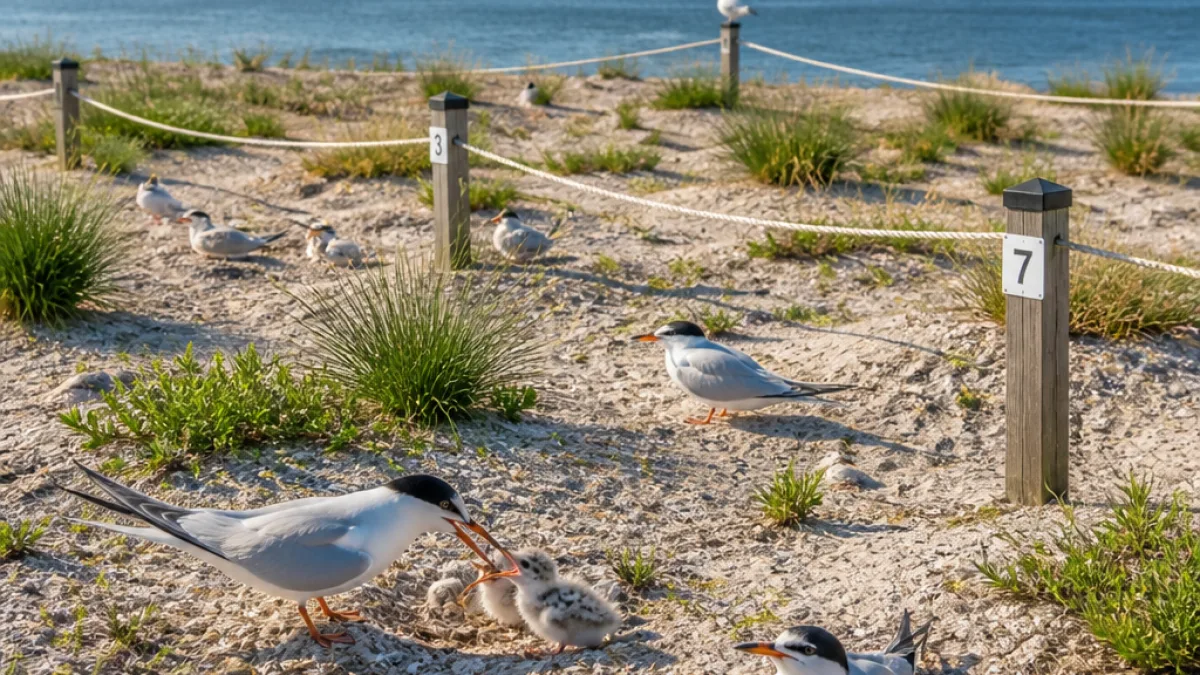
PENIKESE ISLAND / BUZZARDS BAY — Conservation staff from the Massachusetts Division of Fisheries and Wildlife (MassWildlife) are reporting promising signs for the roseate tern after more than three decades of focused protection on Penikese Island, one of the key breeding sites in the region.
Why Penikese matters
The 75-acre Penikese Island Wildlife Sanctuary lies off the coast of New Bedford and forms part of Buzzards Bay. It plays an outsize role in the species’ prospects because, according to MassWildlife, more than 60 per cent of North American roseate terns breed in Buzzards Bay. That concentration makes local conservation efforts crucial to the bird’s recovery.
The roseate tern, named for the faint pink wash on its breast, was listed as both a federal and state endangered species in 1987 after numbers tumbled through the 19th and 20th centuries. Historical drivers of decline included habitat loss and predation, compounded at one time by human hunting of birds and collection of eggs for their speckled shells.
On-the-ground protection
Field biologists working the colony adopt careful routines. On a fog-bound morning on Penikese, a seasonal seabird biologist moved among nests under a pink umbrella and a full-length plastic poncho to shield against aggressive gulls while checking eggs and chicks. Such discipline is necessary because the birds and their colonies are highly sensitive to disturbance.
“It’s very exciting and gratifying when things go in the right direction,” Carolyn Mostello, coastal waterbird biologist with MassWildlife, said in a telephone interview.
MassWildlife’s work encompasses monitoring nests and chicks, managing predators and human disturbance, and maintaining suitable nesting habitat. These interventions are the result of a sustained, decades-long programme aimed at reversing the species’ decline.
- Site: Penikese Island Wildlife Sanctuary (75 acres)
- Species status: Federally and state endangered (listed 1987)
- Regional importance: Buzzards Bay hosts over 60% of North American breeders
- Conservation duration: Three decades-plus of targeted efforts
Local impacts and next steps
The improving signs on Penikese do not mean the species is secure; instead, they mark a hopeful waypoint. Continued protection of nesting sites, controls on predators and careful management of public access will remain necessary. Because such a significant portion of the population nests in Buzzards Bay, local stewardship decisions — from coastal development to recreational access — could have disproportionate effects on the roseate tern’s future.
| Measure | Relevance |
|---|---|
| Nesting monitoring | Detects trends and informs interventions |
| Predator management | Reduces egg/chick losses |
| Access control | Limits disturbance during breeding season |
For residents and visitors, the message is straightforward: the roseate tern’s recovery is possible, but fragile. Support for local conservation groups and adherence to seasonal restrictions on islands and coastal areas help sustain the gains being seen on Penikese and across Buzzards Bay.
Reporting from the region’s islands and shores continues to highlight how local action can influence species survival. I will follow developments in the breeding season and any updates from MassWildlife.