Concern over divisive online remarks from county councillor
A Bridgend county borough councillor is under fire after a series of social media posts about Islam prompted a public rebuke from a local Member of the Senedd and concern among fellow councillors. The remarks, made by Owain Clatworthy, who represents Pyle, Kenfig Hill and Cefn Cribwr, have been described as “hateful”, “deeply divisive” and “dangerous”.
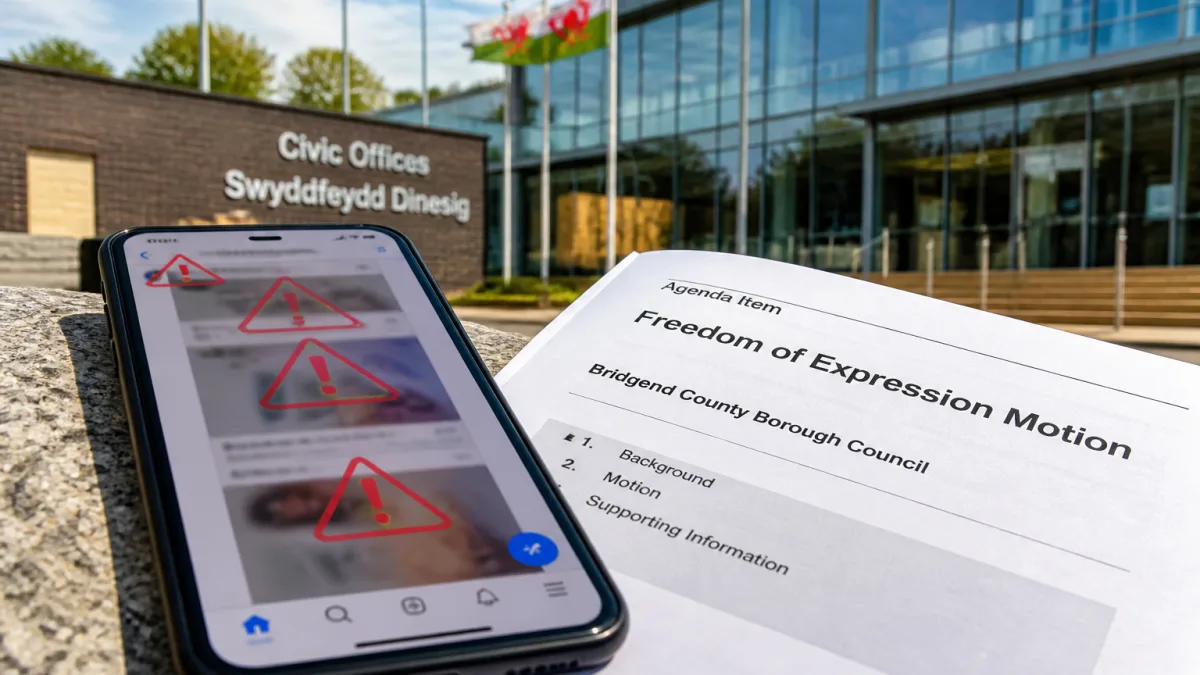
Sarah Rees, the Plaid Cymru MS for Pen-y-bont Bro Morgannwg, condemned posts in which Cllr Clatworthy asserted that Islam was incompatible with Western society. Her intervention follows a recent period of heightened debate locally, including a motion brought by the councillor at a full council meeting seeking protections for freedom of expression among elected members.
“These hateful comments from the Restore councillor are dangerous, deeply divisive, and completely unacceptable.
In recent weeks, the councillor shared a video clip from the Lord Mayor of Birmingham’s signing-in ceremony, where an Islamic prayer was read in the council chamber. He framed the moment as evidence of what he called “open displays of Islamic dominance” in local government, adding: “This is not integration. This is replacement.” Earlier posts also set out opposition to UK Government plans to extend so-called “safe and legal” refugee routes.
Among the most widely shared messages was his claim that “Islam is not compatible with western civilization”. The comments triggered objections from several Bridgend councillors and prompted Ms Rees to make a public statement arguing that the language does not reflect the values of communities in the county borough or across Wales.
Political backdrop and party switch
Cllr Clatworthy was first elected in May 2025 as a member of Reform UK before defecting to Restore Britain earlier this year. His posts surfaced just weeks after he tabled a freedom-of-speech motion at a full council meeting, intensifying discussion locally about how elected representatives conduct themselves online and the balance between expression and responsibility to all residents.
While the councillor has defended his online activity when questioned by the Local Democracy Reporting Service, insisting his posts were neither racist nor designed to divide, his stance has crystallised political disagreement. Ms Rees contrasted his position with her party’s emphasis on bringing communities together rather than stoking culture-war arguments.
Context from Birmingham and reaction locally
On the Birmingham ceremony, a city council spokesperson has previously explained that it is customary for each incoming Lord Mayor to invite a local spiritual leader of their choosing to contribute at the start of their year in office. That practice, the spokesperson indicated, is long-standing and not specific to any single faith tradition.
In Bridgend, councillors from a range of backgrounds have voiced disquiet, with concerns centring on the potential for such posts to inflame tensions and alienate constituents of Muslim faith or heritage. Community leaders often stress that elected members set the tone for public debate and have a particular duty to avoid language that could marginalise residents.
Timeline of key developments
| Event | Date |
|---|---|
| Elected to Bridgend County Borough Council | May 2025 |
| Defected from Reform UK to Restore Britain | Early 2026 |
| Tables motion on members’ freedom of speech | Spring 2026 |
| Posts on Islam and Birmingham mayoral ceremony shared | May–June 2026 |
| Public criticism by local MS | July 2026 |
What residents are saying and what happens next
Reactions from residents seen by this newsroom range from strong agreement with the principle of free speech to deep unease at the tone and framing of the posts. For some, the issue is not about silencing criticism of religion but about how language used by those in office can filter down into everyday interactions in schools, workplaces and on the high street.
Locally, many will now look to council group leaders and committee chairs to restate expectations around conduct on social media. In practical terms, councils typically encourage members to reflect on how their online presence represents both their ward and the authority when making public comment. The coming weeks may bring further discussion inside the council chamber about how best to navigate robust debate without undermining cohesion.
Why it matters for Bridgend
Bridgend is a county borough of varied communities, with long-established villages and growing estates sitting alongside each other. Faith and non-faith communities live and work side by side, and the tone of public conversation can make a tangible difference to how welcome people feel on buses, in GP surgeries, at school gates and in council buildings. When an elected figure speaks, many residents take it as a signal of what is acceptable to say about neighbours and colleagues.
There are, of course, strong views locally on migration, integration and the responsibilities that come with making a home here, whether people have family stretching back generations or have arrived more recently. The test for public life, as residents often tell me, is whether we can argue our corner without closing the door on those with whom we share streets, services and schools.
How to engage constructively
- Report concerns about online content through the relevant platform tools and, where appropriate, contact your councillor or council group office to share your views respectfully.
- Attend council meetings or follow published agendas to understand how motions and debates are framed, including those on freedom of speech and equality.
- Reach out to local community and faith groups for dialogue events that bring neighbours together to talk about shared priorities.
For now, the focus is on the tone set by those in public office and how that resonates across Bridgend’s neighbourhoods. As this discussion continues, residents will expect clarity, fairness and a commitment to keeping the conversation grounded in respect for everyone who calls the county borough home.